
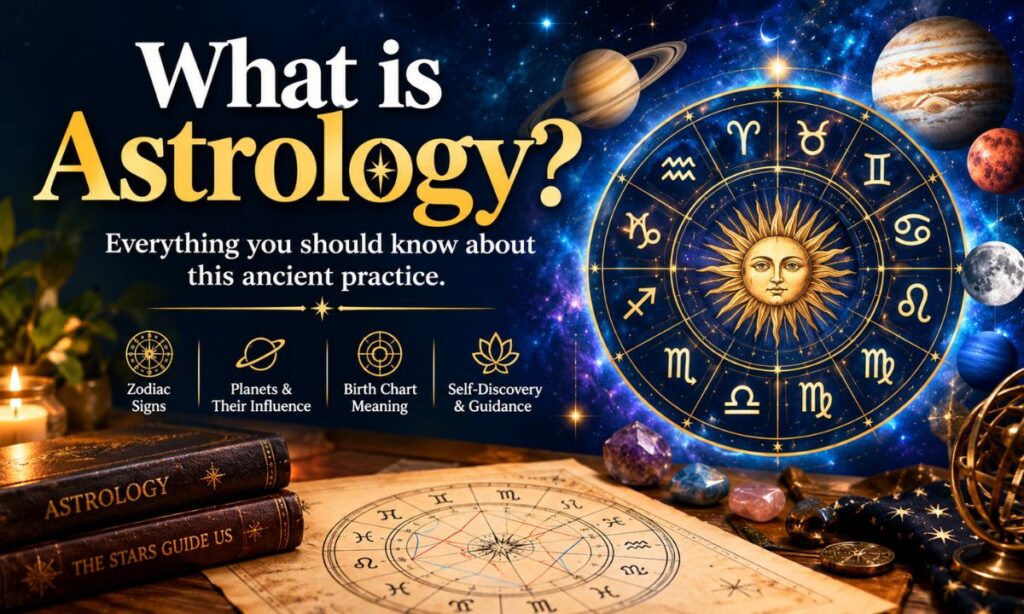
Astrology is the belief system and practice that studies the positions and movements of the Sun, Moon, and planets to interpret their supposed influence on human personality, behavior, and life events. It is not a science in the modern sense, but it has shaped art, culture, and personal reflection for thousands of years. If you have ever checked your horoscope, read about your zodiac sign, or wondered why some people swear by their birth chart, you have already brushed up against this ancient tradition.
This guide walks you through everything you need to know about astrology, from its ancient origins to how modern astrologers read a natal chart today. You will learn what astrology actually studies, how it differs from astronomy, why the twelve zodiac signs matter so much to believers, and why scientists remain skeptical of its claims. Along the way, you will get a clear, honest picture of both the appeal and the criticism surrounding this practice.
Astrology has no basis in the scientific method, yet surveys consistently show that roughly a quarter of Americans say they believe in it. That gap between scientific consensus and public interest is exactly why astrology deserves a closer, more balanced look.
You may be interested in
Before diving into astrology itself, you might enjoy a few related reads on self-discovery, spirituality, and personal growth. These topics often overlap with astrology because people turn to all of them when searching for meaning, direction, or a deeper understanding of themselves. Below is a quick preview of subjects that pair naturally with a discussion of astrology and the human search for insight. What is astrology is one of the questions readers often explore alongside these broader topics.
Chapter 5: From Ego to Inner Peace
A look at how letting go of ego-driven thinking can open the door to lasting inner calm, a theme that shows up often in astrology-adjacent spiritual writing. What is astrology can also be explored through the lens of self-awareness and inner reflection.
Near-Death Experience – NDE
An exploration of what people report after clinical near-death experiences, and how these accounts have shaped modern ideas about consciousness and the afterlife. What is astrology may similarly interest readers who are curious about different perspectives on consciousness and human experience.
Chapter 4: Beyond Mindfulness
A discussion of practices that go further than basic mindfulness, aimed at readers who want to deepen an existing meditation routine. What is astrology can become another topic for readers interested in reflection, symbolism, and personal meaning.
Origin of the Enneagram
A brief look at where the nine-point Enneagram personality system came from and how it compares to other self-knowledge frameworks like astrology. What is astrology becomes especially relevant when comparing different systems used to understand personality and behavior.
Meditation for beginners with Alex Guerra
An introductory guide to building a simple, sustainable meditation habit, useful for anyone new to contemplative practice. What is astrology may appeal to the same readers who enjoy exploring meditation and other reflective practices.
Personal Transformation and Psychedelics
A careful look at how psychedelic-assisted experiences are being studied for their potential role in personal growth and psychological change. What is astrology is another question that can arise when people explore different approaches to understanding personal transformation.
The New Therapeutic Frontiers with Antoni Aguilar
A conversation-style piece on emerging approaches in therapy that blend traditional talk therapy with newer, experience-based methods. What is astrology can also be considered within the broader cultural conversation about self-understanding and personal growth.
What is astrology?
Astrology is the study of how the positions of celestial bodies at a specific moment, usually your birth, are believed to shape your personality and life path. It is one of the oldest belief systems in human history, and it continues to influence pop culture, self-help, and daily conversation across the world today. What is astrology, at its simplest, can therefore be understood as a question about the relationship people have historically believed exists between celestial patterns and human life.
At its core, astrology rests on a simple premise: the sky at the moment you were born acts like a cosmic snapshot, and that snapshot supposedly leaves a lasting imprint on who you become. Practitioners read this snapshot using a birth chart, also called a natal chart, which maps out where the Sun, Moon, and planets sat against the backdrop of the zodiac at your exact time and place of birth. This is very different from simply knowing your Sun sign, which is only one small piece of a much larger picture. What is astrology becomes clearer when this complete chart is considered rather than focusing only on a Sun sign.
Astrology has taken many forms across different cultures, including Western astrology, Vedic astrology from India, and Chinese astrology, each with its own methods and symbolism. Despite these differences, most systems share a common goal: using the sky as a mirror for human experience. Understanding this shared goal is the first step to making sense of everything else astrology claims to offer. What is astrology across these traditions depends partly on the cultural system being examined
What Is Astrology, What Is Astrology, What Is Astrology, What Is Astrology, What Is Astrology, What Is Astrology, What Is Astrology, What Is Astrology, What Is Astrology, What Is Astrology, What Is Astrology.
Origin and evolution of astrology
Astrology’s roots stretch back roughly 4,000 years to ancient Babylon, where priests tracked planetary movements and linked them to omens about kings, harvests, and wars. This early form of astrology was less about individual personality and more about predicting events that affected entire communities or rulers. Babylonian astronomers kept detailed records, and many historians consider this the foundation of what would eventually become horoscopic astrology. What is astrology historically can be traced through these early observations and interpretations.
The practice spread to ancient Greece, where thinkers like Ptolemy helped systematize it into something closer to what we recognize today. Ptolemy’s work Tetrabiblos, written around the second century CE, laid out many of the principles still used by Western astrologers, including the twelve zodiac signs and the astrological houses. Greek astrology also introduced the idea that the sky could reflect an individual’s personal fate, not just the fate of nations. What is astrology in the Greek tradition therefore involved both celestial observation and symbolic interpretation.
From Greece, astrology traveled through the Roman Empire, into the Islamic Golden Age, and eventually into medieval and Renaissance Europe, where it was closely tied to medicine and astronomy. Physicians once consulted planetary positions before performing treatments, believing the timing of the cosmos affected the human body. Only later, during the Scientific Revolution, did astrology and astronomy formally split into separate fields, with one becoming a data-driven science and the other remaining a symbolic, interpretive practice. What is astrology today is partly shaped by this long historical evolution.
What Is Astrology, What Is Astrology, What Is Astrology, What Is Astrology, What Is Astrology, What Is Astrology, What Is Astrology, What Is Astrology, What Is Astrology, What Is Astrology, What Is Astrology.
Definition and main concepts of astrology
The astrology definition most commonly used today describes it as a symbolic system that interprets planetary positions to gain insight into personality, relationships, timing, and life events. It is built on a handful of core concepts that every beginner should understand before going further. These include the zodiac signs, the planets, the astrological houses, and the aspects, which are the angles planets form with each other. What is astrology can be explained through these interconnected concepts.
Each of these building blocks carries its own layer of meaning. The zodiac signs describe broad personality themes, the planets represent different areas of psychological or practical life, the houses show where in your life those themes play out, and the aspects reveal how different parts of your chart interact with one another. A skilled astrologer does not read any single element in isolation; instead, they weave all of these pieces together to form a complete interpretation. What is astrology becomes more understandable when these elements are considered as parts of one symbolic framework.
It’s worth noting that astrology practice varies quite a bit depending on tradition. Western astrology, the most common form in the United States, uses the tropical zodiac, which is based on the seasons rather than the actual position of constellations. Vedic astrology, by contrast, uses the sidereal zodiac, which is aligned with the observable stars. This distinction alone explains why your sign might differ slightly between a Western horoscope and a Vedic reading. What is astrology can therefore have different answers depending on which astrological tradition is being discussed.
What Is Astrology, What Is Astrology, What Is Astrology, What Is Astrology, What Is Astrology, What Is Astrology, What Is Astrology, What Is Astrology, What Is Astrology, What Is Astrology, What Is Astrology.
Difference between astrology and astronomy
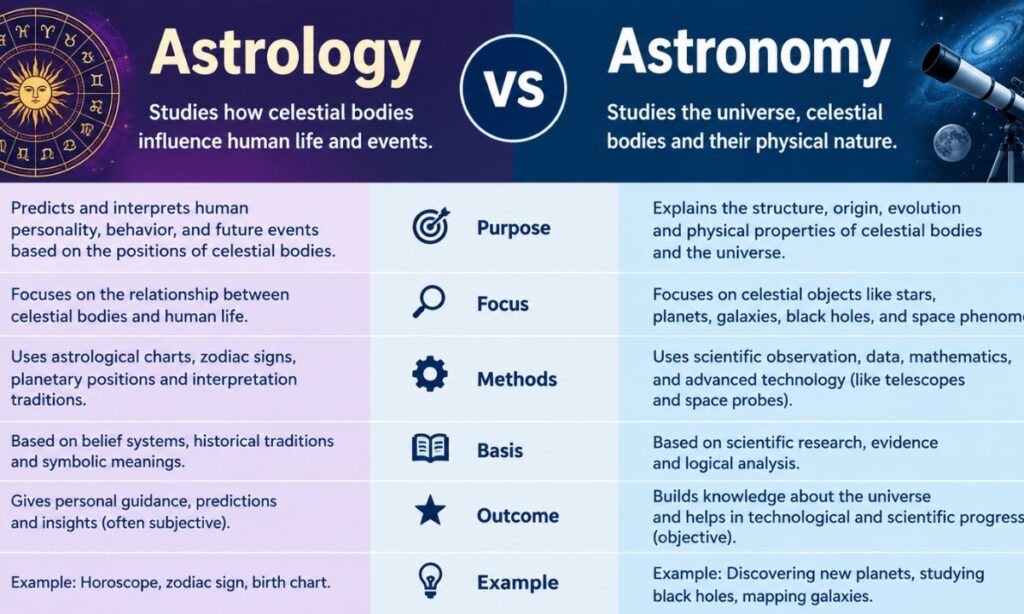
Many people confuse astrology and astronomy, but they are fundamentally different disciplines. Astronomy is a natural science that studies celestial objects, space, and the physical universe using observation, mathematics, and testable predictions. Astrology, on the other hand, is a symbolic and interpretive practice that assigns meaning to celestial positions without scientific evidence to support those claims. What is astrology becomes clearer when it is directly compared with astronomy.
The two fields were once intertwined, and for centuries the same scholars practiced both. Early astronomers needed accurate planetary data to cast horoscopes, which pushed forward real advances in observational astronomy, even though the underlying belief in cosmic influence on personality was never scientifically confirmed. This shared history is part of why the names still sound so similar today, even though modern astronomy and astrology have almost nothing in common methodologically. What is astrology historically was closely connected to the development of astronomical observation.
Today, the difference is stark. Astronomers use telescopes, spectroscopy, and physics to study celestial bodies, publishing findings that can be tested and replicated. Astrologers use birth data and symbolic charts to offer personal interpretation, with no requirement for empirical proof. Recognizing this astrology vs astronomy distinction is essential for anyone trying to understand where astrology fits in the modern world. What is astrology in the modern sense is therefore different from astronomy as an empirical science.
What Is Astrology, What Is Astrology, What Is Astrology, What Is Astrology, What Is Astrology, What Is Astrology, What Is Astrology, What Is Astrology, What Is Astrology, What Is Astrology, What Is Astrology.
The Misinterpretation of Astrology
One of the biggest misconceptions about astrology is that it is only about daily horoscopes and predicting the future. In reality, most serious astrological practice focuses far more on self-reflection and pattern recognition than on fortune-telling.
Pop culture has reduced astrology to bite-sized horoscope columns and viral memes about zodiac signs, which has flattened a genuinely complex symbolic system into something that looks more like entertainment than practice. This simplified version leads many people to dismiss astrology entirely, assuming it only claims to predict specific events like when you will fall in love or get a promotion. Traditional and modern astrologers alike will tell you this is a narrow and often inaccurate picture of what the practice actually involves.
A more accurate view treats astrology as a symbolic language for exploring personality, timing, and life themes rather than a literal forecasting tool. Many practitioners describe it as similar to journaling or therapy, a structured way to reflect on patterns in your life using the birth chart as a prompt. Understanding this distinction matters because it separates thoughtful, self-aware engagement with astrology from the kind of rigid, deterministic thinking that critics rightly push back against.
Astrology as a Guide for Life
Many people use astrology less as a prediction tool and more as a framework for making sense of their choices, relationships, and personal growth. Used this way, astrology functions similarly to other reflective practices like journaling or personality typing.
For some, checking a birth chart before a big decision, such as changing careers or starting a relationship, is less about literal fate and more about creating space to pause and think things through. The chart becomes a conversation starter, a way to ask, “What patterns keep showing up in my life, and why?” This kind of intentional reflection can be genuinely useful, regardless of whether you believe the planets are actually causing anything.
Astrology also offers a shared vocabulary for talking about personality and compatibility, which is part of why it resonates so strongly with younger generations navigating dating, friendships, and career changes. Saying “I’m a very Scorpio person” or “we just don’t work because of our signs” gives people an easy shorthand for complex feelings. Whether or not the underlying mechanism is real, this shared language has real social value, helping people articulate things about themselves and their relationships that might otherwise be hard to put into words.
The zodiac signs
The zodiac consists of twelve signs, each representing a roughly one-month segment of the year and a distinct set of personality traits. These twelve signs form the most recognizable part of astrology and are usually the first thing people learn about the practice.
The twelve signs are Aries, Taurus, Gemini, Cancer, Leo, Virgo, Libra, Scorpio, Sagittarius, Capricorn, Aquarius, and Pisces. Each sign is tied to a date range based on the Sun’s position at the time of your birth, which is why your Sun sign is the one most people already know. But a full chart also includes a Moon sign, which reflects emotional nature, and a rising sign, also called the ascendant, which shapes how others perceive you at first glance.
Understanding zodiac signs goes beyond memorizing personality stereotypes. Astrologers look at how a sign’s ruling planet, element, and modality (cardinal, fixed, or mutable) combine to create a fuller picture. This layered approach is what separates a thoughtful astrological reading from the oversimplified “Leos are dramatic” style content that dominates social media.
Meaning and characteristics of zodiac signs
Each zodiac sign carries a distinct symbolic meaning rooted in mythology, elements, and ruling planets. Aries, for example, is associated with initiative and boldness, while Taurus is linked to stability and sensory pleasure. Gemini brings curiosity and communication, and Cancer is tied to emotional depth and nurturing instincts.
Moving through the rest of the zodiac, Leo represents confidence and creative expression, Virgo is associated with precision and practicality, and Libra centers on balance and relationships. Scorpio carries themes of intensity and transformation, Sagittarius is linked to adventure and philosophical thinking, and Capricorn represents ambition and discipline. Aquarius is tied to originality and independent thought, while Pisces reflects intuition and imagination.
These characteristics are not meant to be rigid boxes. Most astrologers emphasize that a sign describes a tendency or flavor of energy rather than a fixed rule, and that your full chart, not just your Sun sign, ultimately shapes your personality. Treating sign meanings as a starting point for reflection, rather than a strict label, is generally considered the more thoughtful way to engage with this part of astrology.
Influence of zodiac signs on personality
The idea that zodiac signs and personality are linked is astrology’s most widely known claim, even though it remains scientifically unproven. Believers argue that the specific arrangement of the Sun, Moon, and planets at your birth shapes core aspects of temperament, communication style, and emotional needs.
In practice, many people find that reading about their sign feels surprisingly accurate, a phenomenon psychologists often connect to the Barnum effect, where vague, broadly applicable statements feel personally meaningful. This does not necessarily disprove astrology to a believer, but it is an important piece of context for anyone evaluating why sign descriptions often “feel right” regardless of their actual accuracy.
Astrologers who take a more nuanced approach avoid claiming that a single sign determines personality outright. Instead, they look at the interaction between multiple placements, arguing that a person with the Sun in a fiery sign but the Moon in a calm, grounded sign might present very differently than a textbook description would suggest. This layered reading is part of why serious astrology practice resists being reduced to twelve simple personality types.
Relationship between the zodiac signs and the elements
Every zodiac sign belongs to one of four zodiac elements: fire signs, earth signs, air signs, or water signs. Fire signs, which include Aries, Leo, and Sagittarius, are associated with energy, passion, and action. Earth signs, made up of Taurus, Virgo, and Capricorn, are linked to practicality, stability, and material focus.
Air signs, consisting of Gemini, Libra, and Aquarius, are tied to intellect, communication, and social connection. Water signs, which include Cancer, Scorpio, and Pisces, represent emotion, intuition, and depth. Astrologers often use these elemental groupings to explain compatibility, arguing that fire and air signs tend to energize each other, while earth and water signs often blend more naturally.
This elemental framework adds another layer of nuance beyond the individual sign meanings. A person’s chart typically contains a mix of elements, which astrologers say explains why someone might feel emotionally intense like a water sign in some situations, yet practical and grounded like an earth sign in others. Looking at the balance or imbalance of elements across a full chart is considered one of the more sophisticated tools in an astrologer’s toolkit.
Astrology and astronomy
Astrology and astronomy share a common ancient origin but have completely diverged in method, purpose, and credibility today. Astronomy is an empirical science, while astrology remains a symbolic and interpretive tradition.
For most of human history, these two fields were not clearly separated, and the same scholars often practiced both simultaneously, using planetary observation for both scientific and symbolic purposes. It was only with the rise of the scientific method that astronomy broke away as a discipline grounded in testable, repeatable evidence, while astrology remained rooted in symbolic interpretation without empirical validation.
Understanding this split helps explain why modern scientists overwhelmingly reject astrology’s core claims while still respecting its historical role in the development of observational astronomy. It also clarifies why astrology is often described as a pseudoscience rather than simply an alternative science: it borrows the language and imagery of astronomy without following its evidentiary standards.
The historical relationship between astrology and astronomy
In ancient civilizations such as Babylon, Egypt, and Greece, astrology and astronomy developed side by side, often practiced by the same priests, scholars, and court advisors. Careful tracking of planetary movements was essential for both casting horoscopes and creating early calendars, which meant astrological motivations actually drove real advances in observational precision.
Figures like Ptolemy, working in the second century CE, contributed to both fields at once, writing the Almagest as a foundational astronomical text and the Tetrabiblos as a foundational astrological one. This dual legacy shows just how intertwined the two disciplines were for most of recorded history. Even influential astronomers like Johannes Kepler, centuries later, practiced astrology alongside groundbreaking astronomical work, reflecting how normalized this overlap once was among scholars.
The split accelerated during the Scientific Revolution of the 16th and 17th centuries, as thinkers began demanding observable, testable evidence for claims about the natural world. Astronomy adapted to this new standard, while astrology did not, which is why the two fields now occupy such different places in modern intellectual life.
Differences between astrology and astronomy today
Today, astronomy is recognized as a rigorous natural science, studying stars and planets through telescopes, satellites, and mathematical models that produce testable, falsifiable predictions. University astronomy departments, peer-reviewed journals, and international scientific organizations all uphold strict standards of evidence that any claim must meet before being accepted.
Astrology, by contrast, has no equivalent institutional or scientific standing. It is not taught as a science in accredited universities, and its central claims about planetary influence on personality have not held up under controlled testing. Astrologers typically frame their work as an art or a spiritual practice rather than a science, which is a more accurate description of how it actually functions.
This difference in standards is the clearest way to understand the modern astrology vs astronomy divide. One field produces knowledge that can send spacecraft to Mars with pinpoint accuracy, while the other offers a symbolic framework for personal reflection that resists scientific verification. Both can hold cultural value, but only one meets the bar of modern science.
Debate on the scientific validity of astrology
The scientific validity of astrology has been tested multiple times, and the results consistently fail to support its central claims. One of the most cited studies, conducted by physicist Shawn Carlson and published in the journal Nature in 1985, tested whether astrologers could match birth charts to personality profiles better than chance. The astrologers involved performed no better than random guessing.
Beyond controlled experiments, astrology also lacks a plausible physical mechanism. No known force explains how the position of Saturn at the moment of your birth could shape your personality decades later, and proposed explanations involving gravity or electromagnetic influence do not hold up given the relative weakness of planetary forces compared to everyday objects like nearby buildings or even the doctor delivering the baby.
Despite this lack of evidence, astrology’s popularity has not faded, which researchers attribute to psychological factors rather than genuine predictive accuracy. This combination of scientific rejection and continued cultural relevance is exactly what makes astrology such a fascinating case study in belief formation, something the next sections explore in more depth.
What astrology studies
Astrology primarily studies three core elements: the natal chart, the planets, and the astrological houses, combining all three to build a personalized interpretation. These are the working tools every practicing astrologer relies on.
The natal chart acts as the foundation, capturing a precise snapshot of the sky at your birth. The planets then represent different psychological and practical themes layered onto that snapshot, from communication and love to ambition and transformation. Finally, the houses map those planetary themes onto specific areas of life, such as career, relationships, or home.
Together, these three elements form what astrologers call a holistic reading, where no single piece is interpreted alone. A planet’s meaning shifts depending on which sign and house it occupies, and a house’s theme shifts depending on which planets and signs are present within it. This interconnected system is what gives astrology its depth, even though its predictive claims remain scientifically unsupported.
Analysis of the natal chart and its importance in astrology
A natal chart, sometimes called a birth chart or astrological chart, is a map of the sky at the exact date, time, and location of a person’s birth. It is considered the single most important tool in astrology because every other interpretation, from Sun sign traits to planetary influences, is drawn from this one foundational document.
Creating an accurate natal chart requires precise birth data, including the exact time of birth, since even a difference of a few minutes can shift the rising sign and house placements significantly. This is why professional astrologers often ask for a birth certificate or hospital record rather than a rough estimate. Without accurate timing, the chart’s more detailed elements become unreliable, even within the internal logic of astrological practice.
Natal chart interpretation involves reading the relationships between planets, signs, and houses as a unified system rather than a checklist. An experienced astrologer looks for repeating themes, such as multiple planets in one element or house, treating these patterns as more significant than any single placement viewed in isolation. This is considered a core skill that separates a thoughtful astrological reading from a generic, one-size-fits-all horoscope.
The role of planets in astrology
In astrology, each planet represents a different facet of human experience. The Sun symbolizes core identity and ego, the Moon represents emotional life and instinct, and Mercury governs communication and thinking style. Venus is tied to love, beauty, and values, while Mars represents drive, assertiveness, and physical energy.
The outer planets carry broader, slower-moving themes. Jupiter is associated with growth, luck, and expansion, while Saturn represents discipline, limitation, and long-term responsibility. Uranus, Neptune, and Pluto, often called the generational planets because they move so slowly, are linked to sudden change, spirituality and illusion, and deep transformation, respectively, and are thought to shape entire generations rather than individuals alone.
Planetary positions at the moment of birth are believed to shape how these themes show up in a person’s life, with planetary influence varying depending on which zodiac sign and astrological house each planet occupies. For example, Mars in a fiery sign might suggest a direct, high-energy approach to pursuing goals, while Mars in a water sign might suggest a more emotionally driven, indirect style of assertiveness. This layered symbolism is central to how astrologers build a personalized reading.
Interpretation of the astral houses in astrological studies
The astral houses, also called astrological houses, divide the chart into twelve sections, each representing a different area of life. The first house relates to identity and self-image, the fourth house relates to home and family, the seventh house relates to partnerships, and the tenth house relates to career and public reputation, among others.
Unlike zodiac signs, which describe personality themes, and planets, which describe psychological drives, the houses describe where in your life those themes tend to play out. A planet positioned in the seventh house, for instance, suggests its energy shows up most strongly in relationships and partnerships, while the same planet in the tenth house would suggest its energy shows up most strongly in career and public life.
Calculating house placements requires an accurate birth time and location, since houses are based on the Earth’s rotation at the moment of birth rather than the zodiac alone. This is one of the more technical aspects of astrology, and different astrological traditions use different house systems, such as Placidus or Whole Sign houses, which can produce slightly different results from the same birth data. Understanding this technical layer helps explain why two astrologers might interpret the same chart somewhat differently.
Astrology in everyday life
For most people, astrology shows up in daily life through horoscopes, casual conversation, and personal reflection rather than formal chart readings. It has become deeply woven into modern culture, especially online.
Newspaper horoscope columns, astrology apps, and social media content have made astrology more accessible than ever, allowing millions of people to check their daily horoscope with a quick tap on their phone. This everyday accessibility is a major reason astrology has seen a resurgence in popularity, particularly among younger generations who encountered it through apps and social platforms rather than traditional print media.
Beyond casual horoscope checking, astrology also plays a more intentional role for people seeking structured self-reflection, whether through personalized readings with a professional astrologer or through their own independent study of their birth chart. This range, from lighthearted daily content to serious personal practice, shows just how flexible and far-reaching astrology’s presence has become in modern life.
Use of horoscopes in daily astrology
A horoscope is a general prediction or personality overview based primarily on a person’s Sun sign, published daily, weekly, or monthly. Because Sun sign horoscopes only use one piece of a much larger birth chart, they are the most simplified and generalized form of astrology available.
Despite this simplicity, horoscope predictions remain enormously popular, appearing in newspapers, magazines, and dedicated apps that reach millions of readers every day. Their broad, adaptable language is part of their appeal, since a well-written horoscope can feel personally relevant to a wide range of readers even though it was written for an entire twelfth of the population.
Many astrology enthusiasts treat daily horoscopes as light entertainment rather than serious guidance, saving more detailed astrology consultation for bigger life questions. This distinction between casual horoscope reading and deeper chart work is an important one, since conflating the two often leads to unfair dismissals of astrology’s more nuanced, personalized side.
Personalized consultations with astrologers
A personalized astrology consultation involves working directly with an astrologer who analyzes your full birth chart rather than relying on generic Sun sign content. These sessions typically cover multiple areas of life, including career direction, relationship patterns, and periods of personal growth or challenge.
During a typical consultation, an astrologer walks a client through their natal chart, explaining how their unique combination of planets, signs, and houses might relate to their current life circumstances. Many clients seek out these sessions during moments of transition, such as a career change, breakup, or major decision, using the reading as a structured space to reflect rather than as a literal prediction of outcomes.
Professional astrologers often specialize in specific approaches, such as Vedic astrology, psychological astrology, or evolutionary astrology, each offering a slightly different lens on the same birth data. This diversity means two consultations with different astrologers, even using the same chart, can feel quite different in tone and focus, which is worth knowing if you are considering booking a session for the first time.
Empowerment and self-knowledge through astrology
For many practitioners, the real value of astrology lies in astrology and self-knowledge rather than prediction. Working through a birth chart can prompt reflection on long-standing patterns in relationships, career choices, or emotional habits that might otherwise go unexamined.
This reflective use of astrology overlaps closely with astrology and personal growth, since many people use their chart as a mirror for identifying strengths to lean into and challenges to work on. Framed this way, astrology functions less like fortune-telling and more like a structured, symbolic prompt for self-inquiry, similar in spirit to journaling prompts or personality assessments used in coaching and therapy.
Supporters argue that this sense of empowerment comes from feeling seen and understood, even if the underlying mechanism is symbolic rather than scientific. Whether or not the planets are truly responsible, the act of sitting down and reflecting on your patterns, values, and goals through the lens of a birth chart can be a genuinely meaningful exercise for many people, which helps explain astrology’s enduring appeal even in a scientific age.
Criticisms and controversies about astrology
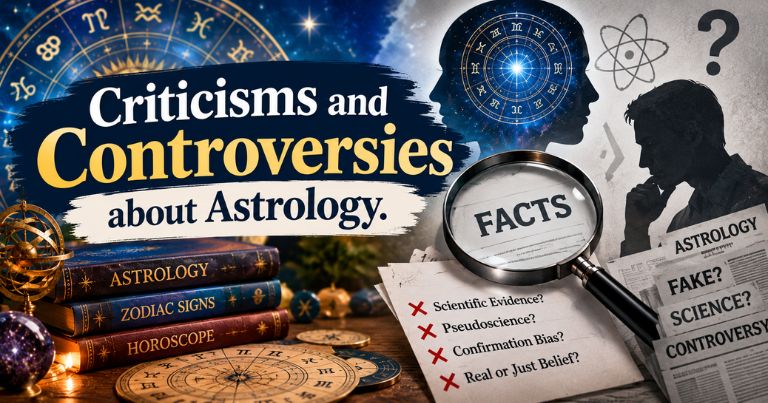
The central criticism of astrology is that it lacks scientific evidence and offers no verified mechanism by which planets could influence human personality or events. This is the most consistent objection raised by scientists, skeptics, and researchers.
Beyond the lack of a physical mechanism, controlled studies have repeatedly failed to show that astrologers can predict personality or life outcomes more accurately than chance. This scientific rejection has not stopped astrology’s popularity, which critics attribute to psychological tendencies that make vague, flattering statements feel personally accurate regardless of their actual truth.
At the same time, defenders of astrology argue that treating it purely as a failed science misses its real cultural and psychological function. Understanding both sides of this debate, the scientific critique and the cultural defense, gives a much fuller picture of why astrology remains controversial yet persistently popular.
The pseudoscientific nature of astrology
Astrology is widely classified as a pseudoscience because it presents itself using scientific-sounding language and structure, such as charts, calculations, and technical terminology, without meeting the actual standards of the scientific method. Real science requires falsifiable claims, controlled testing, and mechanisms that can be independently verified, none of which astrology consistently provides.
Major scientific organizations, including national academies of science in multiple countries, have publicly stated that astrology has no scientific basis. This isn’t a fringe opinion; it reflects a broad consensus across the scientific community, built on decades of failed attempts to find measurable evidence for astrology’s core claims.
It’s worth noting that being labeled a pseudoscience does not automatically make astrology harmful or worthless as a personal or cultural practice. Many pseudosciences, astrology included, persist because they serve psychological or social functions unrelated to their factual accuracy, which is an important nuance often lost in both pro-astrology and anti-astrology arguments online.
Scientific rejection and confirmation bias in astrology
The scientific rejection of astrology rests largely on the absence of a testable mechanism and the repeated failure of controlled experiments to validate its predictive claims. Study after study, including the well-known 1985 test published in Nature, has found that astrologers cannot reliably match birth charts to individuals better than random chance would allow.
Confirmation bias plays a major role in explaining why astrology still feels accurate to so many believers despite this lack of evidence. People tend to remember the details that match their sign’s description while conveniently forgetting or dismissing the parts that don’t fit, reinforcing a false sense of accuracy over time. This psychological tendency is well documented across many areas of belief, not just astrology.
Related to confirmation bias is the Barnum effect, named after showman P.T. Barnum, which describes how people rate vague, generalized personality descriptions as highly accurate specifically because they feel personal, even though the same description could apply to almost anyone. Together, these two psychological patterns go a long way toward explaining astrology’s staying power without requiring the underlying claims to actually be true.
Perspectives and opinions on astrology in today’s society
Modern opinions on astrology in today’s society are sharply divided. Scientists and skeptics generally view it as an unproven belief system that can, in some cases, lead people to make important decisions based on unfounded claims. Communities like certain forums on Reddit and Quora regularly host detailed debates where skeptics push back against astrology enthusiasts using arguments rooted in psychology and the scientific method.
On the other side, many people, particularly younger generations navigating uncertainty around career, relationships, and identity, view astrology as a low-stakes, meaningful tool for reflection rather than literal prediction. Surveys have shown a notable rise in astrology app usage and social media engagement in recent years, suggesting the practice’s cultural relevance has grown even as scientific skepticism remains firmly unchanged.
This divide reflects a broader tension between literal belief and symbolic use. Many thoughtful practitioners occupy a middle ground, enjoying astrology as a reflective and cultural practice without claiming it holds scientific validity, a nuanced position that often gets lost in more polarized online debates. Recognizing this middle ground is probably the most balanced way to understand astrology’s place in modern society.
Frequently Asked Questions About Astrology
Is astrology real?
Astrology has not been scientifically validated, and controlled studies have not found evidence that planetary positions influence personality or life events. Many people still find personal or reflective value in the practice, even though it does not meet the standards of a verified science.
What is the difference between astrology and horoscope?
Astrology is the broader belief system and symbolic practice, while a horoscope is one specific product of astrology, typically a short, generalized personality or prediction summary based mainly on a person’s Sun sign.
How accurate is a birth chart reading?
A birth chart reading’s accuracy depends entirely on the interpretive skill of the astrologer and the belief system of the person receiving it, since there is no scientific evidence confirming that birth charts predict personality or events.
Why do people believe in astrology if it isn’t scientifically proven?
Psychological factors like the Barnum effect and confirmation bias help explain why astrology often feels personally accurate, along with its social and cultural role as a shared language for self-reflection and connection.
What is the difference between Western and Vedic astrology?
Western astrology uses the tropical zodiac, based on the seasons, while Vedic astrology uses the sidereal zodiac, aligned with the actual observed positions of constellations, which can result in different sign placements for the same birth data.
Final Thoughts
Astrology sits in an interesting space between ancient tradition, modern pop culture, and scientific skepticism. It offers no proven predictive power, yet it continues to give millions of people a structured way to reflect on personality, relationships, and life direction. Whether you see it as meaningful self-reflection or harmless entertainment, understanding what astrology actually studies, and where it falls short scientifically, gives you a much clearer, more informed view than a quick glance at a daily horoscope ever could.
