
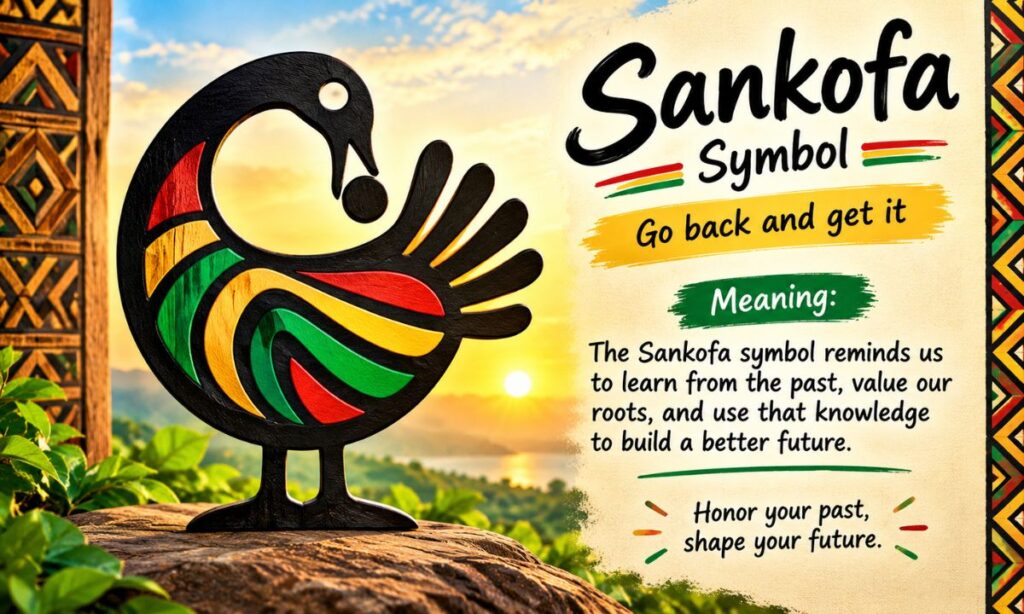
The Sankofa symbol means “go back and get it,” a call to reach into the past, recover what is valuable, and carry it forward into a better future. It comes from the Akan people of Ghana, and it is one of the most recognized Adinkra symbols in the world. You have probably seen it on jewelry, tattoos, murals, or museum walls without knowing its full story, and that story is a lot richer than a single image can show.
This guide walks through everything the Sankofa symbol represents, where it came from, how it moved from Ghana to the rest of the world, and how people use it today in fashion, tattoos, and everyday life. You will also get practical guidance on wearing it respectfully, since a symbol this meaningful deserves to be understood before it is worn.
Quick fact: Sankofa is a Twi word formed from three smaller words, san (return), ko (go), and fa (fetch), which together describe the act of going back to retrieve something left behind.
Quick fact: The Akan proverb most closely tied to Sankofa translates roughly as “it is not wrong to go back for what you have forgotten,” a saying that frames looking backward as wisdom rather than weakness.
How to Pronounce Sankofa
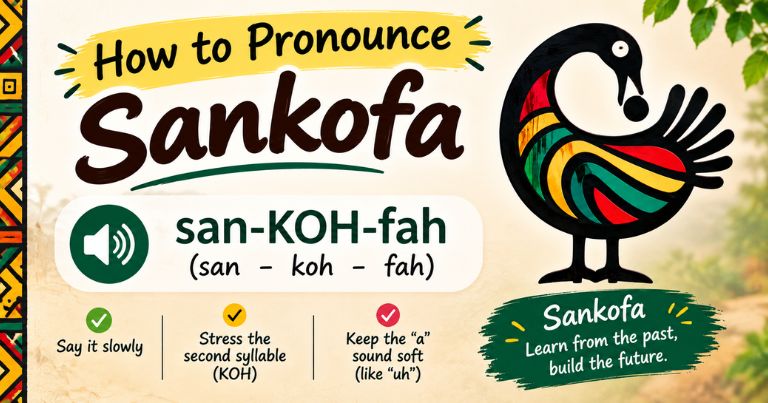
Sankofa is pronounced sahn koh fah, with even stress across the three syllables rather than a strong accent on any single one. Native Twi speakers say it briskly, almost like one word flowing into the next, which is different from how many English speakers first attempt it when they read it on a piece of jewelry or in a caption.
If you break the word down the way it was built, the pronunciation gets easier to Remember. San rhymes with “on,” ko sounds like the start of “coach,” and fa rhymes with “spa,” and when you put them together quickly you get something close to “sahn koh fah.”
Getting the pronunciation right matters more than people assume. Saying a cultural word correctly is a small but genuine sign of respect, and it shows that you took the time to learn something instead of just borrowing an image.
What Does Sankofa Mean
At its simplest, Sankofa meaning points to a single idea: you cannot move forward wisely if you refuse to look back. The word itself is an instruction, almost a command, telling the listener to return, fetch what was left, and bring it along on the journey ahead.
That “something” left behind is not treated as clutter or baggage in Akan thought. It is framed as a gem, a piece of ancestral wisdom, a lesson, or a memory that still has value even though time has passed. Sankofa asks you to separate what is worth keeping from what should stay in the past, then to carry only the good parts forward.
This is why the Sankofa symbol meaning is often summarized in English as “learn from the past to build the future.” It is not nostalgia for its own sake. It is a functional, forward-looking philosophy that uses history as a tool for present day decisions, whether those decisions involve a family, a community, or an entire nation.
The Core Lesson Behind Sankofa
The core lesson of Sankofa is that reflection and progress are not opposites, they are partners. Many cultures treat looking backward as a sign of hesitation, but Akan philosophy treats it as a responsible first step before any real forward motion.
Sankofa also teaches humility. Going back to “fetch” something you forgot means admitting you missed it the first time, and the Akan proverb specifically says there is nothing shameful in that admission. This small detail changes the entire tone of the symbol, turning it from a warning into an invitation.
Finally, Sankofa carries a message about responsibility to the future. The idea is not just personal improvement, it is intergenerational. What you retrieve from the past, you are expected to pass on, which is part of why the symbol resonates so deeply with people thinking about family, heritage, and legacy.
Sankofa Symbol Sankofa Symbol Sankofa Symbol Sankofa Symbol Sankofa Symbol Sankofa Symbol Sankofa Symbol Sankofa Symbol Sankofa Symbol Sankofa Symbol Sankofa Symbol
Where Sankofa Comes From
Sankofa comes from the Akan people, an ethnic and cultural group native to present day Ghana and parts of neighboring Ivory Coast. The Akan include several related groups, among them the Asante, Fante, Bono, and Akuapem, and Sankofa is part of the shared visual and philosophical language they use across those communities.
The symbol belongs to a larger family known as Adinkra symbols, a system of pictographs that each represent a proverb, value, or belief. Oral tradition credits the creation of Adinkra to the Bono people of the Gyaman kingdom, with the design tradition linked to a ruler remembered as Adinkra. After conflict between Gyaman and the neighboring Asante state, the practice of printing these symbols on cloth spread into Asante culture, where it grew into the elaborate tradition recognized today.
Historians point to a specific, dated example that anchors this history. The oldest surviving piece of Adinkra cloth was collected in Ghana in 1817 and has been held by the British Museum since the following year, stamped with fifteen symbols using carved calabash stamps and vegetable based dye. That single artifact shows Adinkra was already a mature, established art form more than two centuries ago.
Sankofa Symbol Sankofa Symbol Sankofa Symbol Sankofa Symbol Sankofa Symbol Sankofa Symbol Sankofa Symbol Sankofa Symbol Sankofa Symbol Sankofa Symbol Sankofa Symbol
Sankofa Within the Adinkra Symbol System
Adinkra symbols are not random decoration. Each one is tied to a specific saying, moral idea, or piece of practical wisdom, and together they form a visual encyclopedia of Akan values, covering everything from leadership and humility to unity and adaptability.
Sankofa sits among symbols like Gye Nyame, which speaks to the supremacy of God, and Dwennimmen, a ram’s horns design about humility paired with strength. Seeing Sankofa in that company helps explain why it carries so much weight. It is not a standalone logo, it is one voice in a much larger conversation about how to live well.
Traditionally, Adinkra cloth was printed for solemn occasions, particularly funerals, since the word Adinkra itself is associated with farewell in the Asante Twi language. Over time, and especially outside Ghana, Adinkra symbols including Sankofa moved beyond funeral cloth into everyday use on textiles, pottery, architecture, and modern branding, which is part of how a symbol tied to mourning became one people now wear as a statement of pride and identity.
Sankofa Symbol Sankofa Symbol Sankofa Symbol Sankofa Symbol Sankofa Symbol Sankofa Symbol Sankofa Symbol Sankofa Symbol Sankofa Symbol Sankofa Symbol Sankofa Symbol
The Sankofa Symbol Explained
The Sankofa symbol exists in two main visual forms, and both communicate the same underlying idea through different imagery. Understanding both versions helps you recognize the symbol wherever it appears, whether that is on a tattoo, a piece of jewelry, or a public monument.
Both forms share a common visual trick, some kind of backward turn or curl that represents looking back, paired with a forward facing element that represents continued movement. That tension between backward and forward is the entire point of the design, and it is worth pausing on that detail because so many people see the shape without noticing what it is actually doing.
The two versions are used somewhat interchangeably today, though they carry slightly different visual histories. Knowing both lets you read the symbol more precisely instead of just recognizing “that African bird thing” or “that heart shape.”
Sankofa Symbol Sankofa Symbol Sankofa Symbol Sankofa Symbol Sankofa Symbol Sankofa Symbol Sankofa Symbol Sankofa Symbol Sankofa Symbol Sankofa Symbol Sankofa Symbol
Pronunciation
As covered earlier, Sankofa is said as sahn koh fah, with a smooth, even rhythm across all three syllables. It is a Twi word, part of the Akan language family spoken across much of southern and central Ghana.
The Sankofa Bird
The Sankofa bird is a mythical creature shown in profile, walking or flying forward while its head is twisted fully backward. In its beak, it typically holds an egg, sometimes described as a precious gem of wisdom, representing the valuable knowledge of the past that must be carried into the future.
The forward facing feet paired with the backward turned head is the visual heart of the whole concept. The bird is not stuck in the past, its body keeps moving ahead, but it refuses to abandon what came before, reaching back just long enough to secure what matters before continuing on.
The Sankofa Heart
The Sankofa heart is a more abstract, stylized design built from symmetrical spirals and curling lines that fold back on themselves. Rather than depicting a literal bird, it uses pure pattern to suggest the same idea of returning and retrieving.
Because it reads as a heart shape to most modern viewers, this version has become especially popular in jewelry and tattoo work, where its meaning can feel personal and emotional in addition to cultural, often tied to family, memory, and inner healing.
Sankofa Bird vs Sankofa Heart
Both versions of the Sankofa symbolism point to the same core proverb, but they differ in form, common use, and the feeling they tend to evoke.
| Feature | Sankofa Bird | Sankofa Heart |
|---|---|---|
| Visual style | Figurative, shows a bird with an egg | Abstract, spiral and curl pattern |
| Common settings | Traditional Akan stools, textiles, public monuments | Jewelry, tattoos, modern logos |
| Emotional tone | Wisdom, knowledge, guidance | Memory, healing, personal reflection |
| Typical audience | Cultural and institutional use | Everyday, personal, fashion use |
Neither form is more “correct” than the other. They function as two dialects of the same message, and many artists mix elements of both, for example placing a small bird silhouette inside a heart shaped outline.
Choosing between them often comes down to personal taste and setting. A bird design tends to suit someone drawn to the storytelling and mythology behind Sankofa, while the heart design tends to suit someone who wants a cleaner, more universally readable shape, especially for tattoos or minimalist jewelry.
Sankofa in African Philosophy
Within Akan philosophy, Sankofa fits into a broader worldview that treats time as circular and connected rather than strictly linear. The past is not something that disappears the moment it ends, it remains available, almost like a resource that can be revisited when needed.
This view stands in contrast to some Western frameworks that treat “moving on” as the healthiest response to the past. Sankofa suggests the opposite in certain situations, that healthy progress sometimes requires a deliberate pause to look backward before any forward step can be trusted.
Sankofa wisdom also connects to the Akan emphasis on community and continuity. Individual decisions are rarely framed as isolated choices, they are framed as part of a longer chain that includes ancestors and descendants alike, which is part of why the symbol carries such strong ties to identity, heritage, and belonging.
Sankofa and the African Diaspora
Sankofa’s journey did not stop in Ghana. Through the transatlantic slave trade and later waves of migration, the concept and imagery of Sankofa spread across the African diaspora, becoming a shared point of cultural reference for communities separated from their ancestral homeland by centuries and oceans.
One of the most striking pieces of evidence for this connection surfaced in Lower Manhattan in 1991, when construction workers uncovered an eighteenth century burial ground containing the remains of enslaved and free Africans. One coffin lid bore a heart shaped pattern formed from iron tacks, and researchers proposed it might represent a Sankofa symbol, a possible sign that African spiritual and cultural practices survived, even in secret, under the brutal conditions of slavery in colonial New York.
That site is now preserved as the African Burial Ground National Monument, managed by the National Park Service, and a large Sankofa design is carved into its black granite memorial. It is worth noting, in the interest of full accuracy, that later peer reviewed research has questioned whether the coffin design was truly a sankofa symbol of African origin or possibly an Anglo American pattern, a genuinely interesting scholarly debate that has not diminished the site’s importance as a place of memory and reflection for the diaspora.
Why Sankofa Resonates So Strongly Outside Africa
Sankofa resonates outside Africa because it speaks directly to the experience of cultural reclamation, the effort to recover history, language, and identity that colonization, slavery, and forced migration tried to erase. For many in the diaspora, the symbol is not just decorative, it is a statement of survival.
The message also translates easily across very different life situations. You do not need to trace your ancestry to Ghana to relate to the idea that your past holds lessons worth keeping, which is part of why Sankofa has been adopted well beyond its original cultural context, sometimes by people with no direct Akan heritage at all.
There is also a practical reason for its spread. Adinkra symbols are visually simple enough to reproduce clearly at small sizes, on skin, on fabric, or on a small pendant, while still carrying an unmistakable, recognizable shape. That combination of deep meaning and simple form is rare, and it is a big part of why Sankofa became one of the most exported Adinkra symbols in the world.
Sankofa in African American Culture
Within Sankofa African American culture, the symbol has become closely tied to education, self determination, and pride in African heritage, particularly from the mid twentieth century onward as interest in African roots grew during and after the civil rights era.
The National Museum of African American History and Culture in Washington, DC uses the heart shaped Sankofa symbol in its own branding, with an explanation that the design represents the importance of learning from the past, a strong signal of how central this concept is to how the museum frames the African American story as a whole.
The symbol also shows up in music and public figures. Janet Jackson has spoken about wearing a Sankofa tattoo on her wrist, and the symbol appeared as part of the visual identity for her 1997 album and tour, one example among many of how Sankofa moved from academic and cultural institutions into mainstream pop culture without losing its original meaning.
Sankofa as a Symbol of Healing and Growth
Beyond its cultural and historical role, Sankofa functions on a very personal level as a symbol of healing and reconnection. Many people choose it during periods of change, recovery, or self reflection, treating the act of looking back as part of moving forward emotionally, not just culturally.
This personal use lines up closely with modern ideas about breaking cycles. Just as the original proverb says there is no shame in going back for what you forgot, people often use Sankofa to represent the work of revisiting difficult memories or family patterns in order to consciously choose something different going forward.
Sankofa personal growth framing has become especially common in wellness spaces, therapy adjacent content, and social media captions, where the bird or heart image accompanies messages about self discovery, forgiveness, and rebuilding. This is a newer layer added on top of the original meaning, but it grows naturally out of the same core idea, that the past is a resource, not a burden to be denied.
Sankofa in Modern Culture
Today, Sankofa modern meaning stretches across art, education, business branding, and personal style. You will find it used as the name or logo for schools, nonprofits, bookstores, community centers, and cultural festivals, almost always chosen specifically because of what the symbol represents rather than for its looks alone.
It has also become a fixture in visual art and murals, particularly in neighborhoods with strong African American or African immigrant communities, where large scale Sankofa designs often serve as informal landmarks and statements of community identity.
Academic and public history projects continue to use Sankofa as shorthand for the broader mission of recovering suppressed or overlooked history. Because the symbol is instantly recognizable to people familiar with Adinkra tradition, it functions almost like a visual footnote, signaling “this work is about remembering and reclaiming” without needing further explanation.
Why Sankofa Works So Well in Fashion
Sankofa works well in fashion because its design is genuinely versatile. Both the bird and heart versions scale cleanly, from a tiny stud earring to a large embroidered patch on a jacket back, without losing legibility, which is a real advantage over more intricate cultural patterns that lose detail at small sizes.
The symbol also carries a built in narrative, which fashion brands and independent designers value highly. A piece of clothing or jewelry featuring Sankofa is rarely marketed as “just a pattern,” it is usually paired with an explanation of the symbol’s meaning, turning the item into a conversation piece rather than a purely decorative object.
There is also a strong emotional pull for wearers. Choosing to put Sankofa on your body, whether as a necklace, a ring, or a printed design, often reflects a conscious decision about identity, similar to choosing a family crest or a meaningful word tattoo, and that emotional weight is something fashion brands cannot manufacture artificially, it has to come from real cultural resonance.
Sankofa as Cultural Storytelling Through Clothing
Clothing has always been one of the primary ways Adinkra symbols were meant to be shared, since the original Adinkra cloth tradition was built specifically around printed textiles worn during significant occasions. In that sense, modern Sankofa fashion is not a departure from tradition, it is a continuation of it.
When someone chooses a garment featuring Sankofa, they are participating in a specific kind of visual communication that predates written language for many Akan communities. The proverb behind the symbol does not need to be spoken out loud, the image itself carries the message to anyone who recognizes it.
Designers working with African heritage brands frequently pair Sankofa with other Adinkra symbols on the same textile, creating garments that read almost like sentences once you understand the individual meanings. This layering turns clothing into a genuine storytelling medium, something closer to a wearable book than a simple outfit.
Sankofa in High Fashion and Public Moments
Sankofa has crossed into high fashion and major public moments in recent decades, appearing on runways, in designer collections inspired by African heritage, and in red carpet styling choices made by public figures who want to signal a connection to African identity.
These moments matter because they put the symbol in front of audiences who might never encounter Adinkra tradition otherwise. A well known figure wearing a Sankofa pendant at a major public event can spark genuine curiosity and searches for its meaning, effectively acting as informal cultural education at scale.
At the same time, high visibility use raises the stakes for accuracy. When a symbol this meaningful appears in a major fashion moment, there is a real opportunity, and arguably a responsibility, for designers and stylists to credit its origin and explain its meaning rather than presenting it as a generic “tribal” motif, a distinction that matters a great deal to the communities the symbol comes from.
Sankofa in Leadership and Ceremonial Dress
Within Akan tradition itself, Sankofa has long held a place in ceremonial symbolism. The bird design appears carved into traditional wooden stools, a category of object that holds deep spiritual and political significance in Akan society, as well as on gold weights historically used in trade and on the finials of ceremonial staffs carried by court officials known as linguists.
These traditional uses were never casual. Stools, staffs, and umbrellas bearing Adinkra symbols were tied to specific chiefs, clans, or offices, and the symbols chosen for them were meant to communicate the values and authority of the person or institution they represented.
Modern leaders and institutions in Ghana and across the diaspora continue this practice, incorporating Sankofa into official regalia, institutional seals, and ceremonial cloth for important public occasions, a direct line connecting today’s use of the symbol back to centuries old Akan political and spiritual tradition.
Why Leaders Use Symbols Like Sankofa
Leaders use symbols like Sankofa because visual imagery communicates values instantly, in a way that a written mission statement cannot. A single recognized symbol can represent an entire philosophy of governance or community responsibility without a single spoken word.
Sankofa specifically signals a leadership style rooted in listening to history, elders, and precedent before acting, which is a valuable message for a leader to project, especially in communities where trust is built on respect for continuity and tradition rather than novelty alone.
Using Sankofa in a leadership context also ties the individual to something larger than themselves. A chief, an institution, or a community organization wearing or displaying the symbol is making a public claim that their authority is connected to ancestral wisdom, not just personal ambition, which carries real weight within Akan cultural values.
What It Means When Someone Wears Sankofa
When someone chooses to wear Sankofa, whether as jewelry, clothing, or a tattoo, they are usually making a statement about identity and belonging. It can signal pride in African heritage, a personal commitment to learning family or cultural history, or simply admiration for the philosophy the symbol represents.
For people with direct Akan or broader African heritage, wearing Sankofa often carries a strong sense of ancestral connection, functioning almost like a visual acknowledgment of where they come from and what they owe to the generations before them.
For others without that direct heritage, wearing Sankofa, when done thoughtfully and with real understanding of its meaning, can represent respect for the philosophy itself, a personal reminder to value history, reflection, and growth, rather than a claim to Akan identity specifically.
Sankofa Tattoos: Meaning and Intention
Sankofa tattoos are among the most common ways people express a personal connection to the symbol permanently. Because both the bird and heart versions translate well into simple line work, Sankofa tattoos remain legible even in small, minimalist styles, which is part of their lasting popularity.
A Sankofa tattoo meaning usually centers on personal history, whether that means honoring ancestors, marking a period of healing, or serving as a daily reminder to learn from past mistakes rather than repeat them. The tattoo becomes a permanent, physical version of the proverb behind the symbol.
Placement often carries its own significance for the wearer. Wrist and forearm placements are common because they keep the symbol visible during daily life, a constant, quiet prompt to reflect before reacting, while chest or back placements tend to signal a more private, internal relationship with the symbol’s meaning.
Why People Choose Sankofa Tattoos
People choose Sankofa tattoos for reasons that usually fall into a few overlapping categories: honoring family and ancestral wisdom, marking a personal turning point such as recovery or a major life change, and expressing pride in African or African American identity. Many people cite more than one of these reasons at once, since the symbol was always designed to hold several layers of meaning simultaneously.
Is It Okay for Anyone to Wear Sankofa
This is one of the most searched questions about the symbol, and the honest answer is nuanced rather than a simple yes or no. Sankofa is not a closed religious symbol restricted to initiates, and it has already spread widely as a public symbol of a universal idea, learning from the past.
That said, respectful use matters. Because Sankofa comes from a specific cultural and historical tradition tied to real communities and real history, including the painful history of slavery and colonization, wearing it thoughtfully, with at least a basic understanding of its origin and meaning, is generally seen as very different from wearing it as a random “cool symbol” with no context at all.
Many Ghanaian cultural commentators and diaspora educators have made the point publicly that sharing Adinkra symbols like Sankofa is often welcomed, since these symbols were designed to communicate proverbs and values widely in the first place. The concern raised most often is not about wearing the symbol itself, it is about stripping it of its meaning entirely or profiting from it without acknowledgment.
What Respectful Use of Sankofa Looks Like
Respectful use starts with understanding, at minimum knowing that Sankofa means “go back and get it” and comes from Akan Adinkra tradition, rather than treating it as generic “African” or “tribal” decoration with no specific origin.
It also means giving credit where it is due. If you are creating content, products, or artwork that uses Sankofa, naming its Akan and Adinkra origin, rather than presenting the design as your own invention, respects the community the symbol comes from and helps educate anyone encountering it through your work.
Finally, respectful use involves being thoughtful about context. Wearing a Sankofa pendant as a personal reminder to value history is different from using the symbol in a way that mocks, trivializes, or commercially exploits it without any connection to its actual meaning, and that difference is usually easy to recognize with a little honest reflection.
What to Avoid When Using Sankofa
Avoid presenting Sankofa as a generic, unnamed “tribal symbol.” This flattens a specific, well documented Akan tradition into vague exoticism, and it erases the actual history and people behind the design.
Avoid using the symbol purely as a trend without engaging with its meaning at all, for example choosing it only because it looks visually interesting without ever learning what it represents. This is where most criticism of casual Sankofa use actually comes from, not from outsiders wearing it thoughtfully.
Avoid combining Sankofa with imagery or messaging that contradicts its meaning, such as pairing it with content that mocks African cultures or treats heritage symbols as costume pieces. A symbol built around respect for ancestry deserves to be used in a way that reflects that same respect.
How Sankofa Is Used Today
Today, Sankofa appears across an enormous range of everyday contexts, jewelry, tattoos, clothing, murals, book covers, nonprofit logos, university programs focused on African studies, and even architectural details in buildings connected to African or African American history and culture.
It also continues to function in its original ceremonial role within parts of Ghana, appearing on traditional stools, cloth, and regalia used in cultural and political ceremonies, showing that the symbol has managed something fairly rare, staying meaningful in its original setting while also thriving in entirely new ones abroad.
Digital culture has added another layer of use, with Sankofa appearing frequently in social media captions, educational graphics, and short videos explaining African heritage concepts, a modern extension of the same basic function Adinkra symbols always served, communicating a proverb visually to anyone who recognizes it.
Practical Guide: Using Sankofa the Right Way
If you want to use Sankofa in your own life, work, or design, a few simple habits go a long way toward respectful use. Learn the basic meaning and pronunciation first, name the Akan and Adinkra origin whenever you share or sell anything featuring the design, and choose a version, bird or heart, that genuinely resonates with why you are drawn to the symbol rather than picking one arbitrarily.
When Sankofa Makes the Most Sense to Use
Sankofa makes the most sense in moments tied to reflection, memory, growth, or heritage. Graduations, family milestones, recovery anniversaries, and cultural celebrations are all natural, meaningful settings for the symbol, since each one involves looking back at a journey before stepping into what comes next.
It also fits naturally in educational and institutional settings focused on African or African American history, where the symbol’s message about learning from the past directly supports the mission of the organization using it.
It fits less naturally, and can come across as careless, in contexts with no connection to reflection, heritage, or growth at all, for example using it purely as a filler design element with no thought behind the choice. The symbol carries enough meaning that it rewards intentional use and loses impact when treated as an afterthought.
Why Sankofa Still Matters Today
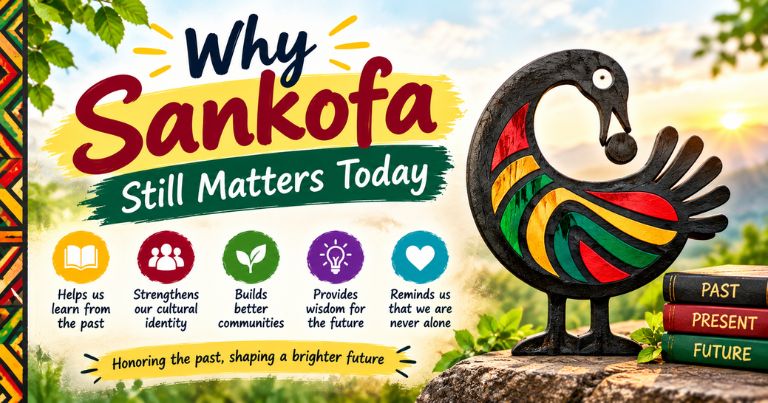
Sankofa still matters because the core problem it addresses, the temptation to ignore history in pursuit of progress, has not gone away. If anything, in a culture that often prizes constant forward motion and instant reinvention, the reminder to pause and learn from the past feels more relevant, not less.
It also matters as an ongoing act of cultural reclamation for communities whose history was deliberately disrupted or hidden, particularly across the African diaspora. Every time the symbol is explained accurately and used thoughtfully, it contributes to keeping that history visible rather than letting it fade further.
Finally, Sankofa matters because its message is genuinely useful at a personal level, regardless of background. Reflecting honestly on your own past, keeping what serves you, and leaving behind what does not, is sound advice in almost any life, which is a large part of why a centuries old Ghanaian proverb continues to resonate with people all over the world today.
Sankofa Frequently Asked Question
What Does Sankofa Mean
Sankofa means “go back and get it.” It is a Twi word from the Akan people of Ghana, built from the words for return, go, and fetch, and it is usually understood as an instruction to retrieve valuable knowledge or lessons from the past.
Where Does Sankofa Come From
Sankofa comes from the Akan people of Ghana and is part of the Adinkra symbol tradition, oral history traces the origin of Adinkra symbols to the Bono people of the Gyaman kingdom, with the practice later spreading into Asante culture.
What Does the Sankofa Bird Represent
The Sankofa bird represents the act of reaching back into the past to retrieve something valuable, symbolized by an egg it carries in its beak, while its body continues moving forward, representing progress that does not abandon its roots.
What Is the Difference Between the Sankofa Bird and Heart
The Sankofa bird is a figurative design showing a mythical bird with its head turned backward, commonly seen on traditional Akan objects like stools and staffs. The Sankofa heart is a more abstract, spiral based design that is especially popular in modern jewelry and tattoos, though both carry the same underlying meaning.
Is Sankofa Religious
Sankofa is a philosophical and cultural symbol rather than a strictly religious one. It reflects Akan values and worldview, but it is not tied to a single religious practice, which is part of why it has been adopted so widely by people of many different faiths and backgrounds.
Why Is Sankofa Popular Today
Sankofa is popular today because its message, learning from the past to build a better future, applies broadly to personal growth, cultural identity, and healing, and because its clean, simple design translates easily into tattoos, jewelry, and modern branding.
Is It Okay for Anyone to Wear Sankofa
Yes, when it is worn thoughtfully, with a real understanding of its Akan and Adinkra origin and respect for the history behind it. Problems tend to arise not from outsiders wearing the symbol, but from using it as decoration with no acknowledgment of its meaning or origin at all.
Is Sankofa Used Only in Africa
No. While Sankofa originates specifically with the Akan people of Ghana, it has spread widely across the African diaspora, including in the United States and the United Kingdom, and is now used globally in jewelry, tattoos, education, and cultural institutions.
Like What You Read?
If this gave you a clearer picture of what the Sankofa symbol truly represents, consider sharing it with someone exploring their own heritage, planning a meaningful tattoo, or simply curious about the deeper meaning behind a design they have seen before. Understanding a symbol like Sankofa is itself a small act of Sankofa, going back to learn something so you can carry it forward.
Conclusion
The Sankofa symbol comes from the Akan people of Ghana. It shows a bird looking backward while its feet face forward. Sometimes the bird holds an egg in its beak. The egg stands for the future. The symbol teaches a simple lesson. We must look back to move forward well.
Sankofa is also a word in the Akan language. It means “go back and get it.” This idea is about learning from the past. It does not mean living in the past. It means using old wisdom to build a better future. People use this symbol to remember their roots.
