
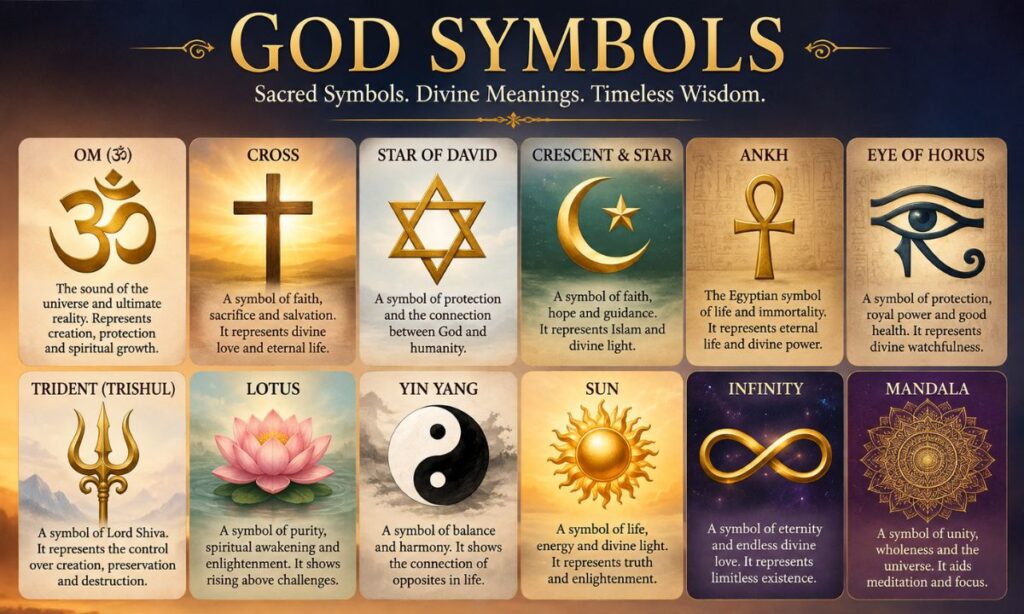
God symbols are visual signs that represent divine power, protection, wisdom, or a specific deity, and they have been used by nearly every culture in human history to make the invisible feel real. From the ankh carved into Egyptian temple walls to the simple cross worn on a necklace today, these images carry meaning far beyond decoration. People search for god symbols for many reasons: they want a tattoo with real significance, they’re curious about mythology, they’re exploring their faith, or they simply saw a symbol somewhere and want to know what it stands for.
This guide walks through more than 70 god symbols and meanings, covering Greek, Roman, Egyptian, Norse, Hindu, Aztec, and Christian traditions, along with the psychology behind why humans are so drawn to divine symbols in the first place. Whether you’re researching for a tattoo, a school project, a spiritual practice, or plain curiosity, you’ll find clear and accurate explanations here.
What Are God Symbols?
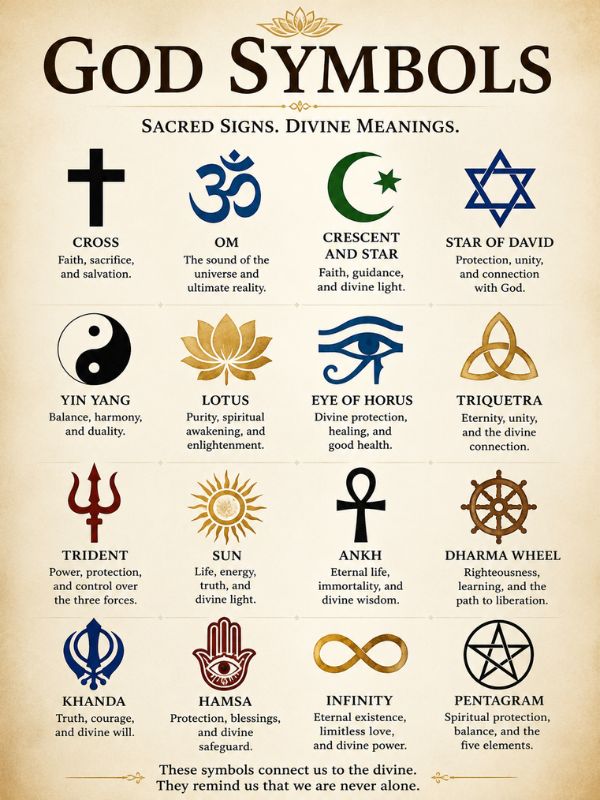
God symbols are images, objects, or marks that stand in for a deity, a divine quality, or a spiritual concept that words alone can’t fully capture. They act as a kind of visual shorthand. A single image, like a thunderbolt or a lotus flower, can instantly communicate an entire story or belief system to someone who recognizes it.
Throughout history, religious symbols served a very practical purpose. Not everyone could read, and spoken stories changed slightly with every retelling. A carved symbol on a temple wall, a coin, or a piece of jewelry stayed consistent. It told the same story to a farmer in one village and a merchant in another, regardless of literacy or dialect. This is part of why sacred symbols spread so widely and lasted so long, in some cases for thousands of years.
Symbols also carry emotional weight that plain description often misses. Saying “this god represents strength” is informative, but showing a hammer or a lion communicates it instantly and viscerally. That’s why deity symbols appear on everything from ancient pottery to modern tattoos: they compress complex spiritual ideas into something the eye can grasp in a second, and the mind can hold onto for a lifetime.
God Symbols You Can Copy And Use Easily
Many readers just want a quick symbol they can paste into a bio, a document, or a design project without digging through mythology books.
God Symbols Text
Several god symbols exist as standard Unicode characters, which means you can type or copy them directly without needing an image file. The ankh (☥), the om symbol (ॐ), the star of David (✡), the crescent and star (☪), and various cross variations (✝ †) are all available as plain text characters. This makes them easy to use in usernames, captions, or simple graphic design work.
Text-based symbols are convenient, but it’s worth remembering that a Unicode character will never look as detailed or as intentional as a hand-drawn or professionally designed version. For anything permanent, like a tattoo, most people use the text symbol only as a starting reference point before working with an artist on a custom design.
God Symbols Copy And Paste
Here are some of the most commonly copied god symbols and meanings people search for:
- ☥ Ankh: eternal life, the key of life in ancient Egypt
- ॐ Om: the sound of creation in Hinduism
- ✝ Cross: sacrifice and salvation in Christianity
- ✡ Star of David: covenant and identity in Judaism
- ☪ Crescent and star: faith and guidance in Islam
- ⚡ Lightning bolt: often used to represent Zeus or Jupiter
- 🔱 Trident: associated with Poseidon or Shiva depending on context
These symbols display differently depending on the font or platform you’re using, so it’s always smart to preview how a symbol renders before using it somewhere permanent, like a printed design or an engraving.
Powerful God Symbols And Meanings
The symbols generally considered most “powerful” are the ones tied to creation, protection, and control over natural forces, like lightning, the sun, and life itself. Power in this context doesn’t always mean physical strength. It can mean authority, life-giving force, or the ability to protect.
God Symbols And Meanings
Across cultures, certain themes repeat constantly in god symbols and meanings: light represents divine presence, circles represent eternity and wholeness, and animals represent specific traits borrowed from nature, such as lions for courage or owls for wisdom. Recognizing these repeating patterns makes it much easier to understand a new symbol you’ve never seen before, even from an unfamiliar tradition.
Powerful Spiritual Symbols And Meanings
Symbols like the all-seeing eye, the tree of life, and the infinity loop are considered powerful spiritual symbols because they represent forces bigger than any single deity: awareness, growth, and eternity. These symbols often cross religious boundaries entirely, appearing in Egyptian, Norse, Celtic, and even modern spiritual movements with only slight variations in design.
Powerful Spiritual Symbols
Beyond named deities, humans have long used sacred geometry to represent divine order. Shapes like the flower of life, the pentagram, and the vesica piscis show up in temples, churches, and mosques across completely different eras and continents. Their repeated appearance suggests these shapes tap into something close to a universal human instinct for finding pattern and meaning in geometry.
Greek God Symbols And Meanings
Greek mythology assigned each Olympian god a specific object or animal that instantly identified them in art, without needing a name written underneath. This system made Greek pottery and sculpture function almost like a visual language.
God Symbols Greek
Ancient Greek artists relied on symbols of the gods so viewers could identify a deity at a glance. A figure holding a thunderbolt was obviously Zeus. A figure with an owl nearby was obviously Athena. This visual shorthand was essential in a world where statues and paintings couldn’t include text captions.
Greek God Symbols
Here’s a quick reference table for major Greek god symbols:
| God | Symbol | Meaning |
| Zeus | Thunderbolt, eagle | Authority, sky, kingship |
| Poseidon | Trident, horse | Sea, earthquakes, power |
| Athena | Owl, olive branch | Wisdom, strategy, peace |
| Apollo | Sun, lyre, laurel | Light, music, prophecy |
| Ares | Spear, helmet | War, aggression, courage |
| Hermes | Winged sandals, caduceus | Speed, communication, trade |
| Hades | Bident, cypress tree | The underworld, wealth beneath the earth |
| Aphrodite | Dove, seashell | Love, beauty, desire |
Greek Gods Symbols And Meanings
Each symbol above wasn’t chosen randomly. The olive branch tied to Athena connected her to peace and agriculture, both central to Greek city life. The trident tied to Poseidon reflected the danger and unpredictability of the sea, something every coastal Greek community understood firsthand. These weren’t abstract choices; they reflected the daily reality of the people who worshipped these gods.
Greek God Symbol
If you’re trying to identify a single Greek god symbol you’ve seen somewhere, start with the object itself. A winged staff usually points to Hermes. A bow and arrow usually points to Apollo or Artemis. A helmet and shield usually points to Athena or Ares. Context, like accompanying animals or plants, often narrows it down further.
Greek God Symbols Percy Jackson
The Percy Jackson book and film series introduced an entire generation of American readers to Greek mythology, and it leaned heavily on traditional symbols to identify each god’s children. Poseidon’s cabin featured a trident, Athena’s featured an owl, and Zeus’s featured a lightning bolt, staying largely faithful to the original mythological symbolism while making it accessible for younger audiences.
Symbols Of Greek God
Lesser-known symbols of Greek gods include Demeter’s wheat sheaf, representing harvest and agriculture, and Dionysus’s grapevine and thyrsus staff, representing wine, festivity, and transformation. These symbols rarely appear in pop culture but were just as central to ancient Greek religious life as the more famous ones.
Greek God Symbol
It’s worth noting that some gods share overlapping symbols depending on the region and time period. Both Zeus and Poseidon, as brothers, were sometimes shown with similar authoritative poses, distinguished mainly by their signature weapon: the thunderbolt versus the trident.
Greek God Symbols Tattoos
Greek god symbols tattoos remain popular in the United States because they combine strong visual design with deep meaning. A trident tattoo might represent someone’s connection to the ocean or a love of sailing. An owl tattoo might represent wisdom or academic achievement. Laurel wreaths, tied to Apollo, are often chosen to represent victory or personal accomplishment.
Other God Symbols
Greek mythology isn’t the only tradition with a rich symbolic vocabulary; nearly every ancient civilization developed its own system.
Roman God Symbols
Roman mythology borrowed heavily from Greek tradition but renamed the gods and adjusted some symbolism. Jupiter kept the thunderbolt and eagle from Zeus. Mars, the Roman god of war, carried a spear and shield, similar to Ares but with a more honored, militaristic reputation in Roman culture. Venus, the goddess of love, was symbolized by the dove and the myrtle plant.
Egyptian God Symbols
Egyptian god symbols are some of the most recognizable in the world today. Ra, the sun god, was represented by a sun disk, often shown above his head in artwork. Isis was symbolized by a throne-shaped headdress and outstretched wings, representing protection and motherhood. Horus, the sky god, was represented by a falcon, and his eye became one of the most enduring symbols in history.
Norse God Symbols
Norse god symbols are deeply tied to nature and survival in a harsh climate. Odin was linked to ravens and spears, representing wisdom gained through sacrifice. Thor, the god of thunder, was represented by his hammer, Mjolnir, a symbol of protection and strength that remains popular in modern jewelry and tattoos.
Hindu God Symbols
Hindu god symbols are some of the oldest continuously practiced religious symbols on earth. Shiva is represented by the trident and the crescent moon. Vishnu is represented by the conch shell and the lotus. Brahma, the creator, is often shown with four heads representing the four Vedas, the sacred texts of Hinduism.
Aztec God Symbols
Aztec god symbols reflect the civilization’s deep connection to the sun, agriculture, and warfare. The feathered serpent, associated with the god Quetzalcoatl, represented the union of earth and sky. The sun stone, tied to solar deities, represented the Aztec calendar and cosmic order, reflecting how closely religion and daily life were intertwined.
Chaos God Symbols
Chaos god symbols appear across multiple mythologies to represent disorder, the unknown, or the raw material from which the universe was formed. In Greek cosmology, Chaos wasn’t even a traditional god but a primordial void, often symbolized abstractly rather than with a specific object, since it existed before form itself.
Zeus God Symbols
Zeus deserves individual focus because he’s the most recognized Greek god in American pop culture. His core symbols are the thunderbolt, the eagle, and the oak tree. The thunderbolt represented his control over the sky and his role as king of the gods, while the eagle symbolized his authority soaring above mortal affairs.
Apollo Greek God Symbols
Apollo is symbolized by the sun, the lyre, and the laurel wreath. As the god of music, prophecy, and light, his symbols reflect clarity and inspiration. The laurel wreath specifically ties back to the myth of Daphne and remains associated with victory and achievement today, including its use in the Olympic Games tradition.
Ares Greek God Symbols
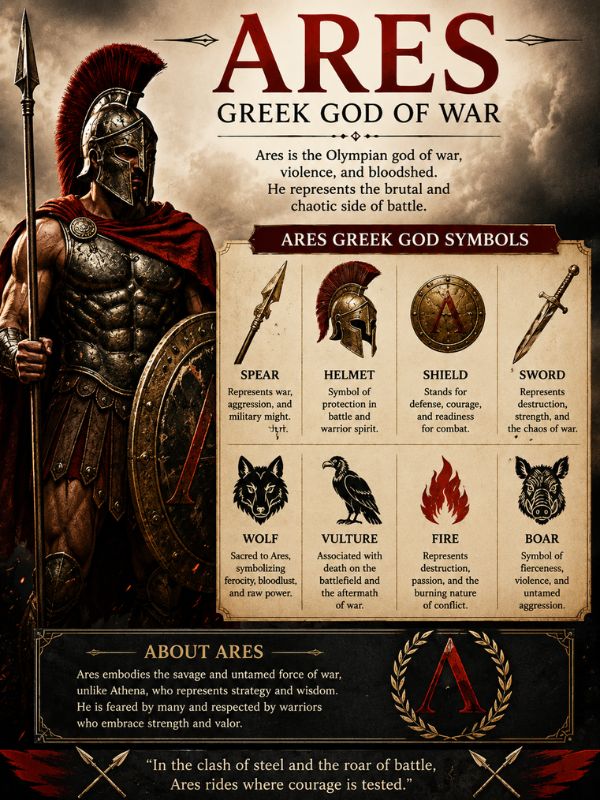
Ares, the god of war, is symbolized by the spear, the helmet, and sometimes vultures or dogs, animals associated with battlefields. Unlike Athena, who represented strategic warfare, Ares represented the chaotic and brutal side of conflict, which is reflected in his more aggressive symbolism.
Apollo God Symbols And Ares God Symbols
Comparing Apollo’s symbols to Ares’s symbols highlights how differently Greek culture viewed order versus chaos. Apollo’s sun and lyre represented harmony, reason, and beauty. Ares’s spear and helmet represented violence and instinct. The Greeks used this contrast intentionally, placing these two gods almost as opposites within the same pantheon.
Greek God Symbols
Returning to individual deities helps clarify a few gods that are frequently searched but often confused with one another.
Hermes God Symbols
Hermes is symbolized by winged sandals, a winged helmet, and the caduceus, a staff with two intertwined snakes. As the messenger god, his symbols all emphasize speed and movement between worlds, including the mortal world and the underworld.
Hermes Greek God Symbols
It’s worth noting the caduceus is frequently confused with the Rod of Asclepius, a separate symbol with a single snake used in modern medicine. Hermes’s version has two snakes and wings, and it represents commerce and communication rather than healing, despite the common mix-up.
Hades Greek God Symbols
Hades, god of the underworld, is symbolized by the bident, a two-pronged staff, along with the cypress tree and the key to the underworld. Despite popular modern portrayals, Hades was not considered evil in ancient Greek religion; he was simply the ruler of the dead, a necessary and respected role.
Hades God Symbols
Hades is also occasionally represented by Cerberus, the three-headed dog that guarded the underworld’s entrance. This symbol reinforced the idea of the underworld as a place with strict boundaries, one that souls could enter but rarely leave.
Pan God Symbols
Pan, the god of the wild and shepherds, is symbolized by pan flutes (also called panpipes) and goat-like features, including horns and legs. His symbols reflect his connection to nature, spontaneity, and rural life, far removed from the structured order of Mount Olympus.
Deity Symbol
A general deity symbol doesn’t always point to a specific god. Circles, halos, and radiating light are used broadly across cultures to indicate divinity itself, regardless of which specific deity is being depicted. This kind of universal marker helps ancient viewers recognize “this figure is divine” even without knowing the exact name.
Symbol Of The Gods
When multiple gods share a scene in ancient art, artists often used a symbol of the gods collectively, like clouds, mountains (representing Mount Olympus), or a shared throne room, to signal that the setting itself was sacred, separate from the mortal world below.
Jesus Symbols
The most direct symbol for Jesus Christ is the cross, representing his crucifixion and the Christian belief in salvation through his sacrifice.
Symbol For Jesus
Beyond the cross, common symbols for Jesus include the fish (ichthys), the lamb, and the shepherd’s staff. The fish symbol dates back to early Christianity, when believers used it as a secret sign to identify one another during periods of persecution in the Roman Empire.
Jesus Symbol
The lamb represents Jesus as a sacrificial figure, tying back to Jewish tradition and the concept of atonement. The shepherd’s staff represents his role as a guide and protector, referencing the biblical phrase describing him as a shepherd watching over his flock.
Jesus Symbols And Symbols For Jesus
Together, these Jesus symbols tell a layered story: the fish for identity and faith, the lamb for sacrifice, the cross for salvation, and the shepherd’s staff for guidance. Each symbol emphasizes a different aspect of his role within Christian theology, and many churches use all four throughout their architecture and artwork.
Christian Symbols for God
Christianity generally avoids depicting God the Father visually, relying instead on abstract symbols like light, a dove, or a hand reaching from clouds.
God Symbols Christian
Common Christian symbols for God include the triangle, representing the Holy Trinity, and rays of light, representing divine presence and truth. Stained glass windows in many American churches use these symbols extensively, translating theology into visual storytelling for congregations.
Symbol For God
Because direct depictions of God are traditionally avoided in Christian art, many artists instead used a symbol for God, like an eye within a triangle, sometimes called the all-seeing eye, to represent divine awareness and omniscience without showing a literal figure.
Universal Symbol For God And Universal God Symbol
There isn’t one single universal symbol for God recognized across all religions equally, since each tradition developed its own visual language independently. However, light, circles, and radiance appear so consistently across unrelated cultures that many scholars consider them the closest thing to a shared, cross-cultural representation of divinity.
God Symbols and Tattoos
God symbols remain one of the most requested tattoo categories in the United States because they combine visual impact with personal, lasting meaning.
Symbols Of God
People choose symbols of God for tattoos to represent protection, faith, or a specific turning point in their life. A cross might mark a recovery milestone. An ankh might represent resilience. These choices are rarely just aesthetic; they usually connect to something the wearer has personally experienced.
God Symbolism
God symbolism in tattoo culture often blends traditions. It’s common to see someone combine a religious cross with sacred geometry, or a Norse symbol with modern linework, creating something personal rather than a strict historical reproduction.
Divine Symbols
Divine symbols chosen for tattoos tend to favor clean, bold designs that age well on skin over decades, which is why simple shapes like the ankh, the om symbol, and Thor’s hammer remain consistently popular choices among tattoo artists and clients alike.
Divine Symbol
Before getting any divine symbol tattooed, it’s worth researching its full cultural context. Some symbols carry deep religious weight for specific communities, and wearing them without understanding that context can unintentionally come across as disrespectful, even if that wasn’t the intention.
Deep Symbolic Meaning of God Symbols
God symbols carry meaning on at least three distinct levels: spiritual, psychological, and cultural, and understanding all three gives a much fuller picture of why they matter.
On a Spiritual Level
On a spiritual level, symbols act as a bridge between the human and the divine. Many faith traditions teach that focusing on a symbol during prayer or meditation helps concentrate the mind and creates a sense of connection to something greater than the individual self.
On a Psychological Level
Psychologist Carl Jung argued that recurring symbols across unrelated cultures point to a shared human unconscious, which he called the collective unconscious. According to Jung, symbols like the circle, the tree, and the divine parent figure appear repeatedly because they reflect universal human experiences, not because cultures copied one another.
On a Cultural Level
On a cultural level, god symbols reinforce group identity and shared history. Wearing or displaying a specific symbol signals belonging to a community, whether that’s a religious congregation, a cultural heritage, or a shared set of values passed down through generations.
Types and Variations of God Symbols
Seven symbols in particular appear again and again across world religions, making them essential starting points for understanding god symbolism as a whole.
1. The Ankh
The ankh, an Egyptian symbol resembling a cross with a looped top, represents eternal life. It appears constantly in Egyptian art, often held by gods like Isis and Ra, offered to pharaohs as a sign of divine favor and continued existence after death.
2. The Eye of Horus
The Eye of Horus represents protection, health, and royal power in ancient Egypt. According to myth, Horus lost his eye in battle with Set, and it was later magically restored, making the symbol a representation of healing and restoration.
3. Om
Om is considered the primal sound of creation in Hinduism, representing the beginning, middle, and end of the universe. It’s chanted at the start of prayers and yoga practices, believed to align the practitioner with cosmic vibration.
4. The Cross
The cross represents sacrifice and salvation in Christianity, referencing the crucifixion of Jesus Christ. Variations like the Celtic cross and the Orthodox cross reflect regional adaptations while keeping the core symbolism intact.
5. The Star of David
The Star of David, a six-pointed star formed by two overlapping triangles, represents the covenant between God and the Jewish people. It has become one of the most recognized symbols of Jewish identity worldwide.
6. The Crescent and Star
The crescent and star are widely associated with Islam, though the symbol’s exact religious meaning is debated among scholars, since it predates Islam and was originally used by various ancient civilizations to represent the moon and sky.
7. Thor’s Hammer
Mjolnir, or Thor’s hammer, represents protection and strength in Norse mythology. It was believed to defend both gods and humans from chaos, and it remains a popular symbol among people connecting with Norse heritage or modern pagan practices.
God Symbols Across Cultures
Geography and daily survival shaped which god symbols each culture developed, since people naturally symbolized the forces that mattered most to their way of life.
Ancient Egypt
Egyptian civilization depended entirely on the Nile River, so many of its Egyptian god symbols reflect themes of life, death, and rebirth tied to the river’s yearly flooding cycle, which determined the success of every harvest.
Ancient Greece
Greek civilization was built around city-states, trade, and the sea, which explains why so many Greek god symbols relate to navigation, wisdom, and warfare, the core concerns of a seafaring, competitive society.
India
India’s symbolic tradition, especially within Hinduism, developed around concepts of cosmic cycles, karma, and enlightenment, producing symbols like the lotus and Om that emphasize spiritual transformation rather than physical power.
Abrahamic Traditions
Christianity, Judaism, and Islam share historical roots and, as a result, some overlapping symbolic themes, even though their specific symbols differ. All three traditions emphasize a single, formless God, which shaped their preference for abstract symbols over literal depictions.
Norse and Celtic Cultures
Norse mythology developed in a harsh northern climate, producing symbols centered on strength, protection, and survival against chaos, reflecting the real dangers of the environment its believers lived in every day.
God Symbols in Art, Movies and Pop Culture
God symbols appear constantly in modern movies, games, and art because they instantly communicate power, identity, and backstory without needing lengthy explanation.
Films like Percy Jackson and the Olympians and Clash of the Titans rely on traditional Greek symbolism to make each god instantly identifiable to audiences. Video games, particularly those in the God of War series, draw heavily from Norse and Greek symbolism to build entire game worlds around mythological accuracy.
Fashion and jewelry brands also use ancient god symbols extensively, from ankh necklaces to hammer pendants, because these designs carry built-in meaning that resonates with buyers looking for something more significant than generic decoration. This ongoing pop culture presence keeps ancient symbolism alive and relevant for new generations who might never read the original myths.
Spiritual and Dream Meaning of God Symbols
Seeing a god symbol in a dream is often interpreted as a sign of guidance, protection, or an unresolved spiritual question the dreamer is working through.
Many spiritual traditions treat dream symbolism as a form of internal communication rather than literal prophecy. A cross appearing in a dream, for example, might reflect a moment of moral decision-making rather than a literal religious message. A thunderbolt might reflect sudden clarity or a breakthrough moment in waking life.
Meditation practitioners sometimes use god symbols intentionally, focusing on an image like Om or the ankh to anchor their attention during practice. This isn’t about literal belief in the deity itself but about using a familiar, emotionally resonant image to quiet the mind and encourage focus.
Positive vs Negative Meaning
Most god symbols carry positive associations like protection and strength, but the same symbol can take on a negative meaning depending on historical misuse or cultural context.
The swastika is the clearest example of this shift. Long before the twentieth century, it was a sacred symbol of good fortune in Hinduism, Buddhism, and Jainism, and it still holds that positive meaning within those traditions today. Its association with Nazi Germany completely altered its perception in Western countries, showing how context can drastically change a symbol’s meaning within just a few decades.
This kind of shift isn’t unique to one symbol. Even the pentagram, historically associated with protection and the five elements, later became linked with occult fear in some Western pop culture, despite having no inherent negative meaning in its original context. Understanding a symbol’s full history matters before assuming its meaning is fixed or universal.
Why Humans Are Attracted to God Symbols
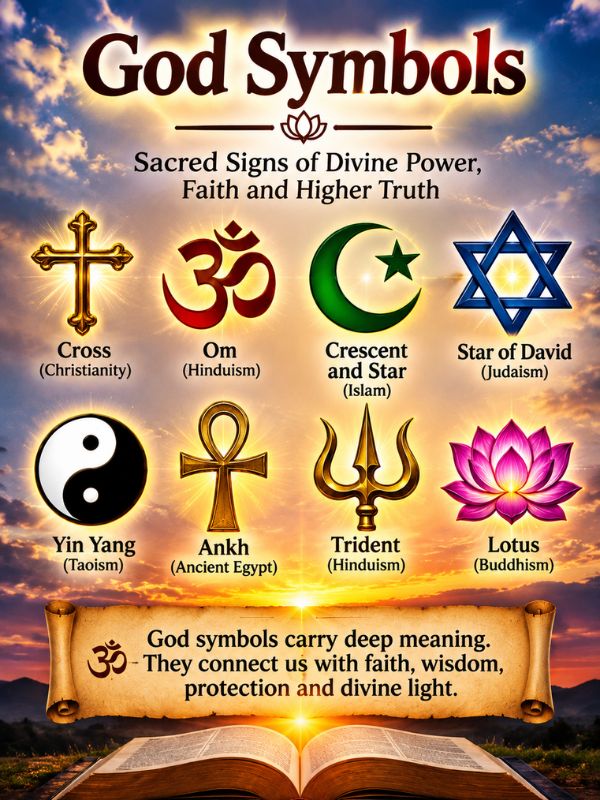
Humans are drawn to god symbols because they offer a sense of order, protection, and connection to something larger than everyday life, satisfying a need that appears consistently across every documented culture.
Psychologically, symbols reduce complex, abstract fears, like death or the unknown, into something visual and manageable. Holding or wearing a symbol can create a genuine sense of comfort, even for people who aren’t strictly religious, because the symbol represents stability and continuity.
Carl Jung’s theory of the collective unconscious offers one explanation for why totally unrelated cultures developed strikingly similar symbols independently. Circles representing wholeness, trees representing life, and parental figures representing divine care show up again and again, suggesting these patterns may be built into how the human brain naturally processes meaning, rather than something purely learned through cultural exchange.
Finally, symbols give people a way to express identity and belief without needing words. A small pendant or tattoo can communicate faith, heritage, or personal philosophy instantly, which explains why god symbols and meanings remain such a consistently popular search topic, even in an increasingly secular, modern society.
Final Thoughts
God symbols have survived thousands of years because they do something words alone can’t: they make faith, power, and meaning visible at a glance. From the ankh and the Eye of Horus to the cross and Thor’s hammer, each symbol carries a story shaped by the people who created and believed in it. Whether you’re drawn to these symbols for spiritual practice, artistic inspiration, or simple curiosity, approaching them with a little research and respect makes the experience far richer than treating them as mere decoration.
Frequently Asked Questions
What are the oldest god symbols in history?
The oldest known god symbols date back over 5,000 years to ancient Egypt and Mesopotamia. Early sun disks and fertility signs were among the first.
Are god symbols universal?
No symbol is used the exact same way everywhere. But themes like light and circles appear across almost every culture.
Can god symbols have different meanings?
Yes, the same symbol can mean different things in different cultures. Meaning often changes with time and context too.
Is it disrespectful to wear god symbols?
It depends on the symbol and your connection to it. Wearing a sacred symbol without understanding it can feel disrespectful to some communities.
Do god symbols have power?
That depends on personal belief. Psychologically, symbols do have real power to shape focus and emotion.
Conclusion
God symbols have been part of human life for thousands of years. They help people connect with something bigger than themselves. A symbol can say what words sometimes can’t. It shows faith, hope, or protection in a single image. From the anchor to the cross, each one carries a story. That story often outlives the culture that created it.
Today, these symbols still matter. People wear them, tattoo them, and study them. They show up in art, movies, and everyday jewelry. Some choose them for faith. Others choose them for meaning or beauty. No matter the reason, understanding a symbol’s roots makes it more powerful and more personal.
