
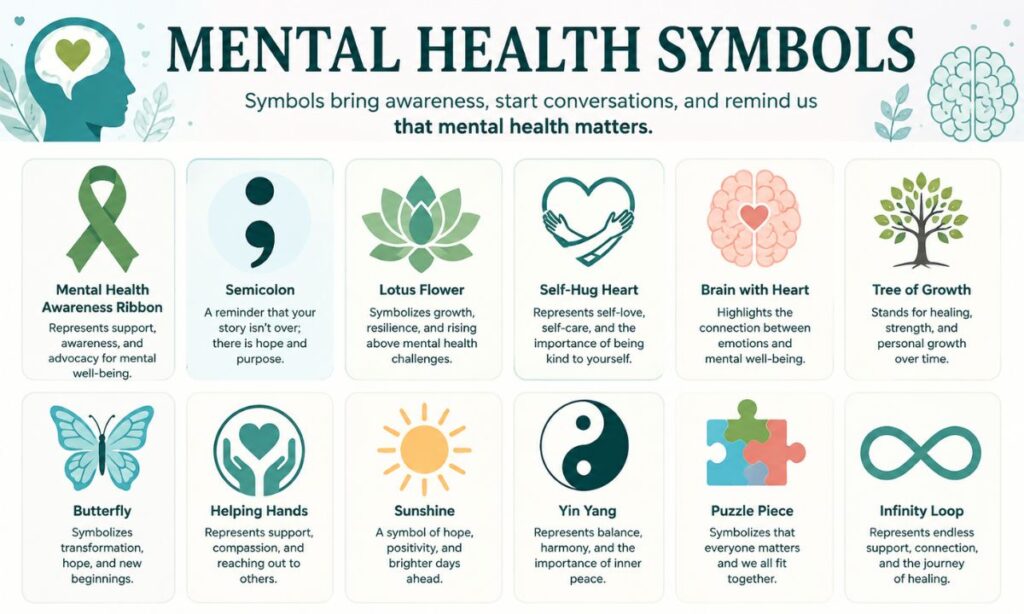
Mental health matters more today than ever before. People all over the world are learning to talk about their feelings openly. Symbols play a big role in this change. A simple icon can carry a strong message. It can show hope, support, or awareness. It can also help people feel less alone.
You may have seen the green ribbon or the semicolon tattoo somewhere. These symbols are not just pretty designs. Each one has a real story behind it. Some symbols represent specific conditions like anxiety or depression. Others stand for recovery, strength, or unity. In this guide, we explain the meaning behind more than 110 mental health symbols.
What Are Mental Health Symbols? 🧠💚🕊️🎗️✨
- Mental health symbols are simple images that carry deep emotional and social meaning for millions of people worldwide today.
- They are used to represent feelings, conditions, struggles, and personal victories that are often hard to explain in plain words.
- Many symbols began as small personal statements before growing into recognized global icons used across countries, cultures, and communities.
- Some symbols come from nature, like trees or butterflies, showing growth, transformation, and the possibility of positive change over time.
- Other symbols are man-made, like ribbons or pins, created specifically to raise awareness about certain mental health conditions and causes.
- Mental Health Symbols
- These symbols appear on clothing, jewelry, social media posts, artwork, and even tattoos as quiet reminders of ongoing personal journeys.
- They help start conversations that might otherwise feel too difficult or uncomfortable to bring up directly in everyday casual conversation.
- A single symbol can instantly signal solidarity with someone who is struggling, without requiring long explanations or spoken words at all.
- Mental health symbols also help reduce stigma by making invisible struggles visible in a gentle, non-threatening, and approachable visual way.
- They are used by advocacy groups, therapists, schools, and families to teach children about emotions and mental wellbeing from an early age.
- Many symbols carry personal significance too, chosen by individuals to represent their own unique story of struggle and survival.
- Understanding these symbols helps outsiders show support more thoughtfully, and helps those struggling feel truly seen and genuinely understood.
- Some symbols are official, created by large organizations, while others grow naturally through communities sharing similar lived experiences online.
- The meaning behind a symbol often deepens over time as more people adopt it and add their own personal stories.
- In short, these symbols turn silent pain into something that can be worn, shared, and openly recognized by others.
Mental Health Symbols And Meanings 💫🎀🦋🌻🕯️
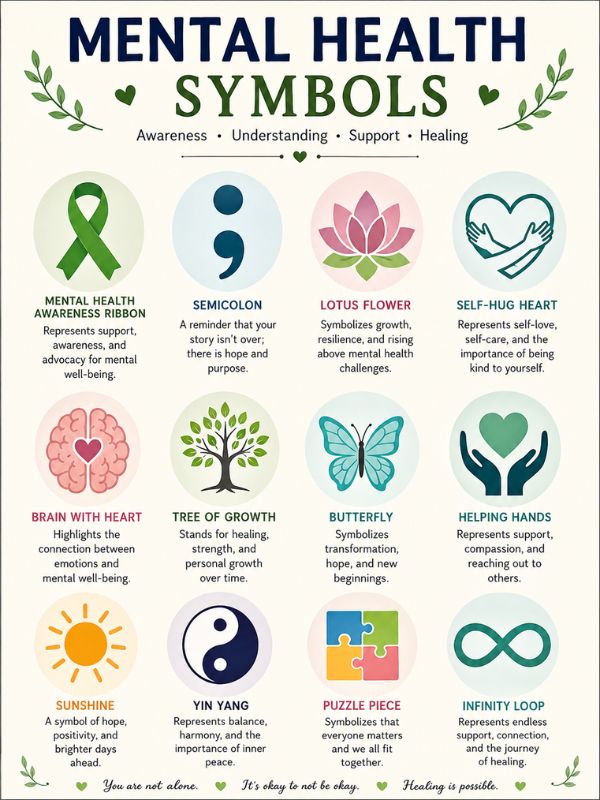
- Every mental health symbol carries a specific meaning that connects directly to a condition, feeling, or important stage of healing.
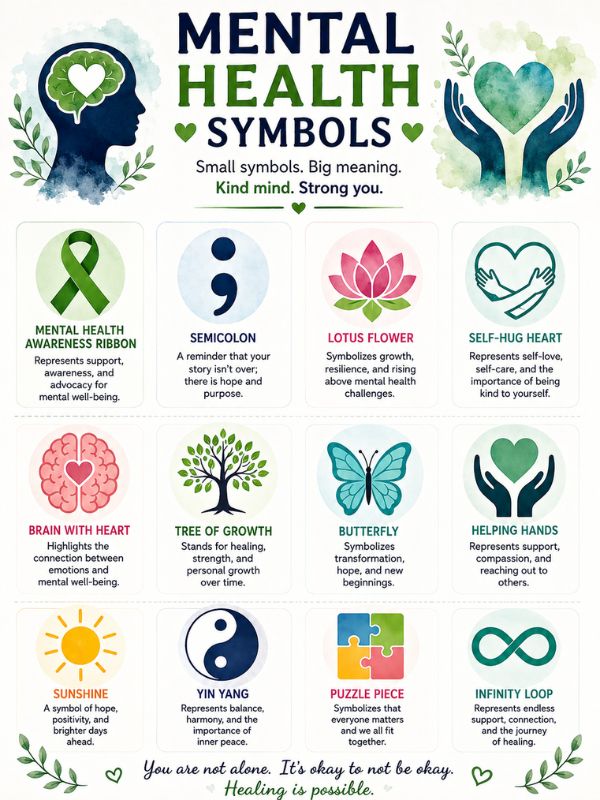
- The green ribbon is the most recognized symbol, representing general mental health awareness and support for people facing daily struggles.
- The semicolon represents a sentence the author could have ended, but chose not to, symbolizing continued life and personal strength.
- Butterflies often represent transformation, showing how someone can grow and change after facing difficult emotional experiences and hardships.
- Lotus flowers symbolize rising above struggle, since the flower blooms beautifully even while growing from muddy, difficult conditions.
- The infinity symbol represents endless strength, continuous healing, and the ongoing nature of managing mental health throughout one’s life.
- Candles are often used to represent hope, remembrance, and light guiding someone through dark and emotionally difficult periods.
- The heart with a puzzle piece represents complex emotions, showing that mental health is made of many connected parts.
- A tree with roots symbolizes stability, growth, and staying grounded even when life feels overwhelming or uncertain.
- The color teal is linked to anxiety awareness, while purple often represents awareness around various other emotional conditions.
- Doves represent peace and calm, often used by people seeking relief from constant worry, stress, or emotional turmoil.
- The number 988 has become a symbol itself, representing the crisis support lifeline available to people in urgent need.
- Sunflowers symbolize hidden struggles, since not everyone facing mental health challenges shows visible signs of their inner pain.
- Anchors represent stability during hard times, showing that someone remains grounded despite facing emotional storms.
- Together, these symbols and their meanings create a shared visual language for millions dealing with mental health.
- Mental Health Symbols
Mental Health Symbols Tattoos 🖋️🦋🌙🩶🌸
- Tattoos have become one of the most personal and permanent ways people choose to express their mental health journey.
- The semicolon tattoo remains extremely popular, worn by people who have survived suicidal thoughts or attempted to end their life.
- Many people choose small butterfly tattoos to represent personal transformation after overcoming depression, anxiety, or another mental health struggle.
- Lotus flower tattoos are common among those who feel they have grown stronger after living through painful, difficult experiences.
- Some people get tattoos of mountains, symbolizing the ups and downs of managing mental health across many different years.
- Anchor tattoos represent staying grounded and stable, especially popular among people recovering from addiction or emotional instability.
- Feather tattoos often symbolize freedom, lightness, and release from heavy emotional burdens carried for a very long time.
- Mental Health Symbols
- The words “breathe” or “keep going” are commonly tattooed as daily reminders during difficult and overwhelming emotional moments.
- Wave tattoos represent the natural ups and downs of emotions, showing that difficult feelings will eventually pass with time.
- Some choose tattoos of birds in flight, symbolizing freedom from anxiety, depression, or other mentally exhausting conditions.
- Sun and moon tattoos together can represent balance, showing both light and dark sides of the emotional experience.
- Tree tattoos with visible roots symbolize staying grounded, even when everything else in life feels unstable and uncertain.
- Many people place these tattoos somewhere visible, hoping to spark conversation and connect quietly with others who understand.
- Mental Health Symbols
- Others keep tattoos hidden, choosing them purely as private, personal reminders meant only for themselves during hard days.
- Regardless of placement, each tattoo tells a real and deeply personal story of struggle, survival, and continued strength.
Symbols Of Mental Health Recovery 🌱🕊️🌈🏔️🔑
- Recovery symbols represent the ongoing journey of healing, growth, and rebuilding after facing serious mental health challenges and setbacks.
- The rising sun symbolizes new beginnings, representing each new day as another chance to continue healing and moving forward.
- Seeds and sprouts represent small beginnings, showing that recovery often starts with tiny, quiet steps taken every single day.
- The phoenix rising from ashes represents complete transformation, showing someone rebuilding their life after very difficult, painful circumstances.
- Keys often symbolize unlocking a better future, representing freedom gained through therapy, support, and consistent personal effort.
- Bridges represent connection and moving from one difficult chapter of life into a calmer, more stable future chapter.
- Mental Health Symbols
- Rainbows appear after storms, symbolizing hope and positive change following extremely difficult and emotionally exhausting periods of struggle.
- Mountains climbed represent the effort required during recovery, showing progress made despite facing many significant obstacles along the way.
- The recovery ribbon, often silver or purple, represents ongoing support for people actively working toward long-term emotional stability.
- Open hands symbolize acceptance, showing willingness to receive help and support from others during the recovery process.
- Footprints represent the steady, ongoing journey of recovery, showing that healing happens gradually over an extended period.
- Light bulbs symbolize moments of clarity, representing breakthroughs that happen during therapy or personal reflection sessions.
- Chains breaking apart symbolize freedom from past trauma, addiction, or other mental health struggles holding someone back.
- Compasses represent direction and purpose, showing that recovery involves finding a clear path forward despite past confusion.
- Together, these symbols remind people that recovery is possible, ongoing, and worth celebrating at every single stage.
Mental Health Symbols Copy Paste 🧠💚🎗️🕊️♾️
- Many people search for mental health symbols they can quickly copy and paste directly into messages, posts, or bios.
- The infinity symbol (♾️) is one of the most copied symbols, representing ongoing strength and continuous mental health awareness.
- The green heart (💚) is frequently used online to show quiet support for mental health awareness and struggles.
- The semicolon (;) is often typed alone in bios or captions to represent survival and continued personal strength.
- The dove symbol (🕊️) is commonly copied to represent peace, calm, and freedom from constant anxious thoughts.
- The lotus flower (🪷) is a popular copy-paste choice, symbolizing growth despite difficult or painful circumstances.
- Mental Health Symbols
- The ribbon symbol (🎗️) is widely copied and shared during mental health awareness campaigns and social media events.
- The butterfly symbol (🦋) is another favorite, often paired with captions about personal growth and positive transformation.
- The brain symbol (🧠) is used simply to represent mental health conversations, therapy, or general emotional wellbeing topics.
- The candle symbol (🕯️) is often copied to represent remembrance during mental health awareness weeks or memorial posts.
- The rainbow symbol (🌈) is frequently used to represent hope, especially after sharing a difficult personal experience.
- The anchor symbol (⚓) is copied by those wanting to express stability during ongoing emotional or mental struggles.
- The puzzle piece symbol (🧩) is sometimes used to represent complexity, though it is more common in other contexts.
- These copy-paste symbols make it easy for anyone to show support instantly without writing a lengthy explanation.
- They are especially popular among younger users who prefer quick visual expression over long written statements.
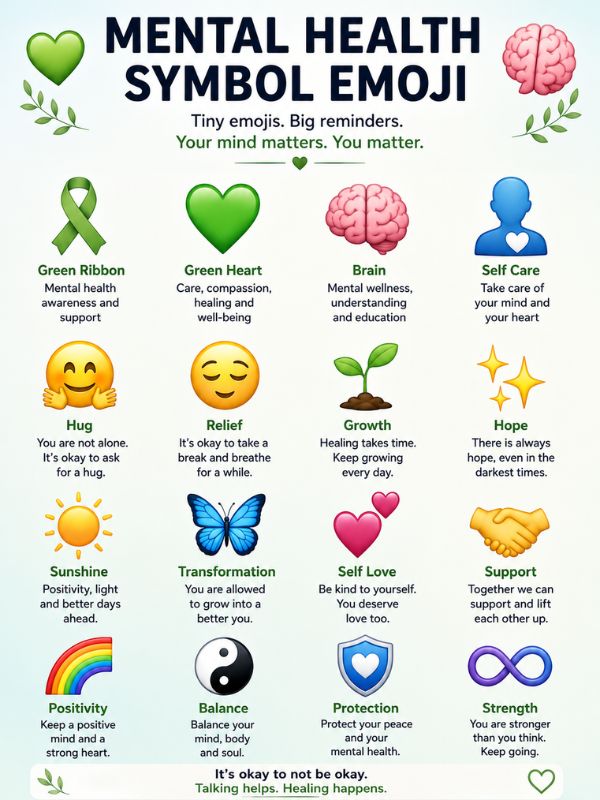
Mental Health Symbol Emoji 🧠💚🎗️🌈🦋
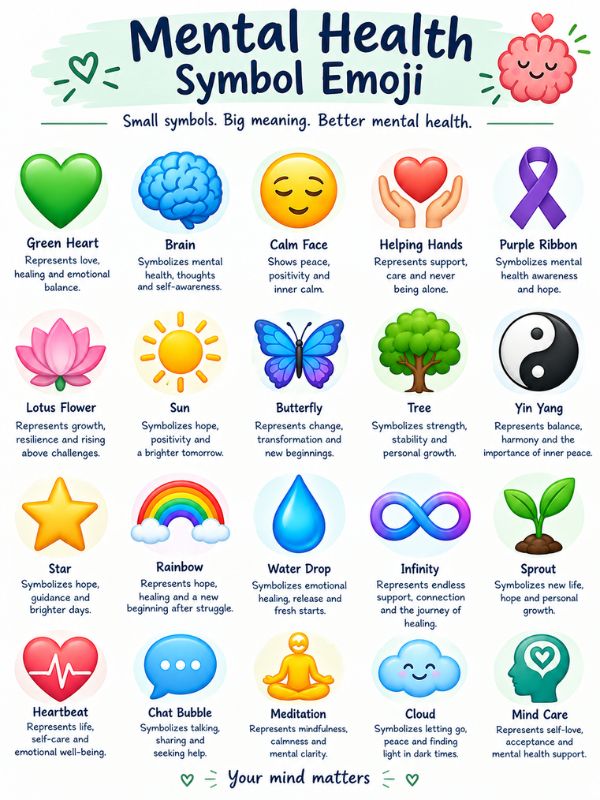
- Emojis have become an easy, informal way for people to express mental health topics in everyday digital conversations today.
- The green heart emoji is widely recognized as a general symbol for mental health awareness and quiet emotional support.
- The brain emoji is often used simply to reference mental health, therapy sessions, or general psychological wellbeing topics.
- The ribbon emoji appears frequently during awareness months, representing solidarity with people facing various mental health conditions.
- The butterfly emoji represents transformation and is commonly used when discussing personal growth after emotional struggles.
- The rainbow emoji symbolizes hope and is often paired with messages about overcoming difficult mental health challenges.
- The dove emoji represents peace and calm, frequently used in captions about anxiety relief or emotional stability.
- Mental Health Symbols
- The candle emoji is used for remembrance, often appearing in posts honoring lives lost to mental illness.
- The sun emoji represents positivity and new beginnings, commonly used alongside messages of encouragement and support.
- The anchor emoji symbolizes stability, often used by people describing their support system during difficult emotional periods.
- The lotus emoji represents rising above struggle, frequently paired with captions about personal healing journeys.
- The infinity emoji represents ongoing strength, often used in bios belonging to survivors of mental health crises.
- The clasped hands emoji represents support and connection, commonly used when responding to someone sharing their struggles.
- The seedling emoji represents small beginnings, often used when discussing early stages of therapy or recovery.
- Together, these emojis create a simple visual shorthand for complex emotional topics across social media platforms.
Mental Health Symbol Drawing 🎨✏️🌙🦋🌿
- Drawing mental health symbols has become a popular and calming creative outlet for people processing difficult, complex emotions.
- Simple line drawings of hearts, brains, or ribbons are common starting points for beginners exploring this type of art.
- Many artists draw butterflies emerging from cracked cocoons to represent personal transformation after emotional struggle or trauma.
- Lotus flower drawings often include detailed petals rising from murky water, symbolizing beauty growing from hardship.
- Mental Health Symbols
- Tree drawings with visible roots and branches are popular, representing stability alongside continued personal growth over time.
- Wave drawings capture the natural rise and fall of emotions, often used in journals or therapy exercises.
- Mountain range drawings represent the ups and downs of managing mental health across many different life stages.
- Some artists draw hands cupping small flames, representing hope carefully protected during dark or difficult periods.
- Mandala-style drawings are often used therapeutically, helping people focus their mind while processing difficult feelings.
- Mental Health Symbols
- Drawings of open doors or windows symbolize new opportunities and positive change following a period of struggle.
- Simple sun and cloud drawings represent balance, showing that both good and difficult days are completely normal.
- Many people draw these symbols in personal journals as part of daily mental health check-in routines.
- Art therapists often encourage clients to draw their own personal symbols representing individual struggles and strengths.
- These drawings do not need artistic skill, since the process itself provides real emotional and therapeutic value.
- Sharing these drawings online has also helped build supportive communities around shared mental health experiences.
- Mental Health Symbols
Popular Symbols For Mental Health Awareness 🎗️💚🕊️🌻♾️
- Awareness symbols are specifically designed to spark public conversation and reduce stigma around mental health conditions worldwide.
- The green awareness ribbon remains the most widely recognized symbol used during mental health campaigns and public events.
- Semicolon Project materials use the semicolon symbol prominently to represent suicide prevention and continued survival.
- Sunflowers have become linked to hidden disabilities, including certain mental health conditions that are not visibly obvious.
- The number 988 is now displayed as a symbol itself, representing the crisis and suicide prevention lifeline.
- Teal ribbons specifically represent anxiety disorder awareness, distinguishing this condition from broader general mental health campaigns.
- Purple ribbons are sometimes used for awareness around several different mental health and neurological conditions.
- The infinity heart symbol combines strength and endless support, frequently used across awareness posters and materials.
- Doves are used during World Mental Health Day campaigns, representing peace and hope for those struggling.
- Light bulbs are sometimes used in awareness campaigns to represent moments of understanding and reduced stigma.
- Puzzle piece imagery occasionally appears in broader wellbeing campaigns, though it is more associated with other causes.
- Candlelight vigils use candle imagery as a powerful symbol during mental health remembrance events each year.
- Rainbow imagery appears during awareness campaigns focused on hope following difficult personal mental health experiences.
- These symbols appear on posters, pins, clothing, and social media during dedicated awareness weeks and months.
- Their widespread use has helped normalize public conversations that were once considered private or shameful.
Semicolon Symbol Meaning Mental Health ⚡;️🦋💚🕊️
- The semicolon symbol has become one of the most powerful and widely recognized icons in mental health awareness today.
- It originated from Project Semicolon, a movement encouraging people to choose to continue their story instead of ending it.
- A semicolon is used when a writer could end a sentence but chooses to continue it with more meaning.
- Mental Health Symbols
- This grammatical idea became a metaphor for people who considered ending their life but decided to keep living instead.
- The symbol represents survivors of suicidal thoughts, self-harm, depression, addiction, and other extremely difficult mental health struggles.
- Many people wear semicolon tattoos, jewelry, or clothing as a permanent reminder of their personal survival story.
- The symbol is also used to show solidarity with someone else who has faced similar difficult experiences.
- It serves as a quiet conversation starter, allowing survivors to share their story only when they feel ready.
- The semicolon reminds people that their story is not over, regardless of how difficult a chapter feels.
- It has grown into a global movement, with organizations using the symbol during suicide prevention campaigns worldwide.
- Many mental health organizations now incorporate the semicolon into official awareness materials and campaign artwork.
- The symbol resonates strongly because it uses something familiar, a simple punctuation mark, to carry deep personal meaning.
- It reminds struggling individuals that continuing forward, even in small ways, still counts as meaningful progress.
- Family members of those lost to suicide also use the symbol to honor their loved one’s memory.
- Overall, this small punctuation mark has become one of the most emotionally powerful symbols in existence today.
Symbol For Mental Illness 🌩️🧩🖤🌫️🩶
- Symbols representing mental illness aim to visually capture experiences that are often invisible, complex, and difficult to describe.
- Storm clouds are frequently used to represent depression, anxiety, or other conditions causing constant emotional heaviness.
- Cracked or broken hearts sometimes represent emotional pain, though many advocates prefer symbols showing eventual healing instead.
- Puzzle pieces occasionally represent the complexity of mental illness, showing how many factors connect to overall wellbeing.
- Chains represent feeling trapped by a condition, often used before recovery symbols like breaking chains appear.
- Fog or mist imagery represents the mental cloudiness often experienced during depression or severe anxiety episodes.
- Masks are sometimes used to represent hiding mental illness behind a calm or happy public appearance.
- Empty chairs occasionally symbolize isolation, a common experience for people struggling with untreated mental illness.
- Black and grey color palettes are sometimes used artistically to represent the heaviness of certain conditions.
- Mental Health Symbols
- Spirals can represent racing thoughts or anxiety, showing the overwhelming nature of certain mental health symptoms.
- Cages sometimes represent feeling trapped within one’s own mind during difficult depressive or anxious episodes.
- Weighted objects, like heavy stones, represent the constant burden carried by people managing mental illness daily.
- These heavier symbols are often paired with hopeful ones, balancing struggle with the possibility of recovery.
- Advocates encourage using these symbols thoughtfully, avoiding imagery that feels overly negative or discouraging to viewers.
- Ultimately, these symbols help validate real struggles while still leaving room for eventual healing and hope.
Symbols For Mental Health Awareness 🎗️🌻💚🕊️♾️
- Awareness symbols exist specifically to educate the public and encourage open, judgment-free conversations about mental health topics.
- The green ribbon continues to serve as the primary global symbol representing general mental health awareness efforts.
- Sunflower lanyards, originally created for hidden disabilities, are now also linked to certain mental health conditions.
- Teal ribbons represent anxiety awareness specifically, helping distinguish this condition within broader mental health conversations.
- The number 988 symbolizes the crisis lifeline, now recognized instantly by many people seeking urgent support.
- Infinity symbols represent ongoing awareness efforts, showing that mental health conversations require continuous, long-term attention.
- Doves represent peaceful advocacy, often used during marches, walks, and public awareness events worldwide.
- Candles represent remembrance during vigils honoring individuals lost to suicide or severe mental illness.
- Light bulbs sometimes represent education and understanding, key goals of most awareness campaigns and materials.
- Rainbow colors occasionally represent diverse experiences within the broader mental health awareness movement globally.
- Pins and badges featuring these symbols are commonly worn during dedicated awareness weeks and months each year.
- Social media filters and profile frames now allow people to display these symbols digitally with ease.
- Schools and workplaces increasingly display these symbols on posters to normalize mental health discussions publicly.
- These symbols collectively remind society that mental health deserves the same attention as physical health.
- Continued use of these symbols helps ensure awareness efforts remain visible throughout the entire year.
Symbols For Mental Health 🧠💚🌱🕊️🦋
- General mental health symbols represent the full spectrum of emotional wellbeing, covering both struggle and eventual recovery.
- The brain symbol represents the biological and psychological foundation underlying all mental health conditions and experiences.
- Hearts represent emotional wellbeing broadly, often combined with other symbols like ribbons or infinity signs.
- Trees represent stability and growth, showing how mental health requires ongoing care similar to nurturing a plant.
- Water and waves represent the natural fluctuation of emotions, reminding people that feelings constantly rise and fall.
- Mental Health Symbols
- Mirrors sometimes represent self-reflection, an important part of understanding and managing one’s own mental health.
- Open books represent storytelling, showing that everyone’s mental health journey is unique and worth sharing.
- Balance scales represent the ongoing effort required to maintain emotional stability across daily life challenges.
- Umbrellas represent protection, often used to symbolize coping mechanisms that shield people from emotional overwhelm.
- Keys represent access to help, showing that support and resources exist for anyone who needs them.
- Stars represent hope during dark times, commonly used in symbols promoting mental health resources and support.
- Circles represent wholeness and unity, sometimes used to represent complete emotional and mental wellbeing.
- Hands reaching toward each other represent connection, a vital part of supporting overall mental health.
- These general symbols apply broadly, unlike condition-specific symbols tied to particular diagnoses or experiences.
- Together, they form a shared visual vocabulary understood across many different cultures and communities worldwide.
Mental Health Tattoo And Illustration Meanings 🖋️🎨🌙🦋🌸
- Tattoos and illustrations often carry layered meanings, combining multiple symbols into one detailed and personal artwork piece.
- A semicolon combined with a butterfly represents both survival and personal transformation within a single meaningful design.
- Lotus flowers paired with wave patterns often represent growth achieved despite constantly changing emotional circumstances.
- Mountain illustrations with a rising sun represent overcoming difficult periods while remaining hopeful about the future.
- Anchors combined with roped hearts represent staying emotionally grounded while remaining connected to loved ones.
- Feathers transforming into birds represent gradual release from heavy emotional burdens over an extended period.
- Trees with roots shaped like a brain represent the deep connection between mental stability and personal growth.
- Broken chains combined with sunrise imagery represent freedom gained after overcoming addiction or past trauma.
- Illustrations combining candles and infinity symbols represent both remembrance and ongoing, continuous personal strength.
- Many illustrations include small handwritten quotes alongside symbols, adding an extra personal layer of meaning.
- Watercolor-style illustrations are popular for representing the fluid, ever-changing nature of emotional experiences.
- Line-art tattoos combining multiple symbols allow people to represent complex personal stories in one design.
- These combined illustrations often become deeply personal, representing an individual’s entire mental health journey visually.
- Tattoo artists frequently work closely with clients to design symbols that feel authentic and meaningful.
- Ultimately, these combined designs turn personal struggle and growth into lasting, wearable pieces of art.
- Mental Health Symbols
Genogram Mental Health Symbols 👪🔷⬜🔶📋
- Genograms use specific standardized symbols to visually map mental health patterns and relationships across family generations clearly.
- Squares typically represent male family members, while circles represent female family members within a genogram chart.
- Double lines connecting individuals represent a close or strong relationship, often used to show family support systems.
- Jagged or zigzag lines between individuals represent conflict or tension within a family relationship over time.
- Dotted lines represent distant or disconnected relationships, showing reduced closeness between certain family members.
- Shading inside a square or circle often represents a diagnosed mental health condition within that individual.
- A diagonal line through a symbol typically represents that a family member has passed away.
- Triangles sometimes represent other significant individuals, such as close friends or important support figures.
- Genograms help therapists identify patterns of mental illness, addiction, or trauma passed through generations.
- These charts are commonly used during family therapy sessions to visually explain complex relationship dynamics.
- Color coding is sometimes added to genograms, representing different specific conditions across family members.
- Genograms allow therapists to spot recurring patterns that might otherwise remain hidden in conversation alone.
- Mental Health Symbols
- Clients often find genograms helpful for understanding how family history connects to their current struggles.
- These symbols follow fairly standardized rules, allowing different therapists to interpret genograms consistently.
- Overall, genogram symbols provide a clear, structured way to map complex family mental health history.
Men’s Mental Health Symbols ♂️🔷💙🦅🛡️
- Men’s mental health symbols aim to encourage open emotional expression, which is often discouraged by traditional gender expectations.
- The blue ribbon is commonly used to represent men’s mental health awareness campaigns and support initiatives.
- Shields sometimes represent strength combined with vulnerability, encouraging men to protect their emotional wellbeing openly.
- Movember, a well-known campaign, uses mustache imagery to represent broader men’s health, including mental wellbeing topics.
- Eagles and other strong birds sometimes represent resilience, a quality often emphasized in men’s mental health messaging.
- Anchors are popular among men, representing stability and staying grounded during emotionally difficult periods.
- The phrase “It’s okay to not be okay” is often paired with simple, minimalist symbols targeting men.
- Mountains represent challenges men face, encouraging them to seek help rather than facing struggles completely alone.
- Handshake symbols represent brotherhood and support systems, encouraging men to lean on trusted friends.
- Compasses represent finding direction, especially relevant for men navigating career or identity-related emotional struggles.
- Simple geometric shapes, like squares or triangles, are sometimes preferred in campaigns targeting a male audience.
- Mental Health Symbols
- Dark blue and grey tones are frequently used in men’s mental health materials and symbolic imagery.
- These symbols aim to break stigma around men expressing sadness, fear, or emotional vulnerability openly.
- Sports teams and organizations increasingly adopt these symbols during dedicated men’s mental health awareness events.
- Overall, these symbols encourage a cultural shift toward men feeling safe to ask for help.
Tattoos Mental Health Symbols And Meanings 🖋️🦋🌙🩶🌿
- Many people choose specific tattoo symbols to permanently represent their personal mental health journey and story.
- Semicolon tattoos remain the most requested design, representing survival after suicidal thoughts or self-harm struggles.
- Lotus flower tattoos represent growth and beauty emerging despite difficult, muddy, or painful life circumstances.
- Wave tattoos represent the natural ups and downs of emotional experiences over an extended period.
- Anchor tattoos represent staying stable and grounded during ongoing mental health struggles and recovery efforts.
- Feather tattoos represent lightness and release from heavy emotional burdens carried for a long time.
- Mountain range tattoos represent overcoming significant obstacles throughout a difficult mental health journey.
- Tree tattoos with deep roots represent stability, growth, and staying connected to one’s inner strength.
- Sun and moon tattoos together represent balance between difficult and hopeful emotional experiences.
- Compass tattoos represent finding direction and purpose during confusing or overwhelming emotional periods.
- Broken chain tattoos represent freedom from addiction, trauma, or other mental health struggles.
- Small star tattoos represent hope, often placed somewhere personal and meaningful to the wearer.
- Bird tattoos in flight represent freedom from anxiety, depression, or other exhausting conditions.
- Many people combine several symbols into one tattoo, representing a more complete personal story.
- These tattoos ultimately serve as permanent, visible reminders of survival, strength, and continued growth.
Mental Health Symbols And Their Meanings 💚🕊️🦋🌻♾️
- Understanding the meaning behind each mental health symbol helps people communicate emotions without needing lengthy explanations.
- Green ribbons represent general awareness, while teal ribbons specifically represent anxiety disorder awareness campaigns.
- Semicolons represent survival, showing that someone’s story continues despite facing extremely difficult circumstances.
- Butterflies represent transformation, showing personal growth achieved after overcoming emotional struggles and hardship.
- Lotus flowers represent beauty rising from difficulty, similar to personal healing following painful experiences.
- Mental Health Symbols
- Infinity symbols represent ongoing strength, showing that managing mental health is a continuous process.
- Doves represent peace and calm, often used by people seeking relief from constant worry.
- Sunflowers represent hidden struggles, reminding others that not all pain is visibly obvious.
- Anchors represent stability, showing that someone remains grounded despite facing emotional challenges.
- Candles represent remembrance and hope, often used during vigils and memorial events.
- Trees represent growth and resilience, showing continued strength despite difficult circumstances.
- Rainbows represent hope following difficult periods, similar to calm returning after a storm.
- Keys represent unlocking a better future through therapy, support, and consistent personal effort.
- Hearts represent emotional connection, often combined with other symbols for added meaning.
- Together, these meanings create a shared language understood across many different communities worldwide.
Mental Health Symbols And Meanings Tattoos 🖋️🌸🦋🌙💚
- Tattoo enthusiasts often research symbol meanings carefully before choosing a permanent design representing their personal journey.
- The semicolon tattoo continues to represent survival, chosen by those who overcame suicidal thoughts.
- Lotus tattoos represent personal growth, often placed somewhere visible as a daily reminder.
- Wave tattoos represent emotional fluctuation, acknowledging that difficult feelings will eventually pass.
- Anchor tattoos represent grounding, popular among those recovering from addiction or instability.
- Mountain tattoos represent overcoming challenges, symbolizing progress made during a difficult journey.
- Tree tattoos represent stability, often combined with roots symbolizing inner strength.
- Sun and moon tattoos represent balance, showing both light and dark emotional sides.
- Feather tattoos represent release, symbolizing letting go of heavy emotional burdens.
- Compass tattoos represent direction, helping guide someone through confusing emotional periods.
- Broken chain tattoos represent freedom, showing liberation from past trauma or addiction.
- Star tattoos represent hope, often small and personally meaningful to the wearer.
- Bird tattoos represent freedom, symbolizing release from anxiety or depressive episodes.
- Mental Health Symbols
- Combined symbol tattoos represent a fuller personal story, blending multiple meanings together.
- These tattoos remain popular because they turn private struggle into visible personal art.
Depression Mental Health Symbols 🌧️🖤🌑🕯️🌫️
- Depression symbols aim to visually represent the heaviness, isolation, and fatigue often experienced during depressive episodes.
- Grey and dark blue colors are frequently used to represent the emotional heaviness of depression.
- Rain and storm clouds represent ongoing sadness, often used in artwork depicting depressive episodes.
- Wilting flowers sometimes represent low energy and motivation experienced during depression.
- Closed doors or windows represent isolation, a common experience during severe depressive periods.
- Heavy chains represent the constant weight carried by someone struggling with depression daily.
- Fog imagery represents mental cloudiness, a common symptom described by people with depression.
- Empty rooms sometimes represent loneliness, even when surrounded by other people physically.
- Candles are used to represent hope, often placed alongside heavier depression imagery.
- Small sprouting plants represent recovery, showing growth possible even during difficult periods.
- Sunrise imagery represents hope, commonly paired with darker symbols representing the struggle itself.
- The color yellow sometimes represents hope, contrasting against heavier depression-related imagery.
- Broken mirrors sometimes represent distorted self-perception common during depressive episodes.
- These heavier symbols are often balanced with hopeful ones to avoid feeling discouraging.
- Mental Health Symbols
- Ultimately, depression symbols aim to validate struggle while still encouraging eventual healing.
Positive Mental Health Symbols ☀️🌈🌱💚🕊️
- Positive mental health symbols focus on hope, growth, and emotional wellbeing rather than struggle alone.
- Sunshine imagery represents optimism, commonly used to encourage positive emotional outlooks daily.
- Rainbows represent hope following difficult periods, showing that calm returns after storms.
- Green hearts represent overall wellbeing, widely used across positive mental health campaigns.
- Blooming flowers represent growth, showing progress achieved through consistent personal effort.
- Doves represent peace, frequently used to represent calm and emotional stability.
- Rising suns represent new beginnings, encouraging fresh starts after difficult experiences.
- Open hands represent support, showing willingness to give and receive help freely.
- Smiling faces represent genuine happiness, though used carefully to avoid feeling dismissive.
- Butterflies represent positive transformation, showing growth achieved through personal effort.
- Stars represent hope, often used to encourage optimism during difficult times.
- Trees represent steady growth, showing that positive change happens gradually.
- Balloons sometimes represent lightness and joy, used in celebratory mental health contexts.
- Light bulbs represent clarity, showing moments of positive realization and understanding.
- These symbols collectively encourage focusing on progress rather than dwelling on struggle.
Mental Health Symbols Illustration 🎨🖌️🌙🦋🌻
- Illustrations combining multiple mental health symbols allow artists to tell more complete emotional stories visually.
- Watercolor illustrations often blend soft colors, representing the fluid nature of emotional experiences.
- Mental Health Symbols
- Line-art illustrations use simple, minimalist designs to represent mental health themes clearly.
- Digital illustrations increasingly combine realistic and abstract elements to represent complex emotions.
- Illustrated figures holding umbrellas represent protection from overwhelming emotional storms.
- Illustrated trees with visible roots represent stability alongside continued personal growth.
- Illustrated waves represent emotional fluctuation, showing calm following difficult periods.
- Illustrated hands reaching toward each other represent connection and mutual support.
- Illustrated mountains with rising suns represent overcoming challenges while remaining hopeful.
- Illustrated butterflies emerging from cocoons represent transformation following personal struggle.
- Illustrated candles represent hope, frequently used in remembrance-themed artwork.
- Illustrated open books represent storytelling, showing each journey remains unique.
- Illustrated keys represent access to help and available mental health resources.
- Mental Health Symbols
- These illustrations are commonly used in books, posters, and awareness campaign materials.
- Mental Health Symbols
- Artists continue creating new illustrations, expanding the visual language around mental health topics.
Childhood Mental Health Symbols Illustration 🧸🌈🎈🦋☀️
- Childhood mental health illustrations use gentle, colorful imagery designed specifically to feel approachable for young children.
- Rainbow imagery is frequently used, representing hope and positivity in child-friendly educational materials.
- Teddy bears represent comfort and security, commonly used in illustrations discussing childhood emotions.
- Balloons represent lightness and joy, often paired with messages about expressing feelings openly.
- Butterflies represent growth, helping children understand change through simple, relatable imagery.
- Sunshine imagery represents happiness, commonly used to encourage positive emotional expression.
- Illustrated families holding hands represent support systems important for childhood emotional development.
- Illustrated open doors represent safety, encouraging children to ask for help when needed.
- Simple smiling and frowning faces help children identify and name their own emotions.
- Illustrated trees represent growth, helping children understand emotional development over time.
- Illustrated stars represent hope, often used in bedtime stories about difficult emotions.
- Soft pastel colors are frequently used, creating a calming visual tone for children.
- These illustrations often appear in school materials designed to teach emotional literacy early.
- Parents and teachers use these symbols to start age-appropriate conversations about feelings.
- Overall, childhood illustrations simplify complex mental health topics into relatable, gentle imagery.
Childhood Mental Health Symbols Images 🧸🎈🌈🦋🌞
- Images representing childhood mental health focus on simplicity, warmth, and easily recognizable everyday imagery for kids.
- Images of children holding hands represent friendship and support during difficult emotional moments.
- Images of open arms represent comfort, commonly used in materials discussing childhood anxiety.
- Images of colorful umbrellas represent protection from overwhelming feelings during stressful situations.
- Images of growing plants represent emotional development happening gradually over childhood years.
- Images of smiling suns represent positivity, frequently used in classroom mental health posters.
- Mental Health Symbols
- Images of gentle waves represent calm, helping children understand managing big emotions.
- Images of soft clouds represent processing difficult feelings without feeling overwhelmed.
- Images of birds learning to fly represent gaining confidence and emotional independence.
- Images of puzzle pieces sometimes represent how different feelings fit together as a whole.
- Images of light bulbs represent understanding, showing moments of emotional clarity for children.
- Images of trusted adults represent safety, encouraging children to seek help when struggling.
- These images are widely used in school counseling materials and children’s books.
- Mental Health Symbols
- Bright, non-threatening colors are prioritized to keep these images comforting rather than scary.
- Overall, these images help introduce mental health concepts gently to young audiences.
Anxiety Mental Health Symbols 🌪️💛🌊🕸️🩶
- Anxiety symbols aim to represent racing thoughts, restlessness, and the overwhelming nature of constant worry.
- Spirals frequently represent racing thoughts, showing the repetitive nature of anxious thinking patterns.
- Teal ribbons specifically represent anxiety disorder awareness within broader mental health campaigns.
- Storm clouds represent overwhelming worry, often used alongside calming imagery for balance.
- Tangled lines or knots represent the confusing, overwhelming nature of anxious thoughts.
- Racing hearts sometimes represent physical anxiety symptoms experienced during stressful situations.
- Waves represent fluctuating anxiety levels, showing that intensity naturally rises and falls.
- Spider webs occasionally represent feeling trapped within repetitive anxious thought patterns.
- Butterflies in the stomach represent nervous anticipation, a common anxiety-related expression.
- Deep breathing symbols, like expanding circles, represent coping techniques used for anxiety relief.
- Anchors represent grounding techniques commonly used to manage overwhelming anxious moments.
- Calm blue tones are frequently used to visually balance anxiety-related imagery.
- Open windows represent relief, showing space and breathing room during anxious moments.
- Mental Health Symbols
- These symbols are often paired with grounding techniques taught during anxiety management therapy.
- Ultimately, anxiety symbols validate the experience while encouraging practical coping strategies.
Mental Health Symbols Clipart 🖼️💚🎗️🦋🕊️
- Clipart versions of mental health symbols are widely used for presentations, posters, and educational materials.
- Simple green ribbon clipart remains the most requested design for general awareness materials.
- Butterfly clipart is popular for materials discussing personal growth and transformation themes.
- Brain clipart is commonly used in educational materials explaining mental health basics simply.
- Heart clipart, often combined with ribbons, represents general emotional wellbeing support.
- Dove clipart represents peace, frequently used in calming, supportive presentation materials.
- Sun and rainbow clipart represent hope, commonly used in encouraging awareness posters.
- Mental Health Symbols
- Candle clipart represents remembrance, often used in memorial event materials and flyers.
- Puzzle piece clipart occasionally appears, though it is more common in other campaigns.
- Tree clipart represents growth, frequently used in recovery-focused educational materials.
- Anchor clipart represents stability, commonly used in men’s mental health campaign materials.
- Simple line-art clipart is popular for minimalist, professional-looking presentation designs.
- Colorful cartoon-style clipart is often used specifically for children’s educational materials.
- These clipart images are widely available through free and paid online resource libraries.
- Overall, clipart makes mental health symbols easily accessible for classrooms and organizations.
Types And Variations Of Mental Health Symbols 🔷🔶🎗️🌙♾️
- Mental health symbols vary widely, ranging from official awareness ribbons to deeply personal individual designs.
- Official symbols, like awareness ribbons, are created and standardized by recognized health organizations.
- Personal symbols are chosen individually, often representing someone’s unique personal mental health story.
- Cultural symbols vary by region, reflecting different traditions and beliefs about emotional wellbeing.
- Religious symbols sometimes intersect with mental health imagery, representing faith-based healing approaches.
- Digital symbols, like emojis, offer casual, easily shareable versions of traditional awareness imagery.
- Tattoo symbols represent permanent personal choices, often combining multiple meanings into one design.
- Mental Health Symbols
- Clinical symbols, like genogram shapes, serve structured, professional purposes within therapy settings.
- Color-based symbols use specific shades to represent different conditions or awareness campaigns.
- Mental Health Symbols
- Nature-based symbols, like flowers or trees, represent growth and organic healing processes.
- Abstract symbols, like spirals or waves, represent complex internal emotional experiences.
- Object-based symbols, like keys or anchors, represent stability, access, and grounding.
- Animal-based symbols, like butterflies or doves, represent transformation and peace respectively.
- These variations allow people to choose symbols that feel personally authentic and meaningful.
- Together, this range of symbols reflects the diverse nature of mental health experiences.
Mental Health Symbols Across Cultures 🌍🪷🕉️🌸⛩️
- Different cultures have developed unique symbols representing mental health, healing, and emotional wellbeing over centuries.
- In many Asian cultures, the lotus flower represents purity and rising above difficult circumstances.
- In Western cultures, awareness ribbons remain the most common symbol representing mental health support.
- In some African cultures, community circles represent collective healing and shared emotional support.
- In Indigenous cultures, feathers often represent spiritual protection and emotional strength during hardship.
- In Japanese culture, cherry blossoms represent the temporary, ever-changing nature of emotional experiences.
- Mental Health Symbols
- In Hindu traditions, certain symbols represent balance between mind, body, and spiritual wellbeing.
- Mental Health Symbols
- In Celtic traditions, knot patterns represent interconnected life experiences, including emotional struggles.
- In Middle Eastern cultures, hand symbols sometimes represent protection from negative energy or harm.
- In Latin American cultures, sun symbols often represent resilience and continued strength.
- In Nordic cultures, tree symbols represent deep roots and steady emotional grounding.
- These cultural symbols often blend with modern mental health awareness imagery today.
- Understanding cultural context helps ensure symbols are used respectfully and appropriately worldwide.
- Many organizations now incorporate diverse cultural symbols into global awareness campaigns.
- Overall, cultural variation shows that mental health symbolism is a truly universal human experience.
- Mental Health Symbols
Mental Health Symbols In Art, Movies And Pop Culture 🎬🎭🖼️🦋🌙
- Art, movies, and pop culture have played a major role in popularizing mental health symbols globally.
- Films depicting mental health struggles often use visual metaphors like storms or cracked mirrors.
- Popular music album artwork sometimes incorporates symbols like butterflies or broken chains.
- Television shows increasingly use symbolic imagery to represent characters’ internal emotional struggles.
- Street art and murals frequently feature mental health symbols in public awareness campaigns.
- Book covers dealing with mental health themes often use minimalist symbolic imagery.
- Celebrities sharing personal mental health struggles have helped popularize symbols like the semicolon.
- Music videos sometimes use visual metaphors like fog or light to represent emotional states.
- Museum exhibitions occasionally feature artwork exploring mental health through symbolic visual representation.
- Social media influencers frequently use these symbols when discussing personal mental health journeys.
- Fashion brands have incorporated symbols like ribbons into clothing supporting awareness causes.
- Video games increasingly use symbolic visual storytelling to represent characters’ mental health struggles.
- Pop culture has helped normalize these symbols, making them widely recognizable today.
- This visibility has significantly contributed to reducing stigma around mental health conversations.
- Overall, art and entertainment continue shaping how society visually understands mental health.
- Mental Health Symbols
Spiritual And Dream Meaning Of Mental Health Symbols 🌙✨🕯️🪷🦋
- Many people find spiritual or symbolic meaning behind mental health imagery appearing within their dreams.
- Dreaming of butterflies is often interpreted as a sign of upcoming personal transformation.
- Dreaming of water represents processing deep emotions, especially during periods of stress.
- Dreaming of mountains represents facing significant challenges requiring inner strength and perseverance.
- Dreaming of light represents clarity, often interpreted as gaining insight into a struggle.
- Dreaming of broken chains represents feeling freed from a difficult emotional burden.
- Dreaming of storms represents unresolved emotional tension requiring attention and processing.
- Dreaming of doves represents seeking peace during a currently stressful life period.
- Dreaming of trees represents personal growth and stability during uncertain times.
- Spiritually, candles represent hope and guidance during emotionally dark or confusing periods.
- Mental Health Symbols
- Spiritually, lotus flowers represent enlightenment achieved through overcoming personal struggle.
- Spiritually, anchors represent staying connected to one’s core values during difficult times.
- Many spiritual traditions view these symbols as messages encouraging reflection and healing.
- Dream interpretation remains subjective, varying significantly based on personal and cultural beliefs.
- Overall, these spiritual interpretations add another meaningful layer to common mental health symbols.
Positive Vs Negative Meaning ⚖️☀️🌧️💚🖤
- Mental health symbols often carry both positive and negative interpretations depending on context and personal experience.
- Storm clouds can represent struggle negatively, or represent temporary difficulty positively when paired with sunshine.
- Chains can represent feeling trapped negatively, or represent freedom positively when shown breaking apart.
- Fog can represent confusion negatively, or represent gradual clarity positively when paired with light.
- Spirals can represent overwhelming anxiety negatively, or represent continuous growth positively depending on context.
- Broken mirrors can represent distorted self-image negatively, or represent honest self-reflection positively.
- Wilting flowers can represent low energy negatively, or represent temporary rest positively before regrowth.
- Dark colors can represent heaviness negatively, or represent depth and complexity positively.
- Empty spaces can represent isolation negatively, or represent peaceful solitude positively depending on framing.
- Closed doors can represent isolation negatively, or represent protective boundaries positively when reframed.
- Cracks can represent damage negatively, or represent resilience positively, similar to healed scars.
- Context, framing, and personal experience heavily influence how a symbol’s meaning is interpreted.
- Advocates encourage balancing heavier symbols with hopeful ones to avoid discouraging viewers.
- Mental Health Symbols
- Understanding both interpretations helps create more thoughtful, sensitive mental health awareness materials.
- Ultimately, meaning depends largely on the individual’s own personal relationship with the symbol.
Why Humans Are Attracted To These Symbols 🧲💭🦋🌟🕊️
- Humans are naturally drawn to symbols because they simplify complex emotions into easily understandable visual imagery.
- Symbols allow people to express difficult feelings without needing extensive verbal explanation or vulnerability.
- Visual imagery is processed faster by the brain compared to reading or hearing lengthy explanations.
- Symbols create a sense of belonging, connecting individuals who share similar personal experiences.
- Wearing or displaying a symbol allows quiet, low-pressure communication about sensitive personal topics.
- Symbols provide comfort, acting as constant reminders of hope, strength, or ongoing recovery.
- Humans are naturally drawn to storytelling, and symbols compress entire stories into single images.
- Symbols reduce stigma by making private struggles visible in a socially acceptable format.
- Repeated exposure to symbols helps normalize mental health conversations within broader society.
- Mental Health Symbols
- Symbols offer control, allowing individuals to choose exactly how much they wish to share.
- Humans find comfort in shared identity, and symbols create instant recognition among peers.
- Symbols often carry emotional weight, making them feel more meaningful than plain words alone.
- Choosing a personal symbol can feel empowering, turning past struggle into present strength.
- Symbols remain memorable, staying in someone’s mind longer than detailed written explanations.
- Overall, humans gravitate toward symbols because they combine meaning, identity, and connection efficiently.
Frequently Asked Questions
What is the most common mental health symbol?
The green awareness ribbon is the most widely recognized general mental health symbol worldwide.
What does the semicolon tattoo mean?
It represents survival, showing someone chose to continue their story instead of ending it.
What color represents anxiety awareness?
Teal is the specific color used to represent anxiety disorder awareness campaigns globally.
What symbol represents depression?
Storm clouds, fog, and dark grey tones are commonly used to represent depression visually.
Are mental health symbols the same in every culture?
No, symbols vary significantly across cultures, though many share similar underlying themes of hope and growth.
Can I use these symbols in my own artwork?
Yes, most symbols are widely used and freely available, though official logos may have usage restrictions.
What does the number 988 represent?
It represents the mental health crisis and suicide prevention lifeline available for urgent support.
Why do people get mental health tattoos?
They serve as permanent, personal reminders of survival, growth, and continued emotional strength.
What symbol represents men’s mental health specifically?
The blue ribbon is commonly used to represent men’s mental health awareness campaigns.
Do emojis count as real mental health symbols?
Yes, emojis like the green heart or brain are widely used as casual awareness symbols.
Conclusion
Mental health symbols carry more power than most people realize at first glance. A small ribbon, a tiny semicolon, or a simple butterfly can say what words often cannot. These images connect strangers who share similar struggles and similar hopes. They turn private pain into something that can be seen and understood. Over time, these symbols have helped millions feel less alone in their journey. They remind us that healing is possible, even on the hardest days.Mental Health Symbols
From tattoos to emojis, these symbols now live everywhere around us. They appear in art, on clothing, and across social media every single day. Each one carries a story of struggle, survival, or quiet strength. Learning their meanings helps us support others with more care and understanding. It also helps us express our own feelings when words feel too hard to find. In the end, these symbols remind everyone that every story is worth continuing.Mental Health Symbols
