
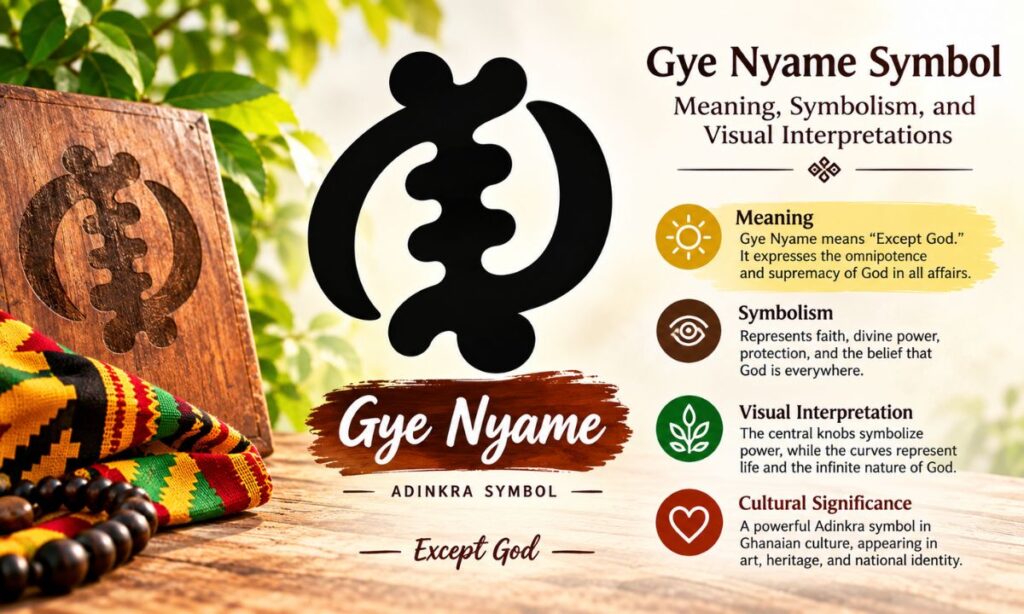
The Gye Nyame symbol means “Except God,” and it stands for the belief that nothing in existence is greater, older, or more powerful than the Supreme Being. That single phrase carries centuries of Akan philosophy inside it, and once you understand it, you start noticing this symbol everywhere: on currency, on university crests, on jewelry, and on the walls of homes far outside West Africa.
If you have ever seen an intricate, almost heart-shaped design with curling lines radiating outward and wondered what it meant, there’s a good chance you were looking at Gye Nyame. It is widely considered the most recognized of all the Adinkra symbols, a visual language created by the Akan people of Ghana and parts of Côte d’Ivoire. This guide walks through how to say it, what it truly means, where it shows up in modern life, where it came from, and the older proverbs that shaped its meaning long before it became a design people wear on t-shirts.
Here’s a fact worth remembering: Gye Nyame appears on Ghana’s highest denomination banknote, the 200-cedi note, which tells you exactly how central this symbol is to national identity, not just religious life. Another fact worth holding onto: in the Akan worldview, God is described as omnipotent, omnipresent, and omniscient all at once, three qualities that Gye Nyame is built to represent in a single image.
How to pronounce Gye Nyame
Gye Nyame is pronounced roughly as “Jyeh Nyah-may,” with the first syllable sounding closer to a soft “j” than a hard “g.”
The word comes from Twi, the most widely spoken language among the Akan people, and Twi uses sounds that don’t map cleanly onto English spelling. “Gye” is not pronounced like the English word “guy.” Instead, it starts with a palatalized sound, something between “j” and “gy,” followed by a short “eh.” “Nyame” breaks down into three light syllables: “Nyah,” “may,” said quickly and smoothly rather than stretched out.
Most English speakers stumble on this name because they try to pronounce every letter the way it looks in English. A more reliable approach is to say it out loud slowly, break it into “Gye” and “Nyame” separately, then blend them. Listening to native Twi speakers, whether through Ghanaian media, language apps, or cultural centers, is the fastest way to get it right. If you’re ordering a piece of Gye Nyame jewelry or discussing the symbol with someone from Ghana, getting close to the correct pronunciation shows genuine respect for the culture behind it.
Gye Nyame symbol Gye Nyame symbol Gye Nyame symbol Gye Nyame symbol Gye Nyame symbol Gye Nyame symbol Gye Nyame symbol Gye Nyame symbol Gye Nyame symbol Gye Nyame symbol Gye Nyame symbol
The meaning and philosophical significance of Gye Nyame
Gye Nyame is an Akan expression that translates directly to “Except God,” and its full meaning is that nothing exists, nothing happens, and nothing has power except through God.
This isn’t a casual saying. It expresses a foundational belief within Akan religious beliefs: that the Supreme Being, known by several names including Nyame, Onyame, Onyankopɔn, and Twereduampɔn (meaning “the reliable one, the one you can lean on like a tree”), sits above every force in the universe. In the Akan scheme of things, God’s power isn’t limited to one domain. He is described as omnipotent, meaning all powerful, omnipresent, meaning present everywhere at once, and omniscient, meaning aware of everything. Gye Nyame packs all three of those ideas into one compact visual and verbal statement.
The phrase also works its way into everyday speech, not just formal religious contexts. A person facing an impossible situation might say something translating to “Nobody can kill me except God,” using the expression to declare both their resilience and their trust that only a force greater than any human threat can determine their fate. That dual use, spiritual devotion on one hand and everyday resilience on the other, is part of why the symbol resonates so widely. It isn’t locked away in temples or ceremonies. It lives in ordinary conversation.
Gye Nyame is often described as the most important of all Adinkra symbols, and that status comes directly from this philosophical weight. Where other Adinkra designs represent values like wisdom, unity, or leadership, Gye Nyame represents the source that Akan philosophy believes all those values ultimately flow from.
Gye Nyame in logos and on bank notes
You can find the Gye Nyame symbol on Ghana’s currency, on the crests of universities, and increasingly on branding created by the African diaspora around the world.
The most visible official use is on the 200-cedi note, Ghana’s highest denomination banknote, where the symbol appears in the corner as a mark of national and spiritual significance. For comparison, the 100-cedi note carries a different Adinkra symbol, Dwennimmen, which represents humility and strength through the image of ram’s horns. Placing Gye Nyame on the country’s top-value currency is a deliberate statement: even a nation’s wealth is understood, within this worldview, as something that exists only because a higher power allows it.
Ghanaian universities have also embraced Adinkra symbols in their official identity. Several institutions incorporate Gye Nyame or related Adinkra motifs into their coats of arms, a practice that signals academic pursuit as something ultimately guided by divine wisdom rather than human achievement alone. This pattern extends beyond universities into government seals, church emblems, and civic organizations across Ghana.
| Where You’ll See Gye Nyame | What It Signifies There |
|---|---|
| Ghana’s 200-cedi banknote | National identity rooted in faith in God’s supremacy |
| University coats of arms | Knowledge and achievement as gifts under divine guidance |
| Church and civic emblems | Institutional trust in a higher moral authority |
| Jewelry and clothing (Ghana and diaspora) | Personal faith, protection, and cultural pride |
| Tattoos and modern art | Individual spiritual identity and heritage connection |
Outside Ghana, the symbol has traveled with the African diaspora into fashion, jewelry, and even body art. American designers and Ghanaian-owned brands alike use Gye Nyame on rings, pendants, and clothing as a way of carrying a piece of Akan philosophy into daily life, far from where the symbol originated. This global spread is one of the clearest signs of how a single Adinkra design can outlive its original setting and take on new meaning for new generations, without losing its core message.
The origin and inspiration of the Gye Nyame symbol
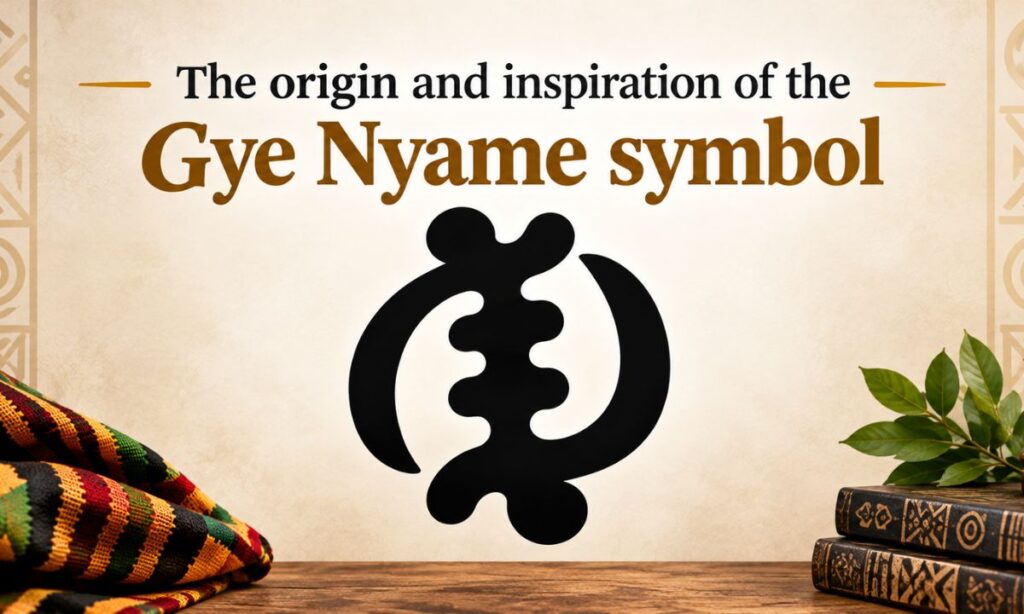
Gye Nyame traces back to the Adinkra tradition of the Akan people, a visual system believed to have started with the Gyaman people before being adopted and expanded by the Ashanti.
According to Ashanti oral history, Adinkra symbols gained prominence after a conflict between the Ashanti and the Gyaman king, Nana Kofi Adinkra, who was said to have angered the Ashanti by attempting to copy their sacred Golden Stool. Following his defeat, the Ashanti absorbed and developed the symbol system that now bears his name, originally stamping the designs onto funeral cloth to express grief, respect, and spiritual belief. Over time, Adinkra symbols moved beyond funerals into everyday decoration, pottery, architecture, and personal adornment, with Gye Nyame rising to become the most widely used of them all.
The visual origin of the Gye Nyame design itself is less settled, and that’s part of what makes it fascinating. Some interpretations describe it as a stylized human eye, watching over creation. Others see two curved hands, cupped or clasped, representing protection or the shape of a fist holding power. Still others describe the pattern as resembling a spiral galaxy, an interpretation that feels almost accidentally scientific for a symbol created long before modern astronomy reached West Africa. None of these readings cancels out the others. Akan visual philosophy tends to embrace layered meaning rather than a single fixed answer, and Gye Nyame is a strong example of that flexibility.
One detail competing articles rarely mention is the orientation debate around the symbol. Many Adinkra designs have a fixed “correct” way to be drawn or stamped, but Gye Nyame is often rendered with slight variations in curve direction and symmetry depending on the region, the carver, or the medium it’s stamped onto. This isn’t considered an error. It reflects how the symbol has been passed down through generations of hand carving rather than standardized printing, giving each version a slightly personal signature while keeping the core meaning intact.
Gye Nyame symbol Gye Nyame symbol Gye Nyame symbol Gye Nyame symbol Gye Nyame symbol Gye Nyame symbol Gye Nyame symbol Gye Nyame symbol Gye Nyame symbol Gye Nyame symbol Gye Nyame symbol
🛍️ Grab Gye Nyame-themed products from The Adinkra Store
If the meaning behind Gye Nyame speaks to you, wearing or displaying it is a common way to carry that philosophy into daily life.
Gye Nyame Ceramic Mug
Start your morning with a visual reminder of divine supremacy. This mug features the Gye Nyame design printed clearly on both sides, making it easy to enjoy your coffee while keeping a piece of Akan heritage close at hand.
Gye Nyame T-Shirt
A simple, everyday way to wear your faith and cultural pride. The design is centered and sized to be noticeable without being overwhelming, suitable for casual outings or cultural events.
Gye Nyame Premium Sweatshirt
For cooler weather, this sweatshirt offers the same symbolic design with a heavier, more durable fabric, ideal for layering during fall and winter months while still making a statement.
Gye Nyame Cap
A subtle way to carry the symbol with you. The cap features an embroidered Gye Nyame design, perfect for those who want a smaller, everyday expression of the meaning behind it.
Gye Nyame Heavyweight Tee
Built with thicker fabric for durability, this tee is designed for people who want a long-lasting piece that holds up to frequent wear while still showcasing the Gye Nyame design prominently.
Sankofa Heritage Ceramic Mug
Pairing well with the Gye Nyame mug, this design features Sankofa, another major Adinkra symbol meaning “go back and get it,” a reminder to learn from the past while moving forward.
Akan proverbs about God
Gye Nyame doesn’t stand alone. It sits inside a much larger body of Akan proverbs about God that shaped how the Akan people talk about faith, fate, and human limitation.
1. Obi nkyere akwadaa Nyame
Literally, “No one shows a child God.” The idea is that awareness of the Supreme Being is so natural and universal that it doesn’t need to be taught, even a young child instinctively senses God’s existence.
2. Nyame nwu na mawu
This translates to “God does not die, so I will not die.” It reflects the belief that because the Supreme Being is eternal, something of the human spirit continues beyond physical death as well.
3. Baakofo nsa nso Nyame ani kata
Meaning roughly “One person’s hands cannot cover God’s face,” this proverb speaks to the impossibility of hiding anything from an all seeing God, reinforcing the idea of omniscience at the heart of Gye Nyame.
4. Aboa a onni dua no, Nana Nyame na opra ne ho
This proverb says “For the animal without a tail, it is God who swats the flies,” meaning that God provides protection and care for the defenseless and those who lack the means to help themselves.
5. Worepe asem aka akyere Onyame a, ka kyere mframa
Translating to “If you want to tell something to God, tell it to the wind,” this proverb reflects the belief that God is everywhere, carried on something as invisible and constant as moving air, making prayer possible from anywhere at any time.
Gye Nyame vs. other popular Adinkra symbols
Gye Nyame is powerful partly because of how it compares to other well known Adinkra symbols within the same visual language.
| Symbol | Literal Meaning | Core Theme |
|---|---|---|
| Gye Nyame | Except God | Supremacy and omnipotence of God |
| Sankofa | Go back and get it | Learning from the past |
| Dwennimmen | Ram’s horns | Humility paired with strength |
While Sankofa focuses on memory and Dwennimmen focuses on balanced strength, Gye Nyame sits above them conceptually, since Akan philosophy holds that every other value, including humility, strength, and wisdom, ultimately flows from God’s authority.
Frequently Asked Questions About the Gye Nyame Symbol
What does the Gye Nyame symbol mean? It means “Except God,” expressing the belief that God is the ultimate and only unlimited power in existence.
How do you pronounce Gye Nyame? Roughly “Jyeh Nyah-may,” with a soft palatal sound at the start of “Gye” rather than a hard English “g.”
Is Gye Nyame a religious symbol? Yes, at its core it is a religious and philosophical symbol, though it is also used broadly as a cultural and national symbol in Ghana.
Where can you see the Gye Nyame symbol in Ghana today? On the 200-cedi banknote, university coats of arms, church emblems, and throughout Ghanaian clothing, art, and jewelry.
Can anyone wear the Gye Nyame symbol? Generally yes. It is widely worn by people inside and outside Akan culture as a symbol of faith and respect for Ghanaian heritage, though understanding its meaning adds depth to wearing it.
Is there a “correct” orientation for the Gye Nyame symbol? Not strictly. Unlike some Adinkra designs, Gye Nyame appears with natural variation depending on the carver or region, without losing its intended meaning.
Final Thoughts on the Gye Nyame Symbol
Gye Nyame is far more than a decorative pattern. It’s a compact statement of faith, carrying centuries of Akan philosophy about God’s power, presence, and knowledge into a single, recognizable design. From currency to clothing to conversation, it continues to shape how the Akan people, and increasingly people far beyond Ghana, express trust in something greater than themselves. Whether you’re drawn to its visual complexity, its spiritual depth, or simply want to carry a piece of that meaning with you, understanding the story behind Gye Nyame turns a beautiful symbol into something far more personal.
