


Sun symbols are special text characters and emojis, like ☀️, ☼, ☉, 🌞, and 🌅, that you can copy and paste instantly into any app without needing a keyboard shortcut or design software. If you have ever wanted to brighten up an Instagram bio, add warmth to a text message, or find the right astrology glyph for your star sign, you already know how surprisingly hard it can be to track down the exact symbol you’re picturing in your head. That’s exactly what this guide solves.
Here’s something most people don’t realize: the sun has been one of humanity’s most reused symbols for over 5,000 years, showing up in Egyptian hieroglyphs, Aztec calendars, and Norse runestones long before it ever appeared on a smartphone keyboard. When you drop a ☀️ emoji into a text or paste a ☉ symbol into your astrology notes app, you’re tapping into a visual language that predates writing itself in some cultures.
This guide rounds up more than 100 sun symbols and emojis, explains what each one actually means, and shows you exactly how to copy and paste them on any device. Whether you’re after a black sun symbol for a minimalist logo, a cute sun emoji for your captions, or the correct zodiac sun symbol for Leo season, you’ll find it here, ready to use in seconds.
Quotable fact: The astrological sun symbol (☉), a circle with a dot in the center, has remained visually unchanged in Western astrology texts since at least the 2nd century CE, making it one of the longest-surviving glyphs still in everyday digital use.
Quotable fact: Unicode, the international standard that lets sun symbols display the same way on an iPhone, a Windows PC, and an Android tablet, currently includes more than a dozen distinct sun-related characters across its emoji and symbol blocks.
Types of Sun Symbols
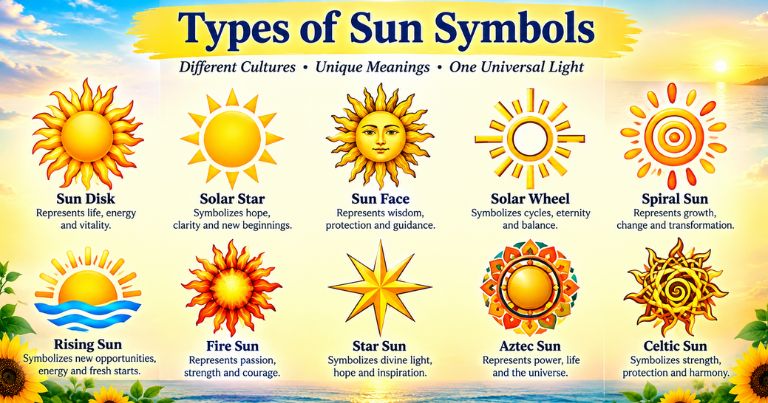
There isn’t just one “sun symbol.” There’s actually a whole family of them, split across emoji, plain text characters, astrology glyphs, and aesthetic text art, and each type serves a different purpose depending on where and how you’re using it.
Emoji versions like 🌞 and 🌅 are full color pictures built for casual chats and social captions, while text symbols like ☀ and ☼ are simple black-and-white characters that work in usernames, bios, and places where colorful emoji can look out of place or won’t render at all. Astrology icons carry specific meaning tied to zodiac charts, and aesthetic sun designs are creative combinations people build for a particular visual vibe. Knowing the difference means you’ll never accidentally paste a cartoon sun into a serious astrology chart, or a plain text glyph into a spot that really called for something more colorful and eye-catching.
Below, we’ll break down each category with ready-to-copy symbols, plus the meaning behind the ones that carry real symbolic weight.
1. Sun Emojis 🌞☀️🌅
Sun emojis are the full-color, expressive versions you’ll recognize instantly from texting and social apps. They’re the most commonly used type because they add personality and warmth without you having to type a single word.
Here’s a practical list of the most useful sun emoji symbols to copy and paste right now:
☀️ ☀ 🌞 🌅 🌄 🌇 🌆 🔆 🌤️ ⛅ 🌥️ 🌦️ 🌈 🔅 🌻 🌱 🕶️ 🏖️ 🏜️ 🌵
Each of these carries a slightly different feeling. The 🌞 emoji, officially called “sun with face,” reads as cheerful and personified, almost like the sun is smiling directly at whoever’s reading your message. The plain ☀️ emoji is more neutral and factual, closer to what you’d see on a weather app. Meanwhile, 🌅 and 🌄 represent sunrise specifically, which is why they’re so popular for “new beginnings” captions, morning motivation posts, and travel photos taken at dawn.
Sun symbol text copy and paste searches usually lead people here first, because emoji are the fastest way to add visual punch to a caption. If you want something with more texture, try combining two or three: “🌅🌻 new day, new energy” reads completely differently from a plain text sentence, and that’s the entire point of using emoji in the first place.
A quick note on sun text symbols meaning: emoji meanings shift slightly by platform and context. On Apple devices, 🌞 tends to appear brighter and rounder, while on Android it can look flatter with a more muted palette. The underlying Unicode code point is identical, but the visual rendering, and sometimes the emotional read, differs. This matters if you’re designing content for a specific audience, since a symbol that looks warm and inviting on one phone might look washed out on another.
For sun text art, people often use combinations like (☀‿☀) or °˖✧◝(⁰▿⁰)◜✧˖° to build a little sun face out of punctuation and symbols. This kind of text art is popular on forums, in usernames, and in Discord bios where a static emoji feels too plain.
2. Sun Text Symbols
Text symbols are the plain, non-colored characters you’ll find buried in Unicode’s symbol blocks. They’re less flashy than emoji, but they’re incredibly versatile because they render consistently as black or outline characters across almost every font and platform.
Here are the core sun text symbols worth bookmarking:
☀ ☼ ☉ ⊙ ⨀ ✺ ❂ ⋆ ★ ☆ ⁕ ⁘ ⋆⁺₊⋆ ⋆.˚ ✩ ⟡
The ☀ symbol (U+2600, officially “black sun with rays”) is one of the oldest sun glyphs in the Unicode Miscellaneous Symbols block, first standardized in 1993. It’s a solid, weather-report style icon, which is why meteorologists and forecast apps have used it for decades before emoji even existed.
The ☼ symbol (U+263C, “white sun with rays”) looks similar but uses an outline instead of a solid fill, giving it a lighter, more delicate appearance. This is the go-to choice for anyone specifically searching for a white sun symbol to use against a dark background, since the outline style keeps the design clean without overwhelming the layout.
Then there’s the ☉ symbol (U+2609), the astronomical and astrological sign for the sun, a small circle with a dot in the middle. This one carries actual scientific weight. It’s the standard symbol astronomers use in star charts and scientific papers to denote the sun specifically, distinguishing it from other stars. If you’re building a simple sun symbol for a minimalist design, ☉ is often the cleanest option because of how compact and geometric it is.
A black sun symbol typically refers to any solid-filled version like ☀ or ⨀, while decorative variants like ✺, ❂, and ⋆ are popular for adding a bit of sparkle or flourish to bios and captions without going full emoji.
3. Sun Icons for Astrology
If you’re into astrology, the sun symbol you want is almost always ☉, but the way it’s used varies quite a bit depending on the context, and getting this right actually matters if you’re serious about chart accuracy.
In a natal chart, the astrology sun symbol represents your core identity, ego, and the general “life force” energy that astrologers say shapes your personality. It’s considered one of the “Big Three” placements in Western astrology, alongside your moon sign and rising sign, and it’s the one most people already know because it corresponds to their everyday zodiac sign (Aries, Taurus, Gemini, and so on).
The zodiac sun symbol itself doesn’t change based on which sign you were born under; ☉ always represents the sun regardless of placement. What changes is the zodiac symbol it’s paired with. For example, someone with their sun in Leo would see ☉ combined with ♌ (the Leo glyph, representing a lion’s mane) on their chart. This is a common point of confusion, since people often search for a “Leo sun symbol” expecting something unique, when really it’s just the standard ☉ symbol placed next to the Leo glyph.
Astrologers and astronomers have shared this same symbol for centuries, which is a good example of how scientific and symbolic traditions sometimes overlap rather than diverge. According to entries referenced across astronomical societies and historical symbol archives, the circle-with-a-dot design likely represents the sun as a life-giving center point, a visual metaphor that shows up again and again across unrelated ancient cultures, from Egyptian sun-disc imagery to early alchemical texts. That kind of independent convergence is part of why ☉ still feels intuitively “right” as a sun symbol even to people with no astrology background at all.
4. Sun Aesthetic Designs

Aesthetic sun symbols are less about literal meaning and more about vibe. These are the decorative combinations people use to build a specific mood, usually for Pinterest boards, Instagram bios, journal spreads, or website headers.
Popular decorative sun symbols and combos include:
° ☀︎ ° · ✧ ☀ ✧ · ° ˖°𓂃☀️𓂂˖° ⋆౨ৎ˚₊‧꒰ა ☀ ໒꒱‧₊˚ ✧˖° ☀ °˖✧ 𓆩☀𓆪 ☀︎˖°
These combinations lean heavily on spacing, small stars, and decorative brackets like 𓂃 and 𓆩𓆪 (borrowed from Egyptian hieroglyph-style Unicode blocks) to create a soft, dreamy, “cottagecore” or “y2k aesthetic” feel that a plain emoji simply can’t achieve on its own.
Cute sun symbols tend to pair the sun with flowers, hearts, or sparkles: 🌻☀️✨, 🌞💛, ☀︎ ˖°. Unique sun symbols for bios often mix scripts and fonts too, using stylized Unicode letters alongside a sun glyph to build a signature look, something like “☀ 𝓼𝓾𝓷𝓴𝓲𝓼𝓼𝓮𝓭 ☀” for a soft, artistic username.
The appeal here is entirely visual. A well-placed aesthetic sun combo can turn a plain bio into something that feels curated and intentional, which is exactly why this category has exploded across TikTok and Instagram over the past few years.
How to Copy and Paste Sun Symbols
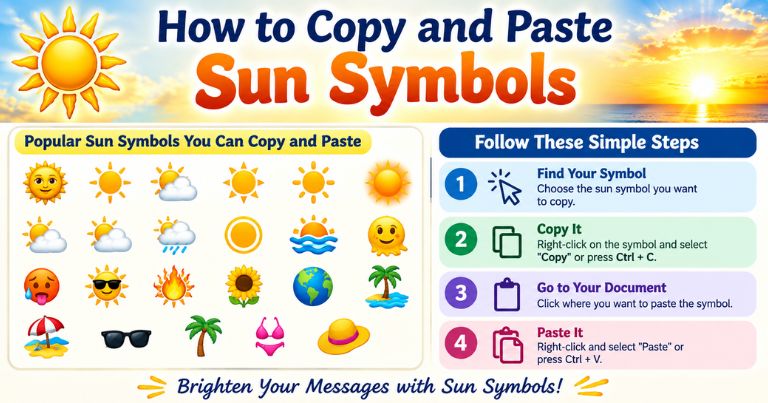
Copying a sun symbol takes about two seconds once you know where to click, and the process barely changes whether you’re on a laptop or a phone.
The simplest method on any device is to highlight the symbol you want from a list like the ones above, copy it using your device’s standard copy command, and paste it directly where you need it. No downloads, no special apps, no font installations required.
On PC:
On Windows, highlight the symbol with your mouse, right click, and select “Copy,” or use the keyboard shortcut Ctrl+C. Then click into your target field and press Ctrl+V to paste. Windows also has a built-in Character Map tool and an emoji panel you can open with Windows key + period (.), which lets you search “sun” directly and insert emoji without ever leaving your keyboard.
On a Mac, the process is nearly identical: highlight the symbol, press Cmd+C to copy, then Cmd+V to paste. Mac users also have access to the built-in emoji picker by pressing Cmd+Ctrl+Space, which opens a searchable panel where typing “sun” instantly surfaces every sun-related emoji Apple supports.
On Mobile:
On both iPhone and Android, press and hold on the symbol text until a selection menu pops up, then tap “Copy.” Switch to your messaging app, keyboard app, or bio field, tap and hold where you want to paste, and select “Paste” from the menu that appears.
For emoji specifically, you don’t even need to copy and paste at all. iPhone’s keyboard includes a dedicated emoji key (the small globe or smiley icon next to the spacebar), and Android keyboards like Gboard have the same feature. Just tap it, search “sun,” and tap the emoji you want to insert it directly.
Pro Tip:
Save your favorite sun symbols for Instagram or WhatsApp in your phone’s Notes app or a dedicated text expander tool, so you’re not searching for the same combo every single time you post. Many people keep a running list of their five or six go-to symbols right at the top of their Notes app for one-tap access.
Creative Uses of Sun Symbols
Sun symbols aren’t just decoration. They actually change how a message, profile, or design feels to the person looking at it, and choosing the right one for the right context makes a real difference.
Different platforms and purposes call for different styles of sun symbol, and matching the symbol to its context is what separates a polished-looking profile from one that feels randomly thrown together.
1. For Astrology Lovers
Astrology fans use ☉ constantly, whether it’s labeling a natal chart, writing “☉ in Leo” in a bio, or tagging astrology-themed social posts. Pairing ☉ with the correct zodiac glyph shows real fluency in astrological shorthand, which matters a lot to a community that pays close attention to accuracy.
2. For Instagram Aesthetics
Instagram bios thrive on short, punchy visual cues, and a well-placed aesthetic sun emoji or text symbol can instantly communicate a “sunny,” upbeat, or beach-vacation personality without using a single word. Many creators build entire visual themes around a repeated sun motif across their captions and highlight covers.
3. For Design Projects
Designers reach for the plain Unicode sun glyphs, like ☼ or ☉, when they need a lightweight icon that doesn’t require importing an image file. Since these are just text characters, they scale perfectly at any size, load instantly, and can be recolored with simple CSS, making them genuinely useful in real production work, not just casual posts.
4. For Messaging
In everyday texts, sun emojis do a lot of emotional heavy lifting. A quick “☀️ beautiful day!” text communicates mood and tone far faster than typing it out, which is exactly why sun emoji for positive messages is such a common search.
Category
| Use Case | Best Symbol Type | Example |
|---|---|---|
| Astrology charts | Astrological glyph | ☉ |
| Instagram bio | Aesthetic combo | ⋆౨ৎ˚₊ ☀ |
| Weather-related captions | Emoji | ☀️🌤️ |
| Logo or icon design | Plain Unicode text | ☼ ☉ |
| Texting friends | Emoji | 🌞🌅 |
Best Platforms to Use Sun Symbols
Where you’re pasting a sun symbol changes which type actually works best, since not every platform renders every character the same way.
1. Social Media
Instagram, TikTok, and Twitter/X all fully support colorful emoji and most Unicode text symbols in bios, captions, and comments. Sun symbols for social media work especially well in bios because they break up plain text and draw the eye without needing an actual graphic.
2. Messaging Apps
WhatsApp, iMessage, and Telegram all render emoji beautifully and consistently. Sun symbols for WhatsApp are extremely popular for status updates and quick check-in texts, since a single sun emoji can replace an entire sentence about the weather or your mood.
3. Design Tools
Tools like Canva, Figma, and even basic word processors will accept pasted Unicode symbols directly into text layers, though for logo work most designers eventually trace or rebuild the symbol as a vector shape to guarantee it looks identical across every export format and device.
FAQs About Sun Symbols
1. What does the sun emoji mean?
The sun emoji generally represents warmth, positivity, energy, and good weather. Depending on context, it can also symbolize optimism, a fresh start, or simply literal sunny weather in a forecast-style message.
2. Can I use sun symbols commercially?
Yes. Standard Unicode characters and emoji are not copyrighted and are free to use in commercial projects, including logos, apps, and marketing materials, since they’re part of the open Unicode standard rather than proprietary artwork.
3. Where can I find unique sun symbols?
Beyond the standard emoji keyboard, Unicode blocks like Miscellaneous Symbols, Dingbats, and Egyptian Hieroglyphs contain lesser-known decorative characters that pair beautifully with a sun glyph to create a more unique sun symbol combination for bios and aesthetic designs.
4. How do I use sun symbols in astrology?
Pair the ☉ glyph with your specific zodiac sign symbol to indicate your sun sign placement, for example “☉ ♌” for a sun in Leo. This is the standard shorthand used across astrology apps, birth chart generators, and astrology-focused social communities.
Conclusion
Sun symbols carry far more range than people usually expect, from the scientific precision of the astrological ☉ glyph to the playful warmth of a simple 🌞 in a text message. Whether you’re decorating an Instagram bio, labeling a birth chart, or building a clean icon for a design project, there’s a specific symbol built for that exact purpose, and now you know exactly where to find it and how to use it correctly.
The next time you need to brighten up a caption, finish a natal chart, or just add a little visual warmth to a message, you’ve got over 100 ready-to-copy options sitting right above, no downloads or design skills required.
