
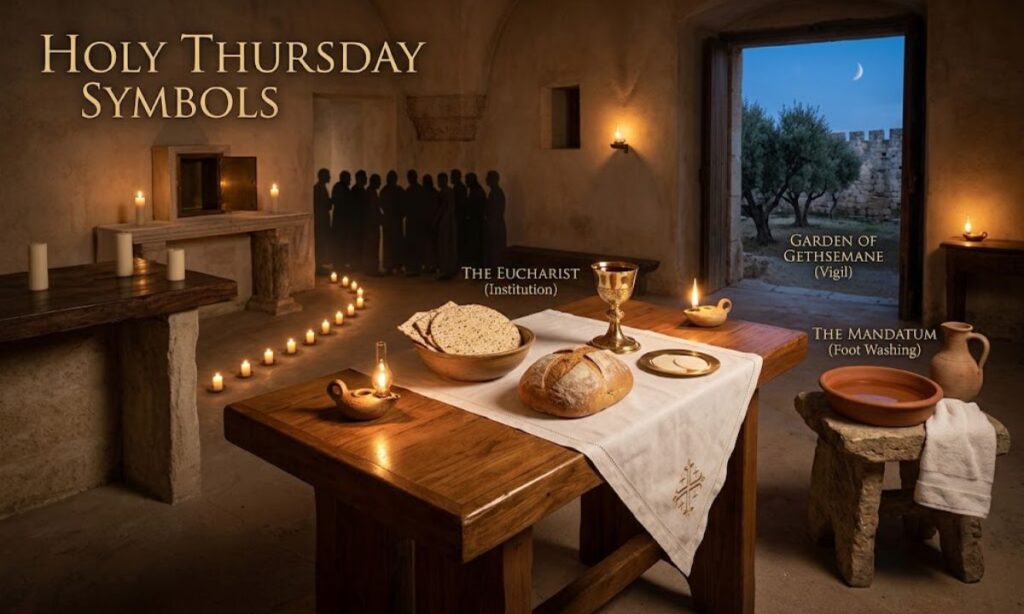
Holy Thursday symbols are the sacred objects, gestures, and images, like bread, wine, a basin, a towel, and a stripped altar, that represent Jesus Christ’s final night with his disciples before his crucifixion. Each one carries a specific spiritual message about love, sacrifice, humility, and faith. If you have ever wondered why churches suddenly go quiet and bare after Holy Thursday Mass, or why priests kneel down to wash the feet of ordinary people, this guide will walk you through every symbol and exactly what it means.
Holy Thursday, also called Maundy Thursday, kicks off the Easter Triduum, the three most sacred days on the Christian calendar. It commemorates the Last Supper, the institution of the Eucharist, and the moment Jesus knelt down and washed his disciples’ feet. For millions of Catholics, Anglicans, Lutherans, Orthodox Christians, and other denominations across the United States, this day is not just a ritual. It is a lived experience of humility, gratitude, and remembrance.
In this article, you will find a complete breakdown of over 110 Holy Thursday symbols and their meanings, explained in plain English. We will cover the religious history, the Catholic traditions, the artistic representations, and even how these symbols show up in dreams and pop culture. Let’s get started.
What Are Holy Thursday Symbols?
Holy Thursday symbols are physical objects and ritual actions used during Christian worship to represent the events of the Last Supper and the beginning of Christ’s passion. They include bread, wine, a basin and towel, a chalice, candles, and the number twelve, each pointing back to something Jesus said or did on that final night.
These symbols didn’t appear out of nowhere. They come directly from the Gospel accounts of Matthew, Mark, Luke, and John, where Jesus shares a meal with his twelve apostles, breaks bread, blesses wine, and then shocks everyone by washing their feet like a servant. Early Christian communities began recreating these actions in worship almost immediately, and by the fourth century, Holy Thursday liturgies were already well established in Jerusalem and Rome.
What makes these symbols so powerful today is that they are not abstract. You can see them, touch them, and take part in them. A person doesn’t need a theology degree to understand what it means when a priest kneels and washes a stranger’s feet. The symbol speaks for itself. That is exactly why Holy Thursday remains one of the most emotionally moving days in the entire Christian calendar, even for people who don’t attend church regularly the rest of the year.
Holy Thursday Meaning And Symbolism
Holy Thursday marks the night Jesus instituted the Eucharist and demonstrated servant leadership through foot washing, and its symbolism centers on sacrifice, humility, and covenant. It is the hinge point between Jesus’ public ministry and his passion.
Holy Thursday Meaning
The Holy Thursday meaning comes directly from three events packed into one evening: the Last Supper, the washing of feet, and Jesus’ agony in the Garden of Gethsemane. Together, these moments tell a story of a leader who chose to serve rather than be served, right before facing betrayal and death.
Historically, the name “Maundy” comes from the Latin word mandatum, meaning “commandment.” This refers to Jesus telling his disciples, “A new commandment I give you: love one another.” That single sentence is arguably the theological core of the entire day. Everything else, the bread, the wine, the basin, flows outward from that command to love.
For American churchgoers, Holy Thursday often feels like the quiet before the storm. Palm Sunday is celebratory, Good Friday is somber, and Easter Sunday is joyful. Holy Thursday sits in between, intimate and reflective, more like a private family dinner than a public celebration. That emotional tone is part of its meaning too.
Thursday Symbolism
Thursday symbolism in the Christian tradition isn’t limited to Holy Week. In general Christian thought, Thursday has long been associated with providence, gratitude, and abundance, partly because it falls in the middle of the work week and partly because of its ties to the Eucharistic meal itself.
Within Holy Week specifically, Thursday represents transition. It is the last “normal” day before the arrest, trial, and crucifixion begin. Many theologians describe it as the moment where time seems to slow down, because the Gospels record incredibly detailed accounts of everything Jesus said and did that night, more than almost any other single day in his life.
There is also a numerical layer to Thursday symbolism. It is the fifth day counting from Sunday, and in Hebrew numerology, five often represents grace. Whether or not that connection was intentional in early Christian thought, it has become part of how theologians frame the day’s deeper significance.
Happy Holy Thursday
You might notice that some people say “Happy Holy Thursday,” and others find that phrasing a bit off given the somber events being remembered. Both reactions are understandable, and the answer depends on which part of the day you’re focusing on.
The Last Supper itself was actually a joyful meal. It was a Passover Seder, a celebration of freedom and God’s faithfulness, shared among close friends. In that sense, greeting someone with warmth on Holy Thursday isn’t inappropriate at all. It reflects gratitude for the Eucharist and for Christ’s example of love.
That said, many Christian communities prefer more reflective greetings like “Blessed Holy Thursday” or simply a quiet acknowledgment of the day’s weight. If you’re sending a message to a Catholic or Christian friend, either phrase works, but reading the room matters. A parish still in mourning mode by evening Mass might appreciate a gentler tone.
Holy Week Symbols And Meanings
Holy Week symbols trace the entire arc of Christ’s final week, from the palm branches of his triumphant entry to the empty tomb of Easter morning. Each day has its own distinct set of images and meanings.
Holy Week Symbols And Meanings
Holy Week begins with Palm Sunday, symbolized by palm branches representing victory and praise. It moves through Holy Monday, Tuesday, and Wednesday, which mark quieter events like the anointing at Bethany and Judas’ betrayal negotiations. Then comes Holy Thursday, Good Friday, Holy Saturday, and finally Easter Sunday.
Each symbol builds on the last. The palm branches of Sunday give way to the bread and wine of Thursday, then the cross and nails of Friday, the silence and stone of Saturday, and finally the empty tomb and lily of Sunday. Together, these images form a complete visual narrative of death and resurrection that Christians have used for education and worship for nearly two thousand years.
In the United States, many churches use this progression intentionally in their decor. Sanctuaries often shift from festive palm displays early in the week to bare, stripped altars by Thursday night, and finally to lilies and bright white cloth by Easter morning. Watching that transformation happen over just a few days is, for many parishioners, one of the most powerful visual sermons of the year.
Good Friday Symbol
The Good Friday symbol most people recognize instantly is the cross, but the day is rich with additional imagery, including the crown of thorns, the nails, and the color black or red used in vestments. Each one points to suffering, sacrifice, and atonement.
The cross specifically represents the instrument of execution transformed into a symbol of victory over death. This paradox, an object of torture becoming a sign of hope, is central to Christian theology and explains why the cross remains the single most recognized religious symbol in the world today.
Good Friday connects directly back to Holy Thursday. The bread and wine blessed on Thursday point forward to the body broken and blood shed on Friday. Without understanding the Last Supper symbols first, the crucifixion symbols on Good Friday lose much of their layered meaning.
Holy Thursday Symbols Catholic
In Catholic tradition, Holy Thursday symbols include the Chrism Mass oils, the washing of feet, the transfer of the Blessed Sacrament, and the stripping of the altar, all tied to the priesthood and the Eucharist.
Holy Thursday Symbols Catholic
The Catholic Church treats Holy Thursday as one of the most liturgically dense days of the year. In the morning, many dioceses celebrate the Chrism Mass, where bishops bless three holy oils: the Oil of the Sick, the Oil of Catechumens, and Sacred Chrism. Priests also renew their ordination vows during this Mass, linking Holy Thursday directly to the institution of the priesthood.
In the evening, the Mass of the Lord’s Supper includes the washing of feet ritual, known as the mandatum. This is followed by a procession where the consecrated host is carried to a specially decorated altar of repose, where the faithful are invited to pray in adoration, echoing the disciples being asked to “watch and pray” with Jesus in Gethsemane.
The Mass ends without a formal dismissal or blessing, which is unusual and deliberate. The liturgy simply continues into Good Friday, symbolizing that these events are one continuous act rather than separate, finished celebrations. This is a detail many casual observers miss, but it is theologically significant.
Catholic Holy Thursday Symbols
Beyond the Mass itself, Catholic Holy Thursday symbols extend into home and community traditions. Some families prepare a symbolic meal reflecting Passover elements, since the Last Supper itself was a Seder meal. Others visit multiple churches on Holy Thursday night, a tradition sometimes called “visiting the seven churches,” to pray before the altar of repose at each location.
The color white or gold is used for vestments during the evening Mass, a shift from the purple of Lent, signaling joy at the institution of the Eucharist even amid the coming sorrow. Bells are rung during the Gloria and then fall silent until the Easter Vigil, another auditory symbol marking the solemnity of the coming days.
Statistically, Holy Thursday remains one of the most attended weekday Masses of the entire year in American Catholic parishes, second only to Christmas Eve and Ash Wednesday in terms of turnout, according to diocesan attendance patterns reported across the country. That level of engagement shows just how central these symbols remain to modern Catholic identity.
Maundy Thursday Symbols Explained
Maundy Thursday symbols center on the “new commandment” to love one another, expressed through the foot washing ceremony, the shared meal, and the institution of the priesthood and Eucharist.
Maundy Thursday Symbols
The word “Maundy” itself is a symbol of sorts, a linguistic reminder that this entire day exists because of one command: love each other as I have loved you. Every ritual object connected to Maundy Thursday, from the basin to the bread, exists to make that abstract command visible and touchable.
Anglican, Lutheran, and Methodist churches in the United States also observe Maundy Thursday with similar reverence, often including foot washing ceremonies and communion services. This shows that these symbols are not exclusively Catholic; they belong to the broader Christian faith tradition, spanning denominations that otherwise differ significantly on doctrine.
The shared use of these symbols across denominations is actually a point of unity during Holy Week. Even churches that disagree on other theological matters tend to converge on the same core Maundy Thursday practices, which speaks to how foundational these events are to Christian identity as a whole.
Symbols Of Maundy Thursday
The symbols of Maundy Thursday include the basin and towel, unleavened bread, wine or grape juice depending on denomination, the number twelve representing the apostles, and candlelight representing watchfulness during the night vigil.
Unleavened bread specifically ties back to the Jewish Passover, since Jesus and his disciples were observing that festival when the Last Supper took place. The absence of yeast symbolizes purity and haste, recalling the Israelites’ quick departure from Egypt in the Exodus account.
Candlelight plays a quieter but important role too. As churches move into evening prayer vigils after the Thursday Mass, candles represent the disciples staying awake with Jesus in Gethsemane, even though the Gospel accounts note they eventually fell asleep. The candle becomes a gentle challenge to the modern worshiper to stay spiritually alert.
Maundy Thursday Symbol
If you had to pick just one Maundy Thursday symbol to represent the entire day, most theologians would point to the basin and towel used for foot washing. It is the single most countercultural image in the entire Christian story, a divine figure kneeling before ordinary fishermen and tax collectors.
This symbol works because it inverts expectations so completely. In first century Jewish culture, foot washing was a task reserved for the lowest servant in a household, not for a teacher or master. Jesus performing this task himself would have stunned his disciples, and it still carries that same shock value today.
Peter’s initial refusal to let Jesus wash his feet, recorded in John’s Gospel, adds another layer to the symbol. It shows human resistance to grace and humility, something many modern readers relate to instantly, since accepting help or love from someone we admire can feel uncomfortable even now.
Maundy Thursday Holy Thursday Symbols
Some people search for Maundy Thursday Holy Thursday symbols because they are unsure if these are two different observances. They are not. Maundy Thursday and Holy Thursday are simply two names for the exact same day, used more commonly by different denominations.
Generally, Catholic and Orthodox communities lean toward “Holy Thursday,” while many Protestant and Anglican communities prefer “Maundy Thursday,” though there is significant overlap and both terms appear across denominations in the United States. The symbols themselves don’t change based on which name a church uses.
Understanding this naming overlap actually helps clear up a lot of online confusion. If you’re researching this topic and see both terms used interchangeably, that’s accurate, not a mistake. The underlying theology and symbolism remain identical regardless of the label.
Symbols Of Holy Thursday
The symbols of Holy Thursday collectively tell the story of a servant leader preparing his followers for loss, using shared food, humble service, and physical touch to communicate truths that words alone couldn’t fully capture.
Symbols Of Holy Thursday
Beyond the well known bread, wine, and basin, the symbols of Holy Thursday also include the table itself, representing fellowship and community, and the number of guests present, which reinforces the apostolic foundation of the Church. Even the room where the meal took place, traditionally called the Upper Room, has become a symbolic location in Christian pilgrimage and art.
The shared cup used during the meal represents unity, since everyone at the table drank from the same vessel. In a culture increasingly focused on individualism, this image of communal drinking carries fresh relevance for modern Christians looking to rebuild a sense of shared community and belonging.
Darkness and night itself function as a symbol too. The Last Supper and the arrest in Gethsemane both happened after sundown, and Scripture frequently uses darkness to represent both danger and spiritual testing. This is why so many Holy Thursday evening services are held after dark, deliberately recreating that atmosphere.
Symbols For Holy Thursday
When people search for symbols for Holy Thursday to use in church bulletins, school lessons, or home devotionals, the most commonly recommended set includes bread, a cup, a basin and towel, a rooster (representing Peter’s denial), and a garden (representing Gethsemane).
The rooster is a particularly interesting inclusion. It doesn’t appear during the meal itself but during the events immediately following, when Peter denies knowing Jesus three times before the rooster crows. Many religious educators include it in Holy Thursday materials because it bridges the meal to the passion narrative that follows.
These symbols are frequently used in Catholic school classrooms across the United States during Holy Week lesson plans, helping younger students grasp abstract theological concepts through simple, memorable imagery they can draw, color, or act out.
Holy Thursday Symbol
Choosing a single Holy Thursday symbol for a bulletin cover or sermon title is a common challenge for pastors and worship planners. Most opt for either the chalice, representing the Eucharist, or the basin and towel, representing service, since these two capture the twin themes of the entire day.
Some traditions also use a sheaf of wheat alongside grapes, representing bread and wine before they’re transformed into their sacramental form. This agricultural imagery connects the Eucharist back to everyday, tangible life, reminding worshipers that sacred meaning often grows out of ordinary things.
Whichever single symbol is chosen, the goal is the same: to compress the entire theological weight of Holy Thursday into one recognizable image that a passerby or new visitor could understand at a glance.
Symbol For Holy Thursday
A symbol for Holy Thursday doesn’t have to be complex to be effective. Even a simple candle, a loaf of bread, or a pair of sandals removed at the door can communicate the day’s meaning in a home or classroom setting without requiring elaborate church furnishings.
Sandals specifically tie back to the foot washing narrative and are sometimes used in family devotionals as a physical reminder to “take off” pride before serving others. This kind of hands on symbolism has grown in popularity among American Christian families looking to make Holy Week more tangible for children.
Simplicity, in fact, is part of what makes Holy Thursday symbolism so enduring. Unlike some religious imagery that requires extensive theological training to interpret, these symbols were designed from the start to be understood by fishermen, farmers, and ordinary people, and they still work that way today.
Symbol Of Holy Thursday
The most historically rooted symbol of Holy Thursday remains unleavened bread and wine, since these two elements were physically present at the actual Last Supper and were directly transformed by Jesus into the sacrament Christians now call the Eucharist or Holy Communion.
Archaeological and historical scholarship on first century Passover meals confirms that unleavened bread, wine, bitter herbs, and roasted lamb were standard elements of a Seder table, which is why most scholarly reconstructions of the Last Supper include these specific foods rather than a generic modern meal.
This grounding in real historical practice is part of why the symbol carries so much weight. It isn’t an invented metaphor added centuries later; it reflects an actual meal that took place in a real room, at a real table, among real people whose names and stories are recorded in the Gospels.
Last Supper And Eucharist Symbols
Last Supper and Eucharist symbols revolve around the transformation of ordinary bread and wine into what Christians believe becomes the body and blood of Christ, sealing what theologians call the new covenant.
Last Supper Holy Thursday Symbols
The Last Supper Holy Thursday symbols most central to Christian worship are the bread, broken and shared, and the wine, poured and blessed. Jesus’ words, “This is my body” and “This is my blood,” transformed a routine Passover meal into the foundational act of Christian worship still practiced weekly or even daily in churches around the world.
Leonardo da Vinci’s famous painting of this scene, though created over 1,400 years after the actual event and not historically accurate in its depiction of dress or table arrangement, has become one of the most recognized pieces of religious art in Western history, shaping how millions of people visualize this moment even today.
The Last Supper also introduced the concept of a “new covenant,” language directly echoing the old covenant God made with Israel through Moses. This connects Holy Thursday not just to the crucifixion that follows, but backward to the entire arc of Hebrew Scripture, making it a hinge point in the larger biblical narrative.
Supper Holy Thursday Symbols
The physical setting of the supper Holy Thursday symbols matters too. The meal took place in an upper room, a detail Scripture mentions specifically, and this location has become symbolic of intimacy, privacy, and preparation, since it was set apart from the crowds who had welcomed Jesus into Jerusalem just days earlier.
Reclining at the table, the posture described in the Gospels, was itself symbolic in first century culture, typically reserved for formal or festive meals rather than everyday eating. This detail reinforces that the Last Supper was treated as a significant, intentional occasion rather than a casual dinner.
The presence of Judas at the table, knowing he had already agreed to betray Jesus, adds a layer of tension to the supper symbolism that many artists and writers have explored for centuries. It reminds believers that betrayal and grace can exist in the very same room, at the very same table.
Holy Eucharist Holy Thursday Symbols
The Holy Eucharist Holy Thursday symbols form the theological center of Catholic and many Protestant traditions. The chalice, the paten (the plate holding the bread), and the tabernacle where the consecrated host is stored afterward all extend the meaning of that first meal into ongoing weekly worship.
According to Catholic teaching, the Eucharist is not merely symbolic but becomes the actual body and blood of Christ through a process called transubstantiation, a doctrine formally defined at the Fourth Lateran Council in 1215. This belief is a defining difference between Catholic and many Protestant interpretations, which often treat communion as symbolic remembrance rather than literal transformation.
Regardless of denominational differences on this specific doctrine, virtually all Christian traditions agree that the Eucharist, in whatever form they practice it, connects believers back to that original Holy Thursday meal, making it one of the most unifying rituals across the global Christian faith.
Washing Of Feet Symbols
Washing of feet symbols represent humility, servant leadership, and spiritual cleansing, drawn directly from Jesus kneeling before his disciples in the Gospel of John.
Feet Holy Thursday Symbols
Feet Holy Thursday symbols carry weight because feet, in the ancient world, were considered dirty and low, exposed to dust, mud, and animal waste from unpaved roads. Washing someone’s feet was a job for the lowest ranking servant in a household, never for a guest of honor, let alone a religious teacher.
This is exactly why the act shocked the disciples so deeply. By choosing to wash feet himself, Jesus flipped the entire social hierarchy of his time on its head, demonstrating through action rather than speech what real leadership and love actually look like.
Modern churches replicate this ritual during Holy Thursday services, often inviting twelve parishioners to have their feet washed by the priest or pastor, recreating the scene as closely as possible to help the congregation feel, not just hear, the weight of that original moment.
Washing Holy Thursday Symbols
The washing Holy Thursday symbols extend beyond feet to the broader theme of cleansing. Water itself is one of the oldest and most universal symbols in religious tradition, representing purification, renewal, and the washing away of sin or impurity across many faiths, not just Christianity.
In the Gospel of John, Jesus tells Peter that if he doesn’t allow his feet to be washed, he “has no part” with him, linking the physical act directly to spiritual relationship and belonging. This exchange elevates a simple household chore into a statement about grace, acceptance, and connection to Christ.
Water symbolism on Holy Thursday also echoes forward to baptism, another water based sacrament, creating a thread that connects the beginning of a Christian’s faith journey to this pivotal moment near the end of Jesus’ earthly ministry.
Washing Feet Holy Thursday Symbols
Washing feet Holy Thursday symbols have inspired real world social action too. Pope Francis, for example, drew international attention when he chose to wash the feet of prisoners, refugees, and people with disabilities during Holy Thursday services, rather than limiting the ritual to clergy or church insiders.
This modern application demonstrates how an ancient symbol can remain relevant and even provocative today. By extending foot washing to marginalized groups, church leaders reinforce the original point Jesus was making: that true service crosses social, economic, and even religious boundaries.
Many American parishes have followed similar approaches in recent years, incorporating foot washing ceremonies that include people experiencing homelessness or recent immigrants, deliberately widening the circle of who gets included in this powerful, humbling ritual.
Jesus Washing Feet Holy Thursday Symbols
The image of Jesus washing feet Holy Thursday symbols has become one of the most reproduced scenes in Christian art, appearing in stained glass windows, oil paintings, and modern illustrations across thousands of churches worldwide.
Artistically, painters often depict Peter’s shocked expression or raised hands as he initially resists, capturing the emotional tension of the moment. This visual choice helps viewers connect with the scene on a human level, since resisting help or grace is something almost everyone can relate to.
Beyond visual art, the scene has also influenced Christian ethics and social teaching broadly, often cited in discussions about servant leadership in business, healthcare, and education, well beyond strictly religious contexts, showing just how far this single symbolic act has traveled culturally.
Creative And Visual Symbols
Creative representations of Holy Thursday symbols help translate ancient religious concepts into modern formats that are easy to share, teach, and display, from clipart to short symbolic actions used in worship.
Clipart Holy Thursday Symbols
Clipart Holy Thursday symbols are widely used in church bulletins, Sunday school worksheets, and social media graphics across American parishes. Common clipart images include a chalice with grapes, a basin with a towel draped over it, a loaf of bread with wheat stalks, and a simple cross set against a purple or white background.
These simplified graphic versions matter more than people might assume. For children and visual learners, a clear, uncluttered image often communicates theological concepts faster than paragraphs of text ever could, which is why religious education programs rely on them so heavily during Holy Week.
Many parishes now also create digital versions of these symbols for use on church websites, social media posts, and email newsletters, especially since online engagement around Holy Week has grown steadily as more American churches livestream their services.
Action Holy Thursday Symbols
Action Holy Thursday symbols refer to the physical rituals performed during the liturgy itself rather than static images. These include the actual washing of feet, the procession of the Blessed Sacrament, the stripping of the altar, and the ringing then silencing of bells.
Each action is deliberately sequenced to build emotional and spiritual momentum. The evening typically moves from a joyful celebration of the Eucharist toward an increasingly somber and quiet atmosphere, mirroring the emotional arc of the biblical narrative itself, from a peaceful meal to an agonizing night in the garden.
Because these are lived actions rather than passive symbols, they tend to leave a stronger impression on worshipers than static imagery alone. Surveys of Catholic parishioners consistently show that the foot washing ceremony and the stripping of the altar are cited as the most memorable parts of the entire Holy Week experience.
Holy Thursday Images And Downloads
Digital Holy Thursday images have become an important part of how modern churches and families engage with the holiday, especially through social sharing and printable resources.
Holy Thursday Images Free Download
Searches for Holy Thursday images free download spike every year in the weeks leading up to Easter, as churches, teachers, and families look for graphics to use in bulletins, presentations, and social media posts. Popular formats include the Last Supper table scene, the basin and towel, and simple candle or cross illustrations.
When sourcing these images, it’s worth noting that copyright still applies to most professionally created religious art, including well known Last Supper renderings. Many churches instead rely on royalty free stock libraries or commission original artwork from parish volunteers to avoid licensing issues.
This growing digital demand also reflects a broader shift in how American churches communicate. Where printed bulletins once dominated, many parishes now prioritize digital graphics designed specifically for Instagram, Facebook, and church apps, reshaping how Holy Thursday symbolism gets shared with younger, digitally native congregants.
Maundy Thursday Images 2026
For Maundy Thursday images 2026, expect continued growth in short form video content, including animated explainer graphics and short reels breaking down the meaning of foot washing or the Eucharist for social media audiences who may not attend church regularly.
Church communications teams increasingly design image sets specifically timed to the 2026 liturgical calendar, since Easter’s date shifts annually based on the lunar calendar, meaning Holy Thursday falls on a different date each year and requires updated, dated graphics for accurate promotion.
This trend toward timely, shareable visual content reflects a broader effort by American churches to meet people where they already are, online, rather than waiting for them to walk through the church doors, extending the reach of Holy Thursday symbolism far beyond the physical sanctuary.
Deep Symbolic Meaning
At its deepest level, Holy Thursday symbolism is about transformation: ordinary bread becomes sacred, a household chore becomes a theological statement, and an approaching death becomes the doorway to new life.
This layered meaning is what separates Holy Thursday from a simple historical reenactment. Every object used, the bread, the cup, the basin, exists on two levels simultaneously: as a literal physical item and as a doorway into something much larger about love, sacrifice, and covenant relationship with God.
Theologians often describe this as “sacramental thinking,” the idea that physical, ordinary things can carry and communicate spiritual reality. This concept didn’t start with Christianity, but Holy Thursday represents one of its clearest and most fully developed expressions in the entire Christian tradition.
It’s worth noting too that the deepest meaning of these symbols isn’t static. Each generation of believers brings its own struggles, questions, and context to the table, which is part of why foot washing ceremonies now sometimes include prisoners, refugees, or hospital patients, expanding the symbol’s meaning without changing its original intent.
Types / Variations of Holy Thursday Symbols
Holy Thursday symbolism can be grouped into five major categories, each representing a different dimension of the day’s meaning.
The Bread and Wine
Bread and wine symbolism forms the sacramental core of Holy Thursday, representing Christ’s body and blood offered for humanity. Bread specifically represents nourishment and sustenance, while wine represents joy, sacrifice, and the shedding of blood in covenant making, a concept with deep roots in ancient Hebrew tradition.
The Basin and Towel
The basin and towel together represent humility and servant leadership. The basin holds the water used for cleansing, while the towel, used to dry the disciples’ feet, represents the ongoing, practical nature of service, something that requires follow through, not just a symbolic gesture.
The Chalice
The chalice used during the Last Supper and in ongoing Eucharistic celebration represents unity and shared sacrifice. Because everyone at the table drank from the same cup, it symbolizes a single community bound together through Christ, rather than isolated individuals practicing faith separately.
The Twelve Disciples
The twelve disciples present at the table symbolize the foundation of the Christian Church, echoing the twelve tribes of Israel from the Old Testament. This number wasn’t accidental; it deliberately connected Jesus’ new movement to the existing story of God’s people.
The Stripped Altar
The stripped altar, cleared of cloths, candles, and decoration immediately after the Holy Thursday liturgy, represents Christ being stripped of his garments before crucifixion. The bare, empty sanctuary left afterward is one of the most visually striking symbols in the entire Christian liturgical year.
Holy Thursday Symbols Across Cultures
While the core Holy Thursday symbols remain consistent across Christian denominations, cultural expressions vary widely around the world, adding rich local flavor to the shared theological foundation.
In the Philippines, Holy Thursday often includes elaborate street processions and visits to seven churches, a tradition also practiced in some Latin American and Filipino American communities in the United States. In Spain and parts of Latin America, hooded penitents and elaborate floats depicting the Last Supper are common, blending indigenous, Moorish, and Catholic influences into a distinctly regional visual language.
In many African and Caribbean Christian communities, foot washing ceremonies incorporate traditional music, drumming, and communal singing, transforming a solemn ritual into a deeply participatory, joyful expression of the same underlying symbolism. Eastern Orthodox churches, meanwhile, emphasize the reading of twelve specific Gospel passages during a lengthy Holy Thursday evening service, a practice not commonly found in Western churches.
These cultural variations don’t dilute the core meaning of Holy Thursday symbols; if anything, they demonstrate the flexibility and universal resonance of the story. A meal, a basin, and a towel translate across languages, continents, and centuries in ways that remain remarkably consistent despite enormous cultural differences in how they’re expressed.
Holy Thursday Symbols in Art, Movies and Pop Culture
Holy Thursday imagery has shaped Western art and media for centuries, extending its influence well beyond church walls into museums, films, and popular storytelling.
Leonardo da Vinci’s “The Last Supper” remains the most famous artistic depiction, but it is far from the only one. Countless Renaissance and Baroque painters, along with contemporary artists, have tackled the same scene, each adding their own interpretation of the emotional dynamics at the table. Films like “The Passion of the Christ” and various biblical dramas produced for American television have also brought these symbols to mainstream audiences who might never set foot in a church.
Even secular pop culture frequently borrows Last Supper imagery, arranging characters in a recognizable table composition to evoke themes of betrayal, community, or impending loss, whether in advertising, television, or album art. This widespread cultural borrowing shows just how deeply embedded these symbols have become in the broader Western visual vocabulary, independent of religious belief.
This crossover into secular media has sparked debate among some religious communities about whether such use trivializes sacred imagery or, alternatively, keeps these powerful symbols culturally relevant to audiences who might otherwise never encounter their original meaning. Both perspectives have merit, and the conversation itself reflects how alive and contested this symbolism remains today.
Spiritual and Dream Meaning of Holy Thursday Symbols
Beyond formal worship, many people report spiritual or symbolic significance to Holy Thursday imagery appearing in dreams, particularly around themes of service, betrayal, and cleansing.
Dream interpretation, both in religious and secular psychological contexts, often treats water and washing as symbols of emotional release or the need for forgiveness, closely mirroring the theological meaning behind the foot washing ritual itself. Someone dreaming of washing another person’s feet, or having their own feet washed, might interpret this as an unconscious signal about pride, humility, or unresolved relational tension.
Bread and shared meals in dreams are commonly associated with community, provision, and nourishment, again echoing the Last Supper’s core themes. Jungian psychology in particular has explored how communal meal imagery taps into deep archetypal patterns around belonging and sustenance that appear across many cultures and religious traditions, not just Christianity.
It’s worth being cautious here though. While spiritual and psychological dream interpretation can offer meaningful personal reflection, it shouldn’t be confused with formal Christian doctrine, which treats Holy Thursday symbols as historical and sacramental realities rather than purely symbolic dream content. The two frameworks can coexist, but they answer different kinds of questions.
Positive vs Negative Meaning
Holy Thursday symbols carry overwhelmingly positive theological meaning, centered on love, service, and grace, but they also contain difficult, even painful, undertones tied to betrayal and impending suffering.
| Symbol | Positive Meaning | Difficult or Negative Undertone |
|---|---|---|
| Bread and Wine | Nourishment, covenant, unity | Body broken, blood shed |
| Basin and Towel | Humility, service, love | Reminder of servitude and low status |
| Chalice | Shared community, grace | Cup of suffering Jesus later prays to avoid |
| Stripped Altar | Preparation, simplicity | Loss, abandonment, exposure |
| Rooster (Peter’s denial) | Eventual repentance and restoration | Failure and broken promise |
This dual nature is actually one of the most theologically rich aspects of Holy Thursday. The symbols never let believers stay purely comfortable; even the most beautiful images, like shared bread and communal wine, sit right next to reminders of betrayal, fear, and coming death.
Understanding both sides matters because it keeps the symbolism honest and emotionally real. A faith tradition that only offered comfort without acknowledging suffering wouldn’t resonate nearly as deeply with people navigating real hardship, which is part of why Holy Thursday continues to feel relevant to modern struggles with loss, disappointment, and betrayal.
Why Humans Are Attracted to This Symbol
People across cultures and generations remain drawn to Holy Thursday symbolism because it combines universal human experiences, shared meals, physical touch, service, and betrayal, into one emotionally coherent story.
Psychologically, shared meals are one of the oldest bonding rituals in human history, predating written religion itself. Anthropologists studying communal eating across cultures consistently find that sharing food creates trust and social cohesion, which helps explain why the Last Supper resonates so strongly even among people unfamiliar with its specific theological claims.
Physical touch, particularly the intimate, humbling act of foot washing, also taps into something deeply human. In a modern world often criticized for isolation and disconnection, an image of someone kneeling to physically care for another person’s basic needs feels almost countercultural and refreshing, regardless of a person’s specific religious background.
Finally, the story’s emotional honesty about betrayal and fear, right alongside love and grace, mirrors real human relationships more accurately than a purely triumphant narrative would. This blend of vulnerability and hope is likely a major reason Holy Thursday symbolism has remained culturally and spiritually resonant for nearly two thousand years, and shows no sign of fading in relevance today.
Frequently Asksd Questions
What is the main symbol of Holy Thursday?
The two most central symbols of Holy Thursday are the Eucharist (bread and wine) and the basin and towel used for foot washing. Together, they represent the twin themes of sacrifice and humble service that define the entire day.
Why is foot washing important on Holy Thursday?
Foot washing matters because it demonstrates servant leadership in action rather than just words. Jesus, as a teacher and spiritual leader, performed a task reserved for the lowest servant, modeling humility and love as core Christian values still practiced in churches today.
What does the stripped altar mean?
The stripped altar symbolizes Christ being stripped of his garments before crucifixion. The bare sanctuary left after Holy Thursday Mass visually represents loss, vulnerability, and the beginning of Christ’s suffering, setting a somber tone leading into Good Friday.
Are Holy Thursday symbols only religious?
No. While rooted in Christian faith, symbols like shared meals, service, and cleansing carry meaning across secular psychology, art, and culture as well. Many people connect with the emotional themes of humility and community regardless of their specific religious beliefs.
What do these symbols mean in dreams?
In dream interpretation, water and washing often represent emotional release or forgiveness, while shared meals symbolize community and belonging. These interpretations draw on psychological frameworks and shouldn’t be confused with formal Christian theological teaching.
Conclusion
Holy Thursday symbols, from the bread and wine of the Eucharist to the basin and towel of foot washing, tell one of the most emotionally rich stories in the entire Christian tradition. They combine sacred history, artistic beauty, and deeply human themes of love, service, betrayal, and hope into a single unforgettable evening.
Whether you encounter these symbols in a Catholic Mass, a Protestant communion service, a piece of Renaissance art, or even a dream, they continue to communicate something timeless about what it means to love, serve, and be loved in return. Understanding them doesn’t require a theology degree, just a willingness to sit with the story and let its images speak for themselves.
As you move through Holy Week this year, whether at church, at home, or simply reflecting on your own, these symbols offer a meaningful invitation: to serve others humbly, to share what you have generously, and to face difficult moments with the same honesty and love that defined that first Holy Thursday night.
