

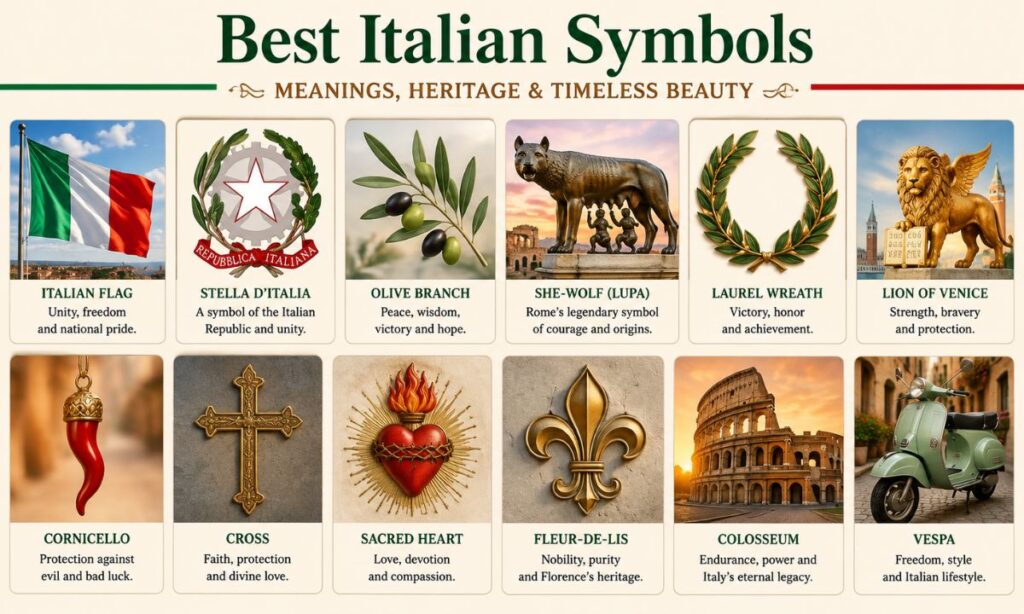
Italian symbols are the visual and cultural markers, like the cornicello, the Roman eagle, the olive branch, and the tricolor flag, that carry Italy’s history, faith, and identity from one generation to the next. If you’ve ever wondered why your Italian grandmother kept a little red horn charm hanging in the kitchen, or why the eagle shows up on everything from ancient coins to modern government buildings, you’re really asking about the deeper story behind Italian symbols and meanings. This article walks through that story in plain, easy English, with real history and real context, not just a list of pretty pictures.
Italy has one of the longest continuous cultural timelines on the planet. The Etruscan civilization came before Rome, the Roman Empire shaped Western law and architecture, the Catholic Church built its headquarters in Vatican City, and the Renaissance rewired how the world thinks about art and science. Every one of those chapters left behind symbols that Italians, and people of Italian descent around the world, still use today. Some of these symbols protect against bad luck. Some celebrate family. Some represent raw political power. A few carry all three meanings at once, depending on who’s wearing them and why.
By the end of this guide, you’ll understand what makes a symbol distinctly Italian, how to read the meaning behind the most common ones, and why so many Americans with Italian roots choose these designs for tattoos, jewelry, and home decor. Let’s get into it.
What Are Italian Symbols?
Italian symbols are visual representations, objects, gestures, or images that express Italy’s national identity, spiritual beliefs, and cultural values. They range from official government emblems to folk charms passed down through families for centuries.
Not every symbol tied to Italy is official. The country actually recognizes only three symbols by law: the green, white, and red flag, the emblem of the Italian Republic, and the national anthem, “Il Canto degli Italiani.” Everything else, from the cornicello to the laurel wreath, earned its place through centuries of shared use rather than legislation. That distinction matters because it shows how Italian cultural identity grows organically. People keep a symbol alive by using it, wearing it, and passing it down, not because a government office declared it meaningful.Italian Symbols
A useful way to think about it is that Italian symbols work on three levels at once. There’s the historical level, where a symbol like the Roman eagle points back to a specific empire and its legions. There’s the folk level, where a charm like the cornicello gets tied to superstition and protection against the evil eye. And there’s the personal level, where a symbol becomes part of someone’s identity through a tattoo or a piece of jewelry inherited from a parent. Most Italian symbols carry weight on all three levels simultaneously, which is part of why they feel so rich compared to generic decorative icons.
It’s also worth noting that Italy isn’t one uniform culture. Regional traditions in Sicily look different from those in Tuscany or Veneto, so many “Italian symbols” are actually regional symbols that spread nationally over time, like the Lion of Venice, which started as a purely Venetian emblem before becoming recognized across the whole country and internationally.
Famous Italian Symbols And Their Meanings
The most recognized Italian symbols combine ancient history with everyday superstition, and understanding their meanings reveals a much deeper story than most people expect.
Italian Symbols And Meanings
At the core of Italian symbolism sits a small set of instantly recognizable images: the tricolor flag, the Roman eagle, the cornicello horn, the olive branch, and the fleur de lis. Each one maps to a specific idea. The flag represents national unity forged during the 19th century movement for Italian independence. The eagle represents imperial power inherited from Rome. The cornicello represents protection from envy and misfortune. The olive branch represents peace and abundance. The fleur de lis, though more associated with France, appears throughout Florence’s own history and heraldry.
Fact: The Italian flag, known as “il Tricolore,” was first adopted in 1797 by the Cispadane Republic, decades before Italy became a unified nation in 1861.
What makes these meanings stick is repetition across centuries of art, coinage, architecture, and religious ceremony. When a symbol shows up on a Roman coin, then a medieval cathedral, then a Renaissance painting, then a modern soccer jersey, its meaning doesn’t dilute, it deepens. Every generation adds a new layer of context without erasing the old one.Italian Symbols
Italian Symbols Tattoos
Tattoos are one of the most personal ways people express Italian heritage, and certain symbols dominate this space for very specific reasons. The Italian horn, the map of Italy’s boot shape, the Roman numeral of a birth year, and religious images like the Sacred Heart or a small cross rank among the most requested designs at American tattoo studios with Italian-American clientele.Italian Symbols
The appeal isn’t just aesthetic. For many Italian-Americans, a tattoo is a way to stay connected to a homeland they may never have visited, or to honor grandparents who immigrated decades ago. A cornicello tattoo, for example, often represents a direct link to a specific relative who wore the charm, turning body art into a form of living family history rather than a passing trend.
Placement matters too. Smaller symbols like the horn or a cross often go on the wrist or behind the ear, while larger pieces like the Roman eagle or an elaborate family crest tend to cover the forearm or back, giving the artist room to include fine detail like feathers or Latin script.
Italian Tattoo Symbols
Beyond the classics, several lesser-discussed symbols are gaining popularity in tattoo culture. The laurel wreath, once reserved for victorious generals and poets in ancient Rome, now appears on tattoos representing personal achievement or academic success. The Colosseum silhouette represents endurance and resilience, since the structure has survived earthquakes, looting, and nearly two thousand years of weather.
Some clients request the phrase “Famiglia” in elegant script alongside a symbol like the olive branch or a rosary, combining language and imagery into one cohesive design. Others choose the Bella Figura concept rendered as a peacock or mirror motif, representing the Italian cultural emphasis on presenting one’s best self to the world.
A growing number of tattoo artists specializing in Italian heritage work also report requests for regional symbols, such as the Sicilian Trinacria (a triskelion with a Medusa head at its center) or the Neapolitan cornetto in gold ink, showing that clients increasingly want to represent specific regions rather than a generalized idea of Italy.
Ancient Italian Symbols
Long before the Roman Republic existed, the Etruscan civilization occupied much of central Italy and left behind symbols like the winged lion, the double axe, and intricate geometric patterns found on tomb walls and pottery. These predate Rome by centuries and influenced early Roman religious iconography more than most people realize.
The she-wolf nursing Romulus and Remus stands as arguably the oldest continuously used Italian symbol, tracing back to the founding myth of Rome itself around the 8th century BCE. Bronze statues of the wolf still stand in Rome today, and the image appears on everything from ancient coins to the crest of AS Roma, the city’s professional soccer club.
Fasces, a bundle of rods bound around an axe, originated as a Roman symbol of magisterial authority and the power to punish. It later became politically loaded in the 20th century, which is why modern Italy handles the symbol carefully despite its much older, more neutral original meaning tied to civic order rather than any specific ideology.
National Symbols Of Italy
Italy’s officially recognized national symbols are limited to three: the flag, the emblem of the Republic, and the national anthem. The emblem of Italy was adopted on May 5, 1948, and features a white five pointed star called the Stella d’Italia bordered in red, layered over a five spoked cogwheel, flanked by an olive branch on one side and an oak branch on the other, bound together by a ribbon reading “Repubblica Italiana.”
Fact: The Stella d’Italia is considered the oldest national symbol of Italy, with roots tracing back to Graeco-Roman tradition long before the modern Italian state existed.
The cogwheel represents the labor of Italian workers, the olive branch represents peace, and the oak branch represents strength and the dignity of Italian citizens. Unlike many national emblems that feature animals or weapons, Italy’s chosen a design centered on labor and peace, which reflects the republic’s founding priorities after the Second World War.
Traditional Italian Culture And Heritage Symbols
Traditional Italian symbols connect directly to family life, regional identity, and centuries old customs that Italians carried with them wherever they settled, including the United States.
Italian Symbols Letters
Letters and script play a bigger role in Italian symbolism than most people expect. Elegant calligraphy spelling out words like “Famiglia” (family), “Amore” (love), or “Fortuna” (luck) frequently accompanies visual symbols in jewelry and tattoos. Roman numerals, inherited directly from ancient Rome, remain widely used for dates, especially birth years or wedding anniversaries, giving a design a distinctly classical feel.
The letter combinations found in monograms on Italian family crests also carry meaning, often representing the founding surname of a noble or merchant family from centuries past. Many Italian-American families still display these crests, sometimes without knowing the full history behind the specific letters or Latin mottos included.
Italian Symbols Of Protection
Protection symbols form one of the richest categories in Italian folklore, largely centered on defending against malocchio, the evil eye. The cornicello, a twisted horn shape usually made of red coral or gold, ranks as the single most recognized protection charm in Italian culture.
Other protective symbols include the cimaruta, a charm shaped like a sprig of rue with multiple small symbols attached, historically popular in Naples and believed to ward off evil spirits, and the horseshoe, hung with the ends pointing upward to “hold in” good luck. Garlic, while primarily a kitchen staple, also carries a folk reputation for repelling negative energy in some southern Italian households.
Fact: The belief in malocchio, or the evil eye, predates Christianity in the Mediterranean and appears in ancient Greek, Roman, and Middle Eastern cultures long before it became associated specifically with Italian folklore.
Italian Symbols For Family
Family sits at the center of Italian culture, so it’s no surprise that several symbols exist specifically to represent it. The olive tree, with its deep roots and long lifespan, often stands in for generational continuity and the idea that a family’s strength grows over decades rather than overnight. The image of a large dinner table surrounded by extended relatives, while not a formal emblem, functions as an unofficial symbol of Italian family life that appears constantly in art, film, and advertising.
The Sacred Heart and small crosses also carry family significance, since Catholic faith historically bound Italian households together across generations. Many families passed down a single rosary or a specific religious medal as an heirloom meant to protect the household, turning a personal devotional object into a shared family symbol.
Symbols Of Italy
When people search broadly for symbols of Italy, they’re usually picturing a mix of official and unofficial imagery: the tricolor flag, the Colosseum, the leaning Tower of Pisa, the Vespa scooter, Ferrari’s prancing horse, and regional icons like the gondola in Venice. These symbols work because they’re instantly recognizable even to people with no direct connection to Italy.
The Tower of Pisa deserves special mention here. Built between the 12th and 14th centuries, its famous tilt happened by accident due to unstable soil, yet that imperfection turned it into one of the most photographed structures on earth and a UNESCO World Heritage Site since 1987. It’s a rare example of a symbol becoming beloved precisely because it isn’t perfect.
Italian Symbols Jewelry
Jewelry carries Italian symbolism in a very intimate, everyday way. Gold cornicello pendants remain a staple gift for newborns in many Italian-American families, often given by a grandparent as a first piece of jewelry meant to protect the child through life. Rings featuring the coat of arms of a specific region, like Sicily’s Trinacria, let wearers display regional pride rather than a generic national identity.
Coral has special significance in Italian jewelry traditions, particularly in southern Italy, where it’s believed to carry natural protective properties beyond its decorative value. Combined with gold in a cornicello or a small cross, coral jewelry becomes a layered symbol of both faith and folk protection worn on the body every day.
Bracelets and necklaces featuring the map outline of Italy, sometimes with a small heart marking a specific region or city of family origin, have also grown popular among Italian-Americans looking for a subtle but meaningful way to signal heritage.
Italian National Symbols
Beyond the three legally defined national symbols, Italy has a set of widely accepted unofficial national symbols that function almost as strongly in the public imagination. The Vespa scooter, born in 1946, represents postwar Italian ingenuity and style. Ferrari’s prancing horse, founded by Enzo Ferrari in 1939 in Maranello, represents speed, luxury, and Italian engineering excellence recognized worldwide.
Even Italian cuisine functions symbolically at a national level. Pizza and pasta aren’t just food exports, they’re cultural ambassadors that carry Italian identity into homes across the globe, often serving as many Americans’ very first meaningful contact with Italian culture before they ever learn about the flag or the emblem.
Ancient And Modern Symbols That Represent Italy
Italy uniquely blends symbols that are thousands of years old with modern icons born in the 20th century, and both categories carry equal cultural weight in how the country presents itself to the world.
Italy Symbols
Search interest in “Italy symbols” typically centers on a handful of images: the flag, the Colosseum, the she-wolf, the boot shaped map, and the Vatican’s dome. Together these form a kind of visual shorthand that instantly signals “Italy” even without any text attached, which is exactly why they show up so often in tourism campaigns, food packaging, and film posters aimed at American audiences.
Italian Symbols Of Love
Love symbols in Italian culture lean heavily on nature and religious imagery rather than the generic heart shape alone. The olive branch, beyond representing peace, also historically symbolized marital devotion in ancient Roman weddings. Doves, associated with the Holy Spirit in Christian iconography, also represent romantic fidelity and gentle affection in Italian art and literature.
The city of Verona, forever linked to Shakespeare’s Romeo and Juliet, has become an unofficial symbol of Italian romance itself, drawing visitors who leave love notes on the walls near Juliet’s supposed balcony. This shows how literature, even fictional literature written by an Englishman, can graft itself onto Italian cultural identity when the story feels authentically Italian in spirit.
Things That Represent Italy
When Americans think about things that represent Italy, food, fashion, and architecture usually top the list. Gondolas gliding through Venice’s canals, the rolling vineyards of Tuscany, espresso served in tiny cups, and handmade leather goods from Florence all function as informal ambassadors of Italian identity, even though none of them are official symbols in any legal sense.
Ancient Italian Symbols And Meanings
Returning to antiquity, several symbols deserve deeper explanation. The fasces, a bundle of wooden rods, originally represented a magistrate’s authority to enforce law, including corporal punishment, in ancient Rome. The laurel wreath crowned victorious generals and celebrated poets alike, linking military triumph and artistic achievement under one shared symbol, a pairing that feels distinctly Roman in how it valued both strength and culture equally.
The Roman she-wolf myth carries a meaning beyond simple origin storytelling. It represents resilience and the idea that greatness can emerge from abandonment and hardship, since Romulus and Remus were left to die before the wolf found and raised them.
Something That Represents Italy
If you had to pick a single object that represents Italy to most Americans, the Colosseum would likely win. Completed around 80 CE, it hosted gladiatorial combat and public spectacles for centuries, and its ruins today symbolize both the grandeur of Roman engineering and the passage of time itself, since it has weathered earthquakes, stone theft during the medieval period, and nearly two thousand years of history while still standing.
Things That Represent Italian Culture
Italian culture expresses itself through specific rituals as much as physical symbols. The evening passeggiata, a leisurely walk through town, represents community and unhurried living. The extended Sunday family meal represents the primacy of family bonds over individual schedules. Even the concept of “il dolce far niente,” the sweetness of doing nothing, functions as a cultural symbol of Italy’s different relationship with time compared to the faster paced American lifestyle.
Italian Symbols Of Strength
Strength symbols in Italian culture often draw from Roman military imagery. The Roman eagle, carried by legions into battle, represents disciplined power and dominance. The oak branch featured on the national emblem represents endurance and moral strength rather than raw aggression. Even the Colosseum, through sheer physical survival across two millennia, has become a symbol of resilience that transcends its original violent purpose.
The Deep Symbolic Meaning Behind Italian Symbols
Every Italian symbol operates on spiritual, psychological, and cultural levels simultaneously, which explains why these images resonate so strongly across generations and even outside Italy itself.
Spiritual Meaning
Many Italian symbols carry direct ties to Catholic faith, since Christianity has shaped Italian spirituality for roughly seventeen centuries. The Sacred Heart, the cross, and the halo represent divine protection and grace. Folk symbols like the cornicello blend pre-Christian superstition with later Catholic practice, showing how spiritual belief in Italy rarely exists in a single pure form, but instead layers older pagan ideas underneath a Christian surface.
Psychological Meaning
On a psychological level, Italian symbols often provide a sense of control over uncertainty. Wearing a protection charm against malocchio isn’t just superstition, it’s a psychological tool that reduces anxiety by giving the wearer a concrete action to take against an abstract fear of envy or bad luck. This mirrors similar protective object traditions found across nearly every culture on earth, confirming that the underlying psychological need is universal even when the specific symbol is distinctly Italian.
Cultural Meaning
Culturally, these symbols reinforce group identity and continuity. When an Italian-American wears a cornicello passed down from a great-grandmother, the object becomes a physical bridge connecting present identity to a specific ancestral past. This function, maintaining cultural memory across immigration and generational distance, may be the single most important role Italian symbols play for the millions of people of Italian descent living outside Italy today.
Types of Italian Symbols and Their Meanings
The Cornicello
Visual Description
A twisted, curved horn shape, typically a few inches long, most often crafted from red coral, gold, or silver.
Meaning
Protection against the evil eye and envy, along with a general association with good luck and virility, since the horn shape historically referenced animal strength.
Where It Appears
Worn as a pendant, hung in homes and cars, and sold widely in southern Italy, particularly Naples, where the tradition remains strongest.
The Roman Eagle
Visual Description
A powerful eagle, wings often spread wide, sometimes gripping a bundle of lightning bolts or standing atop a military standard.
Meaning
Imperial power, military strength, and sovereign authority, inherited directly from the standards carried by Roman legions.
Where It Appears
Ancient coins, Roman monuments, and modern government and military insignia across several nations that modeled their own imagery on Rome’s original design.
The Olive Branch
Visual Description
A slender branch with narrow silver green leaves, typically shown extended or held.
Meaning
Peace, reconciliation, and abundance, rooted in the olive tree’s long history as a Mediterranean staple crop.
Where It Appears
The Italian national emblem, wedding traditions, and diplomatic imagery used globally, not only in Italy.
The Lion of Venice
Visual Description
A winged lion, usually shown with one paw resting on an open book, historically the emblem of Saint Mark.
Meaning
Authority, guardianship, and the historic power of the Venetian Republic, which once controlled major Mediterranean trade routes.
Where It Appears
Venetian flags, government buildings throughout the Veneto region, and the Venice Film Festival’s own trophy, the Golden Lion.
The Fleur de Lis
Visual Description
A stylized three petaled flower, often shown in gold or blue.
Meaning
Nobility, purity, and in Florence specifically, civic pride, despite the symbol’s stronger overall association with French royalty.
Where It Appears
Florence’s city emblem, historical Italian heraldry, and Renaissance era artwork produced throughout Tuscany.
Italian Symbols Across Different Cultures
Ancient Roman Culture
Rome built its identity around symbols of law, conquest, and civic order, from the eagle standards carried into battle to the fasces representing magisterial authority.
Christian Italian Culture
Once Christianity took hold, symbols like the cross, the Sacred Heart, and the halo layered new spiritual meaning onto Italy’s existing visual vocabulary, often blending with older folk beliefs rather than fully replacing them.
Renaissance Italy
The Renaissance introduced symbols tied to humanism and artistic mastery, with the laurel wreath returning as a mark of intellectual and creative achievement rather than purely military victory.
Medieval Italian States
Fragmented into competing city states like Venice, Florence, and Genoa, medieval Italy produced distinct regional symbols such as the Lion of Venice and the Florentine fleur de lis, reflecting fierce local pride that predates modern national unity.
Modern Global Culture
Today, Italian symbols circulate globally through fashion houses, film, and Italian-American communities, often detached from their original regional context but still carrying recognizable meaning wherever they appear.
Italian Symbols in Art, Movies, Literature, Tattoos and Fashion
Italian symbols permeate creative industries far beyond Italy’s borders. Renaissance painters like Botticelli and Raphael embedded religious and mythological symbols throughout their work, ensuring images like the laurel wreath and the dove remained visible to millions of museum visitors centuries later. Hollywood frequently leans on Italian imagery, from the Colosseum appearing in historical epics to the Vespa scooter symbolizing carefree Italian romance in countless films.
Literature has done similar work, with Dante’s writing embedding Christian symbolism so deeply into Italian identity that certain images, like the eagle representing divine justice in the Divine Comedy, still echo through modern Italian art. Fashion houses such as Gucci and Versace regularly draw on classical Roman motifs, proving that ancient symbols remain commercially and culturally relevant nearly two thousand years after they first appeared on Roman coins.
Spiritual And Dream Meaning of Italian Symbols
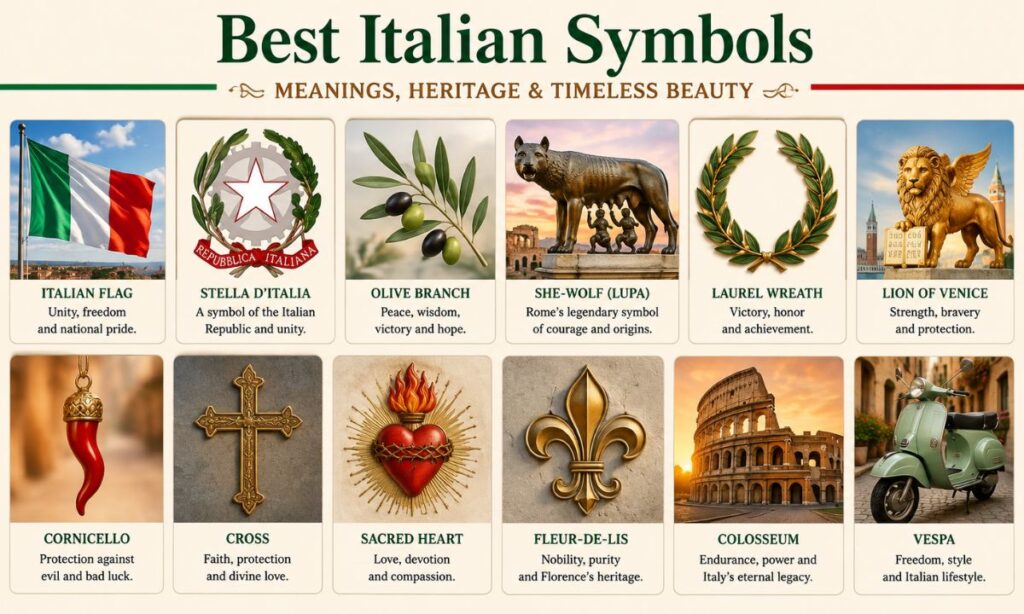
In dream interpretation traditions influenced by Italian folk belief, certain symbols carry specific meanings. Dreaming of a cornicello or horn shape is often interpreted as a subconscious signal of needed protection or an upcoming challenge requiring caution. An eagle appearing in a dream frequently symbolizes ambition or a desire for greater control over one’s circumstances. An olive branch in a dream is commonly read as a sign of impending peace or the resolution of an ongoing conflict.
These interpretations aren’t scientifically validated, but they persist because they connect deeply held cultural symbols to the personal, emotional processing that dreams naturally invite.
Positive And Negative Meanings of Italian Symbols
Most Italian symbols carry overwhelmingly positive associations, but a few carry more complicated histories worth understanding honestly. The fasces, for example, represented neutral civic authority in ancient Rome for centuries before its 20th century political misuse gave it a negative modern association in many contexts, which is why contemporary Italy handles the image carefully despite its much older and more benign original meaning.
The evil eye itself represents a negative force within Italian folklore, envy and ill will directed at another person, while the protective symbols like the cornicello exist specifically as the positive counterforce meant to neutralize that negativity. Understanding both halves of that pairing gives a fuller, more accurate picture than looking at protective charms in isolation.
Why Humans Feel Deeply Attracted to Italian Symbols
People across the world, not only those of Italian descent, gravitate toward Italian symbols because they combine visual beauty with genuine historical depth. A symbol like the Roman eagle doesn’t just look striking, it connects the viewer to one of the most influential empires in human history. That combination of aesthetic appeal and substantive meaning is rare, and it’s part of why Italian imagery continues appearing in tattoos, fashion, and design choices made by people with no Italian ancestry at all.
There’s also a psychological pull toward continuity. In a fast changing modern world, symbols that have survived thousands of years, like the she-wolf or the olive branch, offer a comforting sense of permanence. Choosing to wear or display one of these images can feel like anchoring yourself to something larger and more enduring than current trends.
Italian Symbols And Their Role In Daily Italian Life
Within Italy itself, many of these symbols function quietly in everyday routines rather than as grand statements. A cornicello might hang from a car’s rearview mirror. A small cross sits on a kitchen wall. The Italian flag appears during soccer matches with an intensity that borders on religious devotion. These aren’t museum pieces, they’re living parts of ordinary Italian households, reinforcing the idea that Italian symbolism isn’t confined to history books, it’s actively practiced today.
Frequently Asked Questions About Italian Symbols
What is the most famous Italian symbol?
The Italian flag and the Colosseum are generally considered the most globally recognized Italian symbols, though the cornicello is arguably the most personally significant symbol within Italian and Italian-American households.
What does the Italian horn symbolize?
The Italian horn, or cornicello, symbolizes protection against the evil eye, envy, and bad luck, and it’s traditionally given as a gift to protect the wearer.
Why are Roman symbols still important today?
Roman symbols like the eagle and the fasces remain important because they represent foundational concepts of law, governance, and civic order that continue influencing modern institutions worldwide.
Are Italian symbols religious?
Many Italian symbols, including the cross, the Sacred Heart, and the dove, are explicitly Catholic in origin, while others, like the cornicello, blend older folk superstition with later Christian practice.
What do olive branches mean in Italian culture?
Olive branches represent peace, reconciliation, and abundance, and they appear on Italy’s national emblem specifically to symbolize these values.
Why do people tattoo Italian symbols?
People tattoo Italian symbols to express pride in their heritage, honor family members who carried the same symbols, and maintain a visible connection to Italian identity across generations.
Conclusion
Italian symbols offer far more than decoration. They carry the weight of ancient empires, medieval city states, deeply held religious faith, and generations of family tradition, all compressed into small, recognizable images like the cornicello, the Roman eagle, and the olive branch.
Whether you’re exploring your own Italian heritage, choosing a tattoo, or simply curious about why these symbols keep showing up in art and jewelry, understanding their real history adds meaning that goes far beyond surface level style. Italy’s symbols endure because they were never just images, they were always a way of carrying identity forward, one generation at a time.
