
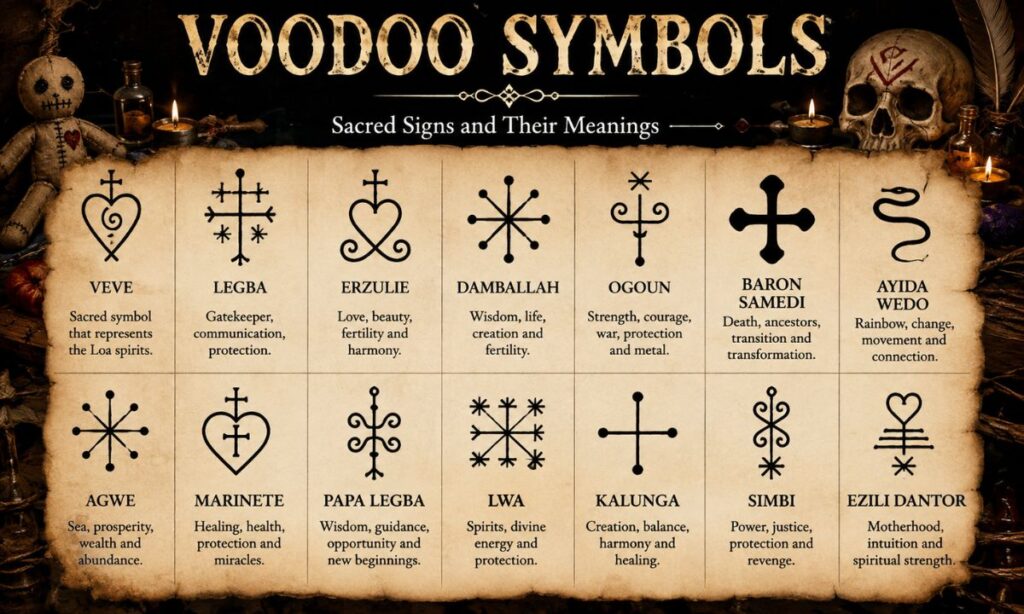
Symbols play a huge role in voodoo. Each symbol is called a veve. They connect people to different spirits. Some symbols bring protection and strength. Others represent love, death, or healing. This guide explores 90+ powerful voodoo symbols.
You will learn their hidden meanings clearly. You will also discover secret spiritual uses. Every sign carries its own unique power. This 2026 guide makes it simple to understand. No confusing words, just easy explanations. By the end, voodoo symbols will make sense.
What Are Voodoo Symbols?
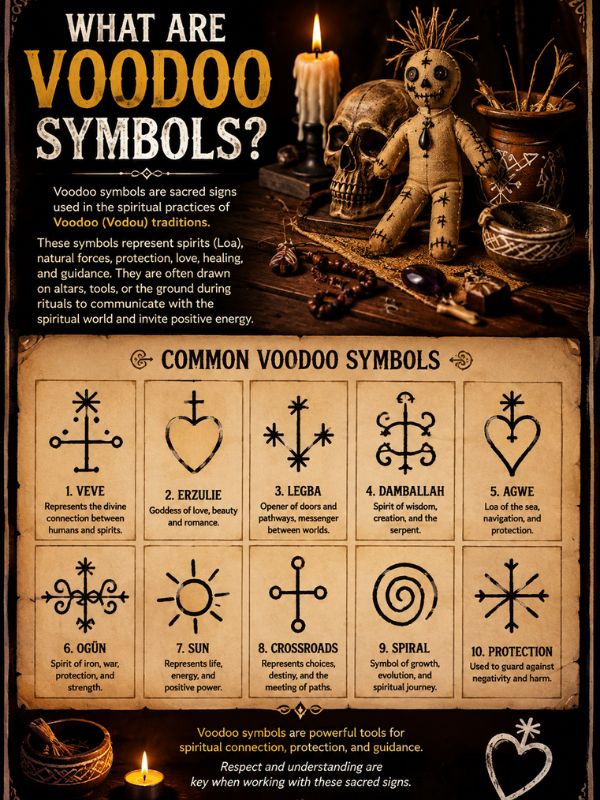
- Voodoo symbols are sacred visual marks used within Vodou practice to represent spirits, energies, and specific spiritual intentions or requests.
- Each symbol, often called a veve, is drawn on the ground using cornmeal, flour, or ash before a ceremony begins.
- These designs act as spiritual doorways, inviting a particular loa, or spirit, to descend and join the ritual space.
- Practitioners believe every line and curve carries meaning tied to nature, ancestry, protection, healing, love, or transition between life and death.
- Symbols are not decorative; they are functional tools believed to channel real spiritual power during worship.
- Voodoo Symbols
- Many designs combine geometric shapes, crosses, hearts, and animal imagery drawn from West African and Caribbean traditions.
- Priests and priestesses, known as houngans and mambos, are typically trained for years to draw these symbols correctly.
- The accuracy of a veve matters because an incorrectly drawn symbol may fail to attract the intended spirit properly.
- Voodoo symbols differ across regions, blending African, Catholic, and Indigenous Caribbean influences into unique local expressions.
- Understanding these symbols requires respecting their religious context rather than viewing them only as mystical or decorative imagery.
- Modern popular culture often misrepresents voodoo symbols, stripping away their genuine spiritual and community significance.
- For believers, these symbols remain living expressions of faith, memory, resilience, and connection to unseen spiritual forces.
Voodoo Symbols | Meanings, Uses and Types 🪬 🕯️ 💀 ☠️ 🐍 🐓 🐐 🐍 🌙 ☀️ ⭐ 🔥 💧 🌿 🌿 🪶 🥁 🎭 👁️ 🖐️ ✋ ❤️ 🖤 🔮 🗝️ ⛓️ 🪢 🧿 🪵 🪦 ⚰️ 🧙♀️ 🧿 🌀 🌪️ ⚡ 🌧️ 🌑 🌕 🌓 🌹 🌺 🌻 🕸️ 🕷️ 🐚 🦴 🪶 🔥 🕯️
- Voodoo symbolism spans several distinct categories, including veve drawings, protective charms, death imagery, and symbols tied to specific loa spirits.
- Meanings shift depending on region, lineage, and the particular spiritual tradition a practitioner follows within the broader Vodou religious family.
- Uses range from healing rituals and protection spells to funeral rites, love workings, and everyday spiritual guidance sought by devoted followers.
- Types include Haitian veve, Louisiana voodoo hoodoo-influenced marks, and older West African Vodun symbols predating Caribbean transformation.
- Some symbols represent single spirits, while others represent broader concepts like fertility, agriculture, war, thunder, or the crossroads between worlds.
- Voodoo Symbols
- Colors matter greatly, since red often signals passion or danger, while white frequently represents purity, death, or ancestral spirits.
- Symbols may appear on altars, flags, tattoos, jewelry, or drawn temporarily on ceremonial ground before being swept away.
- Sequin flags, called drapo, elevate veve designs into wearable or displayable art carrying the same spiritual weight.
- Practitioners learn symbol meanings through oral tradition, apprenticeship, and direct spiritual experience rather than written textbooks alone.
- Outsiders should approach these meanings carefully, since misinterpretation can distort a deeply respected and living religious practice.
- Scholars continue documenting variations across Haiti, Benin, Togo, and the American South to preserve accurate cultural knowledge.
- Ultimately, every symbol functions as a bridge connecting the visible human world with the invisible spiritual realm.
- Voodoo Symbols
Voodoo Symbols for Death 🪬 🕯️ 💀 ☠️ 🐍 🐓 🐐 🐍 🌙 ☀️ ⭐ 🔥 💧 🌿 🌿 🪶 🥁 🎭 👁️ 🖐️ ✋ ❤️ 🖤 🔮 🗝️ ⛓️ 🪢 🧿 🪵 🪦 ⚰️ 🧙♀️ 🧿 🌀 🌪️ ⚡ 🌧️ 🌑 🌕 🌓 🌹 🌺 🌻 🕸️ 🕷️ 🐚 🦴 🪶 🔥 🕯️
- Death symbols in voodoo often connect to Baron Samedi, the guardian spirit of cemeteries, graves, and the passage into the afterlife.
- His symbol frequently includes a black cross, a top hat, skull imagery, and purple or black coloring representing mourning and transition.
- Crossroads imagery also appears in death symbolism, marking the meeting point between the living world and the spirit realm.
- Coffins, bones, and cemetery gates are common visual elements used within death-related veve and ritual artwork.
- The Gede family of spirits, associated with death and ancestors, uses symbols blending humor, sexuality, and mortality together.
- Purple and black candles frequently accompany death symbol rituals meant to honor deceased ancestors respectfully.
- Skull and crossbones imagery in voodoo carries spiritual weight rather than the purely ominous meaning assigned in Western horror culture.
- Death symbols are used in funeral rites to guide a departed soul safely toward ancestral spirits.
- Practitioners believe these symbols help maintain communication between living family members and their deceased loved ones.
- Cemetery crosses drawn or placed on altars represent Baron Samedi’s authority over graves and burial grounds.
- Death imagery in voodoo is not feared but respected as part of a natural spiritual life cycle.
- These symbols remind believers that death connects rather than separates the living from ancestral spiritual guidance.
- Voodoo Symbols
Voodoo Symbols for Protection
- Protection symbols in voodoo are designed to shield individuals, homes, and communities from negative spiritual or physical harm.
- Ogou, the warrior spirit, often lends his symbolism to protection work through machete, iron, and fire imagery.
- Veve dedicated to protective load frequently include crosses, shields, stars, and interlocking geometric patterns believed to block harmful energy.
- Red and black colors commonly appear in protection symbolism, representing strength, courage, and defensive spiritual power.
- Gris-gris bags, small charm pouches, often carry protective symbols alongside herbs, stones, and personal items for added spiritual power.
- Doorway and threshold symbols are drawn to prevent unwanted spirits or negative influences from entering a household.
- Protective tattoos featuring veve designs are worn by some practitioners seeking constant spiritual coverage throughout daily life.
- Iron symbolism connects strongly to protection, since many warrior loa are associated with metalwork and blacksmith traditions.
- Protection rituals often combine symbol drawing with prayer, candle lighting, and offerings to strengthen spiritual effectiveness.
- Family altars frequently display protective symbols to guard the household from illness, misfortune, or spiritual attack.
- Amulets bearing protective veve are sometimes given to travelers before long journeys for safe passage.
- Ultimately, protection symbols reflect a deep belief that spiritual forces actively defend those who honor them properly.
- Voodoo Symbols
Understanding Voodoo Symbols and Their Meanings
- Understanding voodoo symbols requires learning the religious framework behind Vodou rather than viewing symbols as isolated mystical images.
- Each symbol connects to a specific loa spirit, carrying personality traits, preferences, colors, and ritual associations unique to that spirit.
- Meaning is built through generations of oral tradition passed between houngans, mambos, and devoted community members over centuries.
- Symbols often merge African spiritual concepts with Catholic saint imagery, a result of historical religious blending during colonial enslavement.
- Interpretation depends heavily on context, since the same shape can carry different meaning depending on ceremony type or regional tradition.
- Practitioners study symbols through direct participation in rituals rather than academic study alone, deepening spiritual understanding gradually.
- Respectful understanding also means acknowledging Vodou as a legitimate living religion practiced by millions across Haiti and the diaspora.
- Symbols are considered sacred technology, believed to genuinely summon spiritual presence rather than simply representing abstract ideas.
- Misunderstanding often arises from horror films and pop culture, which distort symbols into frightening or evil imagery incorrectly.
- True understanding involves recognizing symbols as expressions of resilience, cultural memory, and community survival throughout difficult history.
- Scholars and practitioners alike emphasize humility when approaching symbol meaning from outside the tradition itself.
- Genuine appreciation grows through respectful curiosity, cultural context, and acknowledgment of Vodou’s deep spiritual significance worldwide.
Voodoo Symbols and Meanings 🪬 🕯️ 💀 ☠️ 🐍 🐓 🐐 🐍 🌙 ☀️ ⭐ 🔥 💧 🌿 🌿 🪶 🥁 🎭 👁️ 🖐️ ✋ ❤️ 🖤 🔮 🗝️ ⛓️ 🪢 🧿 🪵 🪦 ⚰️ 🧙♀️ 🧿 🌀 🌪️ ⚡ 🌧️ 🌑 🌕 🌓 🌹 🌺 🌻
- Voodoo symbols carry layered meanings shaped by spirit identity, ceremonial purpose, and the specific tradition a practitioner follows closely.
- A heart symbol often represents Erzulie Freda, the spirit of love, beauty, luxury, and romantic devotion within Haitian Vodou.
- A ship or anchor may represent Agwe, spirit of the sea, invoked for safe travel and maritime protection.
- Snake imagery frequently symbolizes Damballa, an ancient serpent spirit representing wisdom, creation, and primordial spiritual power.
- Thunderbolt symbols connect to Shango or similar warrior spirits associated with fire, justice, and righteous strength.
- Stars within veve designs often represent guidance, destiny, and spiritual illumination offered by a particular loa.
- Flags decorated with sequins and beads transform symbolic meaning into physical art displayed during major ceremonies.
- Colors carry independent meaning too, with green often symbolizing growth and blue representing water or emotional healing.
- Meaning shifts slightly between Haitian, Louisiana, and West African traditions, reflecting each community’s unique historical development.
- Symbols evolve gradually, incorporating new elements while maintaining core spiritual connections passed down through generations faithfully.
- Voodoo Symbols
- Practitioners often personalize symbol meaning slightly based on family lineage, regional practice, and individual spiritual relationships.
- Overall, symbol meaning remains flexible yet rooted firmly in respect for ancestral spiritual tradition and community wisdom.
Voodoo Symbolism Religion Symbols
- Voodoo symbolism sits at the center of Vodou religious practice, functioning as both a communication tool and spiritual invitation.
- Religious symbols in Vodou often merge African deity concepts with Roman Catholic saint imagery introduced during colonial-era forced conversion.
- This blending created syncretic symbols recognizable to both African spiritual practitioners and outwardly practicing Catholic communities historically.
- Voodoo Symbols
- Crosses appear frequently, representing both Christian influence and the crossroads spirit Papa Legba, guardian of communication and pathways.
- Religious symbols mark sacred space, transforming ordinary ground into a temporary spiritual gateway during formal ceremony.
- Symbolic drumming patterns often accompany visual symbols, since sound and image work together within Vodou ritual practice.
- Altars display religious symbols permanently, creating an ongoing spiritual connection between practitioners and their chosen guardian spirits.
- Religious symbolism extends beyond static images into dance, possession trance, and physical embodiment of spiritual presence.
- Community ceremonies rely on shared symbolic understanding, allowing participants to recognize which spirit has been invited forward.
- Symbols function similarly to religious iconography found in other world religions, conveying complex theology through simplified visual form.
- Voodoo Symbols
- Respecting these symbols means recognizing Vodou as a structured religion with theology, ethics, and community organization.
- Religious symbolism ultimately preserves centuries of spiritual knowledge carried through slavery, displacement, and cultural survival across generations.
Voodoo Symbols and Their Meanings🪬 🕯️ 💀 ☠️ 🐍 🐓 🐐 🐍 🌙 ☀️ ⭐ 🔥 💧 🌿 🌿 🪶 🥁 🎭 👁️ 🖐️ ✋ ❤️ 🖤 🔮 🗝️ ⛓️ 🪢 🧿 🪵 🪦 ⚰️ 🧙♀️ 🧿 🌀 🌪️ ⚡ 🌧️ 🌑 🌕 🌓 🌹 🌺 🌻 🕸️ 🕷️ 🐚 🦴
- Each voodoo symbol carries specific meaning tied directly to the spirit, ritual purpose, or spiritual request it represents.
- Papa Legba’s symbol often includes a cane, keys, or crossroads imagery representing his role opening spiritual communication pathways.
- Baron Samedi’s symbol includes skulls and crosses, representing his guardianship over cemeteries and the dead.
- Erzulie’s heart symbol represents love, femininity, jealousy, and the complex emotional realm she governs spiritually.
- Damballa’s serpent symbol represents ancient wisdom, purity, and the foundational creative force within Vodou cosmology.
- Ogou’s machete symbol represents strength, war, iron craftsmanship, and protective warrior energy within the pantheon.
- Agwe’s ship symbol represents oceanic travel, fishing communities, and protection for those working near water.
- Symbols combine to form complex veve designs during larger ceremonies honoring multiple spirits simultaneously with layered meaning.
- Meaning also depends on symbol placement, whether drawn on ground, painted on flags, or worn as jewelry.
- Practitioners interpret symbols through lived spiritual experience, making meaning feel personal despite shared cultural symbolism.
- Symbol meaning can deepen over years of practice as individuals build stronger relationships with specific lower spirits.
- Together these meanings form a rich symbolic language expressing devotion, protection, healing, and connection to ancestral spirits.
Voodoo Symbols and Meaning
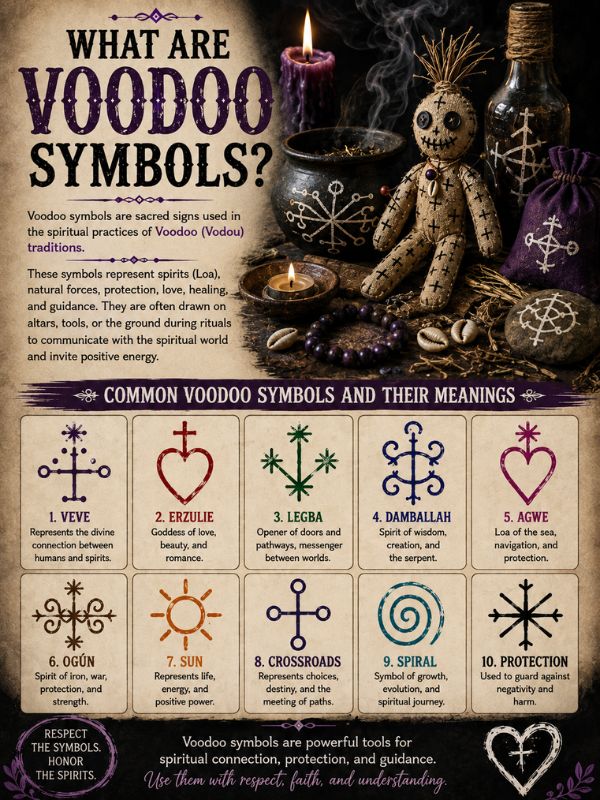
- Voodoo symbol meaning centers on spiritual communication, inviting specific loa spirits into ceremonial space through precise visual representation.
- Meaning is never arbitrary, since each line, curve, and color choice reflects established tradition passed through generations.
- Symbols function as spiritual shorthand, allowing practitioners to instantly recognize which spirit a particular veve design represents.
- Meaning also incorporates practical ritual purpose, whether the symbol seeks healing, protection, love, prosperity, or safe passage.
- Historical meaning traces back to West African Vodun traditions later transformed through the experience of Caribbean enslavement.
- Symbol meaning survived suppression attempts during colonial rule, carried secretly within community memory and oral teaching.
- Contemporary meaning continues evolving as Vodou spreads globally while practitioners maintain core symbolic and spiritual integrity carefully.
- Voodoo Symbols
- Meaning differs slightly by house or lineage, reflecting localized spiritual teaching passed from mentor to student directly.
- Symbol meaning connects strongly to nature, drawing imagery from serpents, trees, water, fire, and celestial bodies.
- Interpreting meaning correctly requires spiritual training, since surface appearance alone rarely reveals a symbol’s full significance.
- Meaning remains sacred and protected within the tradition, discouraging casual or disrespectful use outside religious context.
- Ultimately, symbol meaning represents centuries of resilience, faith, and unbroken spiritual connection across generations of believers.
Types of Voodoo Symbols Around the World
- Types of voodoo symbols vary significantly across the regions where Vodou and related traditions developed historically over centuries.
- Haitian veve represent one major type, featuring intricate ground drawings created with cornmeal before ceremonial gatherings begin.
- West African Vodun symbols represent an older type, predating Caribbean transformation and rooted in Benin, Togo, and Nigeria.
- Louisiana voodoo symbols blend African tradition with hoodoo folk magic elements unique to American Southern culture.
- Sequin flag symbols, called drapo, represent a decorative type transforming spiritual veve into wearable ceremonial art.
- Protective gris-gris symbols represent a portable type, carried within small pouches for personal spiritual defense daily.
- Death and ancestor symbols represent a solemn type, used during funeral rites and ancestral remembrance ceremonies respectfully.
- Love and fertility symbols represent an emotional type, often associated with Erzulie and matters of romantic devotion.
- Warrior symbols represent a protective type, connected to Ogou and other spirits governing strength and courage.
- Water spirit symbols represent a maritime type, honoring Agwe and other spirits governing oceans and rivers.
- Voodoo Symbols
- Crossroads symbols represent a transitional type, marking spiritual pathways between the physical and unseen spiritual worlds.
- Together these types illustrate how geography, history, and community shaped diverse yet deeply connected symbolic traditions.
Haitian Voodoo Symbols 🪬 🕯️ 💀 ☠️ 🐍 🐓 🐐 🐍 🌙 ☀️ ⭐ 🔥 💧 🌿 🌿 🪶 🥁 🎭 👁️ 🖐️ ✋ ❤️ 🖤 🔮 🗝️ ⛓️ 🪢 🧿 🪵 🪦 ⚰️ 🧙♀️ 🧿 🌀 🌪️ ⚡ 🌧️ 🌑 🌕 🌓 🌹 🌺 🌻 🕸️ 🕷️ 🐚 🦴
- Haitian voodoo symbols, known formally as veve, form the visual heart of Haitian Vodou religious ceremony and practice.
- These intricate designs are drawn on temple floors using cornmeal, ash, or flour before spirits are formally invited.
- Each veve corresponds to a specific loa, blending geometric patterns with symbolic imagery representing that spirit’s personality and domain.
- Papa Legba’s veve often includes crossroads and gate imagery, reflecting his role as spiritual gatekeeper and messenger.
- Erzulie Freda’s veve typically features hearts, mirrors, and floral patterns representing love, beauty, and emotional complexity.
- Damballa’s veve includes serpent imagery, symbolizing ancient wisdom and the foundational creative energy within Haitian cosmology.
- Ogou’s veve incorporates weapons and iron tools, representing his warrior strength and protective spiritual authority.
- Haitian veve are considered temporary sacred art, swept away once ceremony concludes to maintain ritual purity.
- Voodoo Symbols
- Skilled houngans and mambos train for years to draw veve accurately, since precision affects spiritual effectiveness directly.
- Haitian symbols also appear on sequined flags displayed permanently within temples, called, honoring specific spirits continuously.
- These symbols represent centuries of resilience, blending African heritage with Haiti’s unique revolutionary and spiritual history.
- Haitian voodoo symbols remain vital living religious expressions rather than historical relics or decorative curiosities alone.
- Voodoo Symbols
Haitian Voodoo Symbols and Meanings
- Haitian voodoo symbols and their meanings connect directly to the extensive pantheon of loa spirits honored within Vodou tradition.
- Meaning begins with understanding that each veve serves as a spiritual invitation rather than purely artistic decoration.
- Papa Legba’s symbol means opening communication between human and spiritual realms, always invoked first during ceremony.
- Erzulie’s symbol means love, jealousy, luxury, and feminine power, reflecting her complex and multifaceted spiritual personality.
- Damballa’s symbol means wisdom, purity, and creation, connecting practitioners to ancient African spiritual foundations respectfully.
- Baron Samedi’s symbol means guardianship over death, cemeteries, and the boundary between living and ancestral worlds.
- Ogou’s symbol means strength, war, and protection, often invoked during times requiring courage or defense.
- Agwe’s symbol means safe passage across water, invoked by fishermen and sailors seeking maritime protection.
- Voodoo Symbols
- Meaning also incorporates color symbolism, with specific shades assigned to each loa representing their unique spiritual energy.
- Symbol meaning strengthens through repeated ceremonial use, building spiritual relationships between community members and their chosen spirits.
- Haitian meaning systems remain remarkably consistent despite regional variation, reflecting shared cultural and historical foundations.
- These meanings continue guiding millions of practitioners seeking spiritual guidance, protection, healing, and connection to ancestral
African Voodoo Symbols 🪬 🕯️ 💀 ☠️ 🐍 🐓 🐐 🐍 🌙 ☀️ ⭐ 🔥 💧 🌿 🌿 🪶 🥁 🎭 👁️ 🖐️ ✋ ❤️ 🖤 🔮 🗝️ ⛓️ 🪢 🧿 🪵 🪦 ⚰️ 🧙♀️ 🧿 🌀 🌪️ ⚡ 🌧️ 🌑 🌕 🌓 🌹 🌺 🌻 🕸️ 🕷️ 🐚 🦴 🪶 🔥
- African voodoo symbols originate primarily from Vodun traditions practiced across Benin, Togo, Ghana, and parts of Nigeria historically.
- These symbols predate Caribbean Vodou, representing the original spiritual framework later transformed through the transatlantic slave trade.
- African symbols often emphasize ancestor veneration, nature spirits, and community-based spiritual practice rooted in agricultural and village life.
- Fon and Ewe communities developed distinct symbolic systems representing spirits governing thunder, earth, water, iron, and fertility respectively.
- Symbols frequently appear on shrines, ceremonial cloth, and carved wooden objects used during traditional African spiritual gatherings.
- Python imagery appears prominently, connecting to Dangbe, a serpent deity honored in Ouidah and surrounding coastal regions.
- Iron symbolism represents Gu, spirit of blacksmiths, warfare, and technological creation within traditional Vodun belief systems.
- African symbols traveled with enslaved people to Haiti, Louisiana, Brazil, and Cuba, evolving into related but distinct traditions.
- Voodoo Symbols
- Original African symbolism remains practiced today alongside Caribbean variations, maintaining direct connection to ancestral homeland spirituality.
- Scholars study African symbols to understand how enslaved communities preserved spiritual identity despite violent cultural suppression attempts.
- These symbols represent living heritage, still actively practiced by millions across West Africa and diaspora communities today.
- African voodoo symbols demonstrate remarkable continuity, connecting contemporary practitioners directly to centuries-old ancestral spiritual traditions.
Louisiana Voodoo Symbols
- Louisiana voodoo symbols developed through blending African Vodun, Haitian Vodou, Catholic imagery, and Indigenous American spiritual elements together.
- This unique American tradition emerged primarily in New Orleans during the eighteenth and nineteenth centuries among enslaved communities.
- Gris-gris bags represent a distinctly Louisiana symbol, combining herbs, stones, and personal items within small protective pouches.
- Marie Laveau, the legendary Voodoo Queen, became closely associated with specific symbols still recognized throughout New Orleans culture today.
- Snake imagery remains significant, connecting Louisiana practice to broader African and Haitian serpent spirit traditions historically.
- Cross symbols blend Catholic saint veneration with African spirit worship, reflecting Louisiana’s unique religious syncretism directly.
- Candle colors carry symbolic meaning, with specific shades used for love, protection, prosperity, or spiritual cleansing purposes.
- Louisiana symbols often incorporate hoodoo folk magic elements, distinct from purely religious Haitian or African Vodun practice.
- Voodoo dolls, though often misrepresented, carry symbolic meaning within certain Louisiana folk magic traditions historically.
- Tourist culture in New Orleans frequently commercializes these symbols, sometimes distorting their genuine spiritual and community significance.
- Authentic practitioners continue honoring traditional symbolism privately, preserving meaningful religious practice beneath commercialized public perception.
- Louisiana voodoo symbols represent a distinctly American spiritual tradition shaped by resilience, adaptation, and cultural survival.
New Orleans Voodoo Symbols 🪬 🕯️ 💀 ☠️ 🐍 🐓 🐐 🐍 🌙 ☀️ ⭐ 🔥 💧 🌿 🌿 🪶 🥁 🎭 👁️ 🖐️ ✋ ❤️ 🖤 🔮 🗝️ ⛓️ 🪢 🧿 🪵 🪦 ⚰️ 🧙♀️ 🧿 🌀 🌪️ ⚡ 🌧️ 🌑 🌕 🌓 🌹 🌺 🌻 🕸️ 🕷️ 🐚 🦴 🪶 🔥
- New Orleans voodoo symbols reflect a distinctive blend of African, Haitian, Catholic, and local Creole cultural influences historically.
- The city became a major center for voodoo practice following waves of migration from Haiti during revolutionary upheaval.
- Marie Laveau’s legacy remains deeply tied to New Orleans symbolism, with her tomb still visited by practitioners seeking blessings.
- Veve-style drawings appear in New Orleans practice, though often simplified compared to traditional Haitian ceremonial versions.
- Gris-gris symbolism thrives locally, with practitioners crafting protective bags using regionally available herbs, roots, and personal items.
- Snake imagery remains prominent, connecting New Orleans tradition to broader serpent spirit worship found throughout African diaspora religions.
- Candle shops throughout the French Quarter sell symbolic items representing love, protection, money, and spiritual cleansing intentions.
- Voodoo museums and shops in New Orleans display symbols publicly, though authentic practice often remains private and community-based.
- Cemetery symbolism carries special weight locally, given New Orleans’ distinctive above-ground tombs and strong ancestor veneration traditions.
- Mardi Gras culture occasionally incorporates voodoo-inspired imagery, blending religious symbolism with citywide festival celebration and tourism.
- Local practitioners work to preserve authentic symbolic meaning despite significant commercial and touristic misrepresentation throughout the city.
- New Orleans voodoo symbols remain a living cultural thread connecting the city to its complex spiritual history.
- Voodoo Symbols
Voodoo Veve Symbols and Meanings
- Veve symbols represent the most recognizable form of voodoo visual expression, drawn on ceremonial ground before ritual gatherings begin.
- Each veve corresponds precisely to one loa spirit, encoding personality traits, domains, and preferences within its geometric design.
- Meaning is conveyed through recurring elements like hearts, stars, snakes, crosses, and weapons representing specific spiritual characteristics.
- Papa Legba’s veve typically includes gates or crossroads, symbolizing his authority over communication and spiritual pathways.
- Damballa’s veve features serpentine curves, representing ancient wisdom and the foundational creative force within Vodou belief.
- Erzulie’s veve incorporates hearts and mirrors, symbolizing love, vanity, beauty, and complex emotional spiritual territory.
- Ogou’s veve includes weapon imagery, representing warrior strength, protection, and righteous defensive power within ceremony.
- Veve are traditionally drawn using cornmeal, wheat flour, or ash, materials chosen for their symbolic connection to sustenance.
- Precision matters greatly, since an inaccurate veve may fail to properly summon the intended spiritual presence.
- Veve designs also appear permanently on sequined flags, called drapo, displayed within temples as lasting ceremonial art.
- Meaning deepens through practice, as houngans and mambos develop personal spiritual relationships with the spirits they invoke.
- Veve symbols ultimately function as sacred technology, bridging human ceremony with genuine invited spiritual presence.
Protection, Signs and Special Voodoo Symbols 🪬 🕯️ 💀 ☠️ 🐍 🐓 🐐 🐍 🌙 ☀️ ⭐ 🔥 💧 🌿 🌿 🪶 🥁 🎭 👁️ 🖐️ ✋ ❤️ 🖤 🔮 🗝️ ⛓️ 🪢 🧿 🪵 🪦 ⚰️ 🧙♀️ 🧿 🌀 🌪️ ⚡ 🌧️ 🌑 🌕 🌓 🌹 🌺 🌻 🕸️ 🕷️ 🐚 🦴 🪶 🔥
- Protection signs within voodoo tradition serve to shield practitioners from negative spiritual energy, illness, and physical harm consistently.
- Special symbols often combine multiple protective elements, layering crosses, stars, and warrior imagery for maximum spiritual defensive strength.
- Ogou’s protective symbolism frequently anchors these designs, given his association with iron, weapons, and warrior courage.
- Threshold symbols, drawn near doorways, prevent unwanted spiritual entities from entering homes or ceremonial spaces uninvited.
- Special protective charms often combine written prayers, herbs, and symbolic drawings within a single physical protective object.
- Red and black coloring frequently signals protective intent, representing strength, courage, and active spiritual defense against harm.
- Signs of protection sometimes appear temporarily, chalked on floors or walls before important events requiring spiritual safeguarding.
- Special symbols for travelers invoke Agwe or Papa Legba, seeking safe passage across water or unfamiliar territory.
- Protective tattoos featuring simplified veve designs allow practitioners to carry spiritual defense with them continuously daily.
- Special ceremonial protection often involves group ritual, combining symbolic drawing with drumming, prayer, and collective spiritual focus.
- Signs placed on business entrances seek protection and prosperity, blending practical concerns with spiritual defensive intention.
- These protective signs and special symbols reflect an active, ongoing spiritual relationship between believers and their guardian spirits.
Voodoo Protection Symbols
- Voodoo protection symbols exist specifically to guard individuals, families, and communities against negative spiritual or physical influence consistently.
- Ogou remains the primary spirit associated with protection, lending his warrior imagery to countless defensive symbolic designs.
- Machete and sword imagery within protection symbols represent readiness to defend against spiritual threats or physical danger.
- Iron symbolism appears frequently, connecting protective power to blacksmith traditions and the strength associated with forged metal.
- Gris-gris bags combine protective symbols with herbs, stones, and personal items sewn into small portable charm pouches.
- Red and black remain dominant protective colors, symbolizing courage, strength, and active spiritual defensive energy against harm.
- Doorway symbols, drawn or placed near entrances, block negative spiritual forces from entering homes or sacred spaces.
- Protective verve are drawn during ceremonies specifically requesting spiritual defense for individuals facing danger or uncertainty.
- Protective jewelry featuring symbolic imagery allows continuous spiritual coverage throughout daily activities and travel.
- Family altars often display protection symbols prominently, maintaining ongoing spiritual guardianship over the household continuously.
- Travelers historically carried protective charms before journeys, seeking safe passage through unfamiliar or potentially dangerous territory.
- Ultimately, protection symbols reflect deep faith that spiritual forces actively defend those who honor and respect them.
Voodoo Symbols of Protection 🪬 🕯️ 💀 ☠️ 🐍 🐓 🐐 🐍 🌙 ☀️ ⭐ 🔥 💧 🌿 🌿 🪶 🥁 🎭 👁️ 🖐️ ✋ ❤️ 🖤 🔮 🗝️ ⛓️ 🪢 🧿 🪵 🪦 ⚰️ 🧙♀️ 🧿 🌀 🌪️ ⚡ 🌧️ 🌑 🌕 🌓 🌹 🌺 🌻 🕸️ 🕷️ 🐚 🦴 🪶 🔥
- Symbols of protection within voodoo tradition draw heavily from warrior spirits, iron imagery, and defensive geometric patterns combined carefully.
- These symbols function as spiritual armor, believed to genuinely shield practitioners from curses, illness, or malicious spiritual attack.
- Ogou’s protective symbolism dominates this category, given his role as spirit of war, iron, and righteous strength.
- Crosses within protection symbolism often blend Catholic influence with African spiritual concepts of spiritual boundary and defense.
- Star patterns represent guidance and protection simultaneously, believed to illuminate safe spiritual pathways during uncertain times.
- Symbols of protection frequently appear alongside candles, incense, and prayer during formal protective ritual ceremonies.
- Portable protective symbols, carried within gris-gris bags, allow constant personal spiritual defense throughout daily life.
- Household protection symbols guard against negative energy entering through doorways, windows, or other vulnerable entry points.
- Protective symbolism extends to business and financial protection, seeking spiritual safeguarding of livelihood and prosperity.
- Symbols of protection are sometimes combined with specific prayers or chants to strengthen their spiritual effectiveness further.
- Community protection rituals use larger collective symbols, seeking spiritual defense for entire neighborhoods or ceremonial groups.
- These symbols collectively represent an active spiritual practice rooted in courage, resilience, and deep protective faith.
Voodoo Symbol for Death
- The primary voodoo symbol for death centers on Baron Samedi, guardian spirit of cemeteries, graves, and ancestral transition.
- His symbol typically includes a black cross, skull imagery, and a distinctive top hat representing formal cemetery authority.
- Purple and black coloring frequently accompanies death symbolism, representing mourning, ancestral respect, and spiritual transition between worlds.
- Crossroads imagery also functions as a death symbol, marking the meeting point between living and spiritual realms.
- The Gede spirit family shares death symbolism with Baron Samedi, blending mortality with humor, fertility, and vitality.
- Cemetery gate imagery represents the threshold between physical death and continued spiritual existence within Vodou cosmology.
- Skulls and crossbones carry spiritual rather than purely ominous meaning, representing respect for ancestors rather than fear.
- Death symbols appear during funeral rites, helping guide departed souls safely toward ancestral spiritual communities.
- Candles used in death rituals often carry purple or black coloring, symbolically honoring the deceased appropriately.
- This symbol reminds practitioners that death represents transition rather than ending within broader Vodou spiritual belief.
- Family altars sometimes display death symbols to maintain ongoing communication with deceased ancestors and loved ones.
- Ultimately, this symbol reflects a spiritual worldview where death connects rather than separates the living and departed.
Voodoo Signs and Symbols 🪬 🕯️ 💀 ☠️ 🐍 🐓 🐐 🐍 🌙 ☀️ ⭐ 🔥 💧 🌿 🌿 🪶 🥁 🎭 👁️ 🖐️ ✋ ❤️ 🖤 🔮 🗝️ ⛓️ 🪢 🧿 🪵 🪦 ⚰️ 🧙♀️ 🧿 🌀 🌪️ ⚡ 🌧️ 🌑 🌕 🌓 🌹 🌺 🌻 🕸️ 🕷️ 🐚 🦴 🪶 🔥
- Voodoo signs and symbols together form a complete visual language used throughout ceremonial practice and everyday spiritual life.
- Signs often function as smaller symbolic markers, while symbols like veve represent larger, more complex spiritual designs.
- Both signs and symbols communicate specific spiritual meaning, whether protective, ceremonial, medicinal, or related to particular loa spirits.
- Crossroads signs mark spiritual transition points, frequently associated with Papa Legba’s role as gatekeeper and messenger.
- Protective signs appear near doorways, while ceremonial symbols appear on temple floors during formal ritual gatherings.
- Signs of illness or spiritual imbalance sometimes prompt practitioners to seek symbolic ritual intervention for healing purposes.
- Symbols representing specific spirits help practitioners quickly identify which loa a particular ceremony or altar honors.
- Signs and symbols together create a shared visual vocabulary understood across Vodou communities despite regional variation.
- Written signs, combined with drawn symbols, sometimes appear within gris-gris bags for additional protective spiritual power.
- Community members learn to read these signs and symbols through participation, observation, and gradual spiritual education.
- Signs interpreted incorrectly can lead to spiritual confusion, emphasizing the importance of proper traditional training.
- Together, voodoo signs and symbols preserve centuries of spiritual knowledge within a rich, evolving visual religious tradition.
Unique and Modern Voodoo Symbol Uses
- Modern voodoo symbol uses extend beyond traditional ceremony into fashion, tattoo art, jewelry design, and contemporary spiritual practice.
- Some practitioners now incorporate veve-inspired designs into personal jewelry, seeking daily spiritual connection through wearable symbolic art.
- Modern tattoo culture has adopted simplified voodoo symbols, though authentic practitioners caution against casual or disrespectful use.
- Digital art increasingly features voodoo symbolism, spreading awareness while sometimes distorting genuine religious meaning through commercial reproduction.
- Contemporary musicians and artists reference voodoo symbols within album art, lyrics, and performance imagery for aesthetic effect.
- Fashion designers occasionally incorporate voodoo-inspired patterns, raising ongoing questions about cultural appropriation versus genuine appreciation.
- Modern practitioners maintain traditional symbol accuracy within actual ceremonies, separating sacred ritual use from casual public display.
- Social media has increased global visibility of voodoo symbolism, creating both educational opportunity and risk of misrepresentation.
- Unique modern applications include symbolic branding for spiritual shops, wellness products, and New Orleans tourism-related merchandise.
- Some diaspora communities use symbols to reconnect with ancestral heritage, finding personal identity through traditional spiritual imagery.
- Academic institutions increasingly study modern symbol use, documenting how tradition adapts while maintaining core spiritual meaning.
- These unique modern uses reflect voodoo symbolism’s ongoing evolution while highlighting the importance of respectful cultural understanding.
Voodoo Symbols in Popular Culture 🪬 🕯️ 💀 ☠️ 🐍 🐓 🐐 🐍 🌙 ☀️ ⭐ 🔥 💧 🌿 🌿 🪶 🥁 🎭 👁️ 🖐️ ✋ ❤️ 🖤 🔮 🗝️ ⛓️ 🪢 🧿 🪵 🪦 ⚰️ 🧙♀️ 🧿 🌀 🌪️ ⚡ 🌧️ 🌑 🌕 🌓 🌹 🌺 🌻 🕸️ 🕷️ 🐚 🦴 🪶 🔥
- Popular culture frequently borrows voodoo symbols, though often distorting their genuine spiritual meaning into frightening or exaggerated imagery.
- Horror films commonly misuse symbols like voodoo dolls, presenting harmful stereotypes disconnected from authentic religious practice and belief.
- Television shows occasionally feature veve-inspired imagery, sometimes researched carefully but frequently simplified for dramatic entertainment purposes instead.
- Video games incorporate voodoo symbolism into fantasy settings, blending authentic elements with entirely fictional invented spiritual concepts.
- Music videos and album covers sometimes reference voodoo imagery, aiming for mysterious aesthetic appeal rather than religious accuracy.
- Animated characters occasionally use voodoo-style symbolism, introducing younger audiences to distorted or oversimplified versions of the tradition.
- Costume culture during Halloween frequently misrepresents voodoo symbolism, reducing sacred imagery to spooky decorative aesthetic choices.
- Literature has long featured voodoo symbolism, ranging from respectful cultural exploration to sensationalized exoticized storytelling depending on the author.
- Documentary filmmakers increasingly attempt accurate representation, working directly with practitioners to portray symbolism respectfully and authentically.
- Museums sometimes display genuine ceremonial symbols, providing educational context absent from typical entertainment media portrayals.
- Growing cultural awareness has encouraged more accurate representation, though stereotypes remain common throughout mainstream entertainment industries.
- Responsible engagement with popular culture requires distinguishing entertainment fiction from the genuine lived religious tradition itself.
Types and Variations of Voodoo Symbols 🪬 🕯️ 💀 ☠️ 🐍 🐓 🐐 🐍 🌙 ☀️ ⭐ 🔥 💧 🌿 🌿 🪶 🥁 🎭 👁️ 🖐️ ✋ ❤️ 🖤 🔮 🗝️ ⛓️ 🪢 🧿 🪵 🪦 ⚰️ 🧙♀️ 🧿 🌀 🌪️ ⚡ 🌧️ 🌑 🌕 🌓 🌹 🌺 🌻 🕸️ 🕷️ 🐚 🦴 🪶 🔥
- Voodoo symbols vary considerably based on geographic origin, historical development, and the specific spiritual lineage a practitioner follows.
- Haitian veve represent one major variation, featuring intricate ground drawings unique to Haiti’s revolutionary spiritual history.
- West African Vodun symbols represent an older variation, predating Caribbean transformation and rooted in Benin and Togo.
- Louisiana voodoo symbols represent an American variation, blending African tradition with hoodoo folk magic and Catholic imagery.
- Brazilian and Cuban traditions, though related, developed their own symbolic variations through Candomble and Santeria practice.
- Symbol variation also depends on which specific loa or spirit family a ceremony or altar honors directly.
- Regional color preferences create variation, with certain communities favoring specific shades for particular spiritual purposes.
- Material variation exists too, since some communities draw veve with cornmeal while others use ash or flour.
- Symbol complexity varies by ceremony importance, with major rituals featuring more elaborate designs than everyday practice.
- Family lineage creates variation, as different houngan and mambo teachers pass down slightly different symbolic interpretations.
- Urban and rural communities sometimes show variation, reflecting different resources, influences, and historical community development patterns.
- These types and variations collectively demonstrate voodoo symbolism’s rich diversity while maintaining shared underlying spiritual foundations.
Voodoo Symbols Across Cultures
- Voodoo symbols appear across multiple cultures, reflecting the widespread historical movement of African spiritual tradition through slavery and migration.
- West African Vodun forms the foundational culture, later transforming into Haitian Vodou through the experience of Caribbean enslavement.
- Louisiana voodoo represents an American cultural variation, blending African tradition with Catholic imagery and Indigenous influence.
- Brazilian Candomble and Cuban Santeria share symbolic roots with voodoo, though each developed distinct cultural characteristics independently.
- Dominican and Cuban traditions occasionally overlap with voodoo symbolism, reflecting shared African ancestral spiritual heritage broadly.
- Diaspora communities worldwide maintain symbolic connections to homeland traditions, adapting practice to new cultural and geographic contexts.
- Cross-cultural symbol comparison reveals shared themes like ancestor veneration, nature spirits, and protective spiritual imagery consistently.
- Academic scholars study these cross-cultural connections to understand how enslaved communities preserved spiritual identity despite displacement.
- Modern global travel and communication have increased cross-cultural symbol exchange, sometimes blending previously distinct traditions together.
- Cultural exchange raises important questions about respectful practice versus appropriation when symbols cross community boundaries.
- Interfaith dialogue increasingly includes voodoo symbolism, fostering greater understanding between different world religious and spiritual traditions.
- These cross-cultural connections highlight voodoo symbolism’s resilience and adaptability across centuries of historical transformation and migration.
Spiritual and Dream Meaning of Voodoo Symbols 🪬 🕯️ 💀 ☠️ 🐍 🐓 🐐 🐍 🌙 ☀️ ⭐ 🔥 💧 🌿 🌿 🪶 🥁 🎭 👁️ 🖐️ ✋ ❤️ 🖤 🔮 🗝️ ⛓️
- Spiritual meaning behind voodoo symbols centers on communication between practitioners and specific loa spirits governing different life aspects.
- Dreams featuring voodoo symbolism are sometimes interpreted as spiritual messages, particularly within communities actively practicing Vodou tradition.
- Dreaming of snakes may relate to Damballa, suggesting wisdom, transformation, or an approaching significant life change.
- Dreaming of crossroads imagery may relate to Papa Legba, suggesting an important decision or new spiritual pathway ahead.
- Dreaming of hearts may relate to Erzulie, suggesting romantic developments or emotional matters requiring careful attention.
- Dreaming of cemetery imagery may relate to Baron Samedi, suggesting reflection on mortality, ancestors, or major transition.
- Spiritual practitioners sometimes consult experienced mambos or houngans to interpret symbolic dreams within proper cultural context.
- Dream interpretation within Vodou differs significantly from mainstream Western dream symbolism, requiring specific cultural and spiritual knowledge.
- Symbolic dreams are sometimes considered direct spiritual communication, prompting ritual response or increased ceremonial attention afterward.
- Spiritual meaning extends beyond dreams into daily life signs, where symbolic coincidences are interpreted as spiritual messages.
- Practitioners maintain journals recording symbolic dreams, tracking patterns that may indicate ongoing spiritual guidance or warning.
- These spiritual and dream interpretations reflect Vodou’s holistic worldview connecting waking ritual with subconscious spiritual experience.
Positive vs Negative Meaning🖐️ ✋ ❤️ 🖤 🔮 🗝️ ⛓️
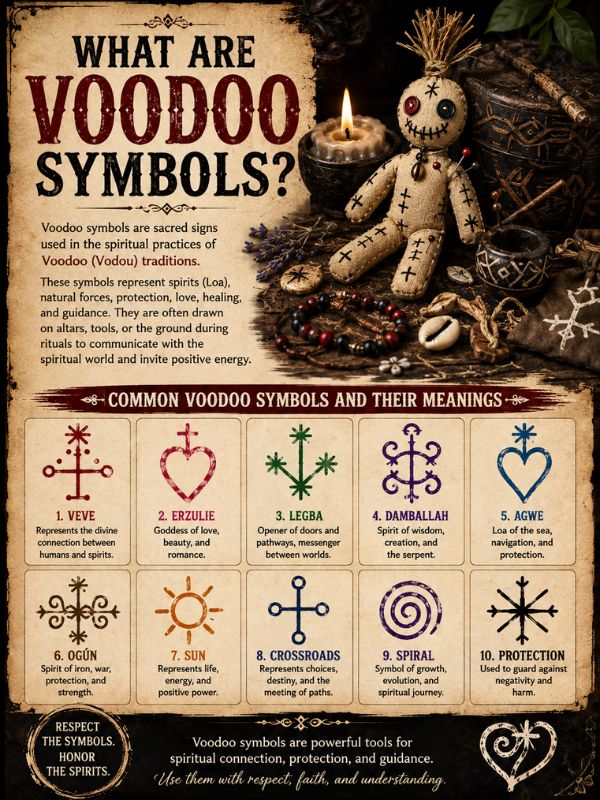
- Voodoo symbols carry both positive and negative interpretations depending on context, intention, and the specific spirit being invoked.
- Positive meaning often includes protection, healing, love, prosperity, and safe passage sought through respectful ceremonial practice.
- Negative meaning sometimes involves symbols associated with conflict, jealousy, or spiritual consequences resulting from broken promises or disrespect.
- Erzulie’s symbolism carries positive meaning through love and beauty, but negative meaning through jealousy and emotional volatility.
- Baron Samedi’s symbolism carries positive meaning through ancestral guidance, but negative meaning when associated with fear of death.
- Popular culture frequently emphasizes negative symbolic meaning, distorting voodoo into purely dark or malevolent spiritual practice unfairly.
- Authentic Vodou tradition views most symbols as neutral tools, with positive or negative outcome depending on practitioner intention.
- Balance remains central to Vodou philosophy, recognizing that spirits embody both nurturing and challenging characteristics simultaneously.
- Negative meaning sometimes arises from misuse, where symbols are drawn incorrectly or invoked without proper respect.
- Positive meaning strengthens through consistent respectful practice, building genuine spiritual relationships between practitioners and honored spirits.
- Community elders help distinguish appropriate positive use from potentially harmful negative misuse within ceremonial teaching.
- Understanding both positive and negative meaning requires recognizing Vodou’s complex, balanced spiritual worldview rather than simplistic judgment.
Frequently Asked Questions
What is a veve in voodoo?
A veve is a sacred ground drawing used to invite a specific loa spirit into a Vodou ceremony.
Are voodoo symbols evil?
No, voodoo symbols are religious tools used for protection, healing, and communication, not inherently evil imagery.
What does the voodoo cross symbol mean?
The cross often represents Baron Samedi or crossroads spirit Papa Legba, symbolizing death, transition, or spiritual pathways.
What color represents protection in voodoo?
Red and black are commonly used to represent strength, courage, and active spiritual protection in voodoo symbolism.
Can anyone draw a veve symbol?
Traditionally, only trained houngans or mambos draw veve accurately, since precision affects the ceremony’s spiritual effectiveness.
What is the difference between Haitian and Louisiana voodoo symbols?
Haitian symbols follow traditional veve practice closely, while Louisiana symbols blend African tradition with hoodoo and Catholic influence.
What does the snake symbol mean in voodoo?
The snake typically represents Damballa, symbolizing ancient wisdom, purity, and the foundational creative force in Vodou belief.
Why are voodoo symbols drawn on the ground?
Ground drawings create temporary sacred space, inviting spirits to descend during ceremony before being swept away afterward.
What does a heart symbol mean in voodoo?
A heart typically represents Erzulie Freda, symbolizing love, beauty, luxury, and complex emotional spiritual territory.
Is voodoo the same as hoodoo?
No, voodoo is a structured religion, while hoodoo is a folk magic practice sometimes used alongside voodoo tradition.
Conclusion
Voodoo symbols are more than art. They carry deep spiritual meaning. Each sign connects to a spirit. Some protect, some heal, some guide. Learning them helps you understand voodoo better. This tradition deserves respect, not fear.
In 2026, more people are curious about voodoo. This guide gives you clear answers. Now you know the hidden meanings. You also know the secrets behind each symbol. Use this knowledge with respect. Let voodoo’s wisdom guide your understanding.
